By Yakov Nayerman

SAN DIEGO — About a year and a half ago, a rabbi named Yechiel Cagen moved with his family to our quiet Rancho Peñasquitos and opened a Chabad synagogue in his home. He turned out to be a smart and interesting man, and we became friends. Since I don’t pray, Yechiel soon stopped trying to draw me into his services… But one day he called and asked me openly:
“Reb Yakov, I don’t often ask for favors, but on Yom Kippur I may be short one man for a minyan. Would you, just this once, come to the service? I knew that without a minyan, the other men wouldn’t be able to complete the prayers properly, and I couldn’t refuse. At 10 a.m., I was there.
His backyard—with cloth canopies, folding chairs, prayer books on the tables, and a beautiful Aron Kodesh looked like a makeshift synagogue. I really was the tenth man—and honestly, I couldn’t remember the last time people were so glad to see me arrive.
After Yechiel’s short but moving introduction, everyone began to pray. I had nothing to do: no phone, no book, and I couldn’t nap, since we kept standing up every few minutes. So I tried to follow the old wisdom: “If there is no way out—just relax and enjoy.” The prayers, many of them sung to half-forgotten tunes from my childhood, wrapped around me and pulled me back to memories of my grandfather’s house, where I’d heard the same melodies. Yechiel, his children, and most of the men had wonderful voices. I lost myself in the moment.
Suddenly I came back to myself, noticing the surprised, approving looks around me. Without realizing it, I had started singing along to the words of Avinu Malkeinu. Then Yechiel’s 12-year-old son lifted his clear soprano voice in harmony. The men softened their voices, and the courtyard filled with that pure sound. At once, I remembered how my own mother used to sing this same melody in the same high voice.
In our family gatherings, we loved to sing—mostly in Russian, sometimes in Yiddish. Although Avinu Malkeinu is officially sung only once a year, on Yom Kippur, it always ended our family sing-alongs. When it was late and people were glancing at their watches, my great-uncle Petya would turn to my mother and say: “Now, Businka, let’s have our favorite.”
And my mother (Busya, called Businka in the family) would begin softly, her voice growing stronger with each note. With all respect to Barbra Streisand, whose version of this old prayer is beautiful, her singing never touched me the way my mother’s did. (Of course, I may not be objective.)
After a few minutes, the men’s voices would join, making room for Misha Roizman, our family’s Odessa tenor, whose runs and ornaments no one else could match. Then my mother would join him in harmony, and they sang together. Finally, everyone joined in, finishing in unison. After that, no one wanted to sing or even talk anymore—it was the natural end of the evening.
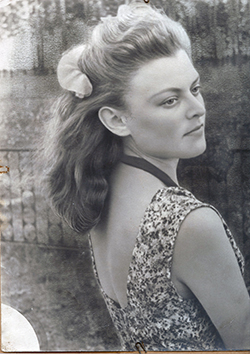
All my childhood was filled with the sound of my mother’s singing. She sang all the time, for as long as I can remember… Cooking, cleaning the house, ironing, or grading papers (she was a teacher), her voice was always there. Clear, silvery, and unbelievably beautiful.
She sang in Russian, Ukrainian, Yiddish and sometimes, even Italian. But most often without words at all. She sang when she was happy, out of pure emotion. She sang when she was sad, to give herself strength. When I was sick with a high fever, she sang to me, sometimes with words, sometimes just melodies.
My grandmother told me that my mother started singing before she even started talking.
Everyone would ask her: “Businka, sing again!”
Even during the evacuation, when she with her younger brother were running from the Nazis, when they spent months in train cars, she sang. With her singing, she softened the dull, hopeless days.
She used to say that without singing, they might not have survived. When the war began, she was only fourteen. Together with other families, they fled Ukraine on foot, always just a few kilometers ahead of the advancing Germans. The sound of artillery became their usual background. But the worst, as she told me, were the weeks they spent in freight cars, slowly moving toward the Volga and then to Central Asia.
The train would stop for days at a time. No one knew when it would move again, so they didn’t dare walk far; they could be left behind. In one old train car, there were eight families, about 40 people, who slept, relieved themselves, loved, gave birth, fell ill, and died in those hateful 54 square meters. During the day it was unbearably hot, and at night the walls were covered in frost. They ate mostly animal feed oilcakes they gathered from abandoned fields during stops. Sometimes the train stopped near potato fields, and broth from rotten potatoes was a real delicacy.
Once I asked her: “What did you do all that time? ”
”
“The old ones prayed. We retold books and stories we once read. And we sang.”
“Sang?!”
“Yes, we sang a lot. Favorite songs. Ukrainian, Jewish, Russian. And when we didn’t know or remember the words, we made up new ones.”.
“But people sing and dance when they’re happy, not when they’re miserable!”
“That’s where you’re wrong! American blues and spirituals were born on the cotton fields, sung by enslaved Africans. (My mother was a teacher of English language and literature, and she also directed a choir of English and American songs. This was her passion.) “The very word blues comes from the phrase blue devils, meaning sadness or depression. Do you want me to tell you an old parable?”
I loved her stories and sat down more comfortably.
“Once there was a cruel and greedy khan. A city he conquered paid him tribute, but he wanted more. So he sent his commander with soldiers to collect extra taxes. The commander came back with nothing. The elders fell to their knees and swore they had given everything, he said.”
“‘Go and beat them in public with rods, answered the khan. I promise you, they’ll find something more.’ The khan was right. Later he sent his commander again. Again, the commander returned empty-handed: ‘They tore their hair, cried, and said they had absolutely nothing.’ ‘Then kill every tenth man,’ said the khan. ‘You won’t have to cut many heads before they hand something over.’ And again, the khan was right.
“But the third time, when the commander returned, he was confused: ‘This time, my lord, they greeted me strangely. They sang and danced, and when I demanded more tax, they laughed in my face.’ ‘Leave them,’ said the khan. ‘They have nothing left. If people sing, dance, and laugh—it means they have nothing more to lose.’ That was how it was for us in that freight car. We had nothing left to lose, and singing was sometimes the only sign of life that helped us survive.”
When she returned to Moscow in 1947, just after the war, she had no doubt where she wanted to study. She wanted to sing. And where had her beloved singer, Nadezhda Obukhova, graduated from? The Moscow Conservatory. That’s where my mother applied.
How could a girl from Kryzhopol have known that before entering the Conservatory, you first had to complete music school and college, and that the competition for the vocal class was more than two hundred applicants per spot?
The entrance exams had three rounds.
The first—the performance audition—she passed by singing a romance and a Ukrainian folk song. They looked at her with some surprise: instead of a formal “opera” dress, she wore her only cotton sundress. In the same sundress, she came to the second round.
The second round tested musical-theory knowledge. Applicants were asked to sight-sing, but my mother had never seen sheet music in her life. She turned the score in her hands, realized the situation, and through tears whispered: ‘I’m sorry, I didn’t know I had to read notes’ and headed for the exit.
Behind her, she heard restrained laughter. Suddenly, just as she reached the door, a strong male voice stopped her: “Young lady, please come back!”
She turned in disbelief. The voice belonged to a short man with thick glasses and slicked-back hair. He was indeed addressing her. The laughter stopped at once, and the rest of the committee, no less intrigued than the applicant herself, waited to see what would happen next. Later, she learned that it was Alexander Sveshnikov, dean of the choral conducting faculty, a Stalin Prize laureate, and head of the State Choir of Russian Song (later named the A. V. Sveshnikov Choir).
“Colleagues,” he said, “I had the chance to hear this Cinderella sing at the first round. This is what we call a ‘voice given by God.’ We can teach her notes in just a few months. But let’s check her ear.”
He went to the piano and turned to my mother:
“I’ll play a few chords, and you try to sing the notes of each chord separately. Like this.”
He played a triad and sang: la — la — la. “Understood?”
He started with triads, then moved on to four-note chords. My mother sang them back.
“And can you do it in reverse, from top to bottom?” he asked. My mother did that too.
“Excellent, thank you!” said Sveshnikov. You see? “The girl not only has perfect pitch, but perfect interval pitch. And note—she has never done this before! I have no doubt she’ll master solfeggio and sight-singing. Now let’s hear her sing”
He stayed at the piano.
“What would you like to sing? Only not a cappella, as in the first round, but with my accompaniment.”
Could you play Chopin’s ‘The Wish?'” she asked shyly.
Everyone smiled.
“I’ll try.”
He began to play, and my mother sang:
“If I were the sun shining in the sky, I would shine only for you, my friend…”
When she finished, everyone applauded.
“Well then,” Sveshnikov asked the committee, “any more questions?”
So, she advanced to the third round and seemed destined to become a student of the Moscow Conservatory.
But the final act of this Cinderella story, alas, never came. On the day of the third round, my mother lay unconscious with typhus and a fever of 41.5°C. There were no antibiotics then, and many people died from typhus.
Three weeks later, the illness receded, but she was temporarily deaf. A few months later, her hearing slowly returned, but she was too weak, singing was out of the question. My grandfather saw it as a sign from above, and when, a year later, my mother once again spoke of a singing career, he was firmly against it.
Then came the campaign against “Jewish traitors,” and for a girl with very typical Jewish name Busya Shmulevna Gelman, any thoughts of a stage career had to be abandoned.
But she never abandoned singing. At first, she simply sang. She joined a choir, brought home sheet music, and worked hard. Later, when she became an English teacher at a secondary school, she organized her own choir of English and American songs. The accompanist was the school’s music teacher, but the choir itself was her creation. It became well known: they performed at concerts and received invitations.
And here, in America, many years later, I was contacted by one of her former students who became a music teacher. She said that it was this very choir that awakened in her a love of songs and music.
As I mentioned before, all our family gatherings always ended with singing. We sang folk songs, bard songs, pop tunes. My father also had a wonderful voice. He was even once invited to join Lundstrem’s ensemble. But he was shy about singing and preferred to sing accompanied by my mother.
In the evenings, we sometimes sat down, started with a quiet tune, and then went through our family repertoire. When I learned to play a few chords on the guitar, I began to accompany them. Those were our happiest hours.
Some of this carried over to my children as well, since even in America, our family sing-alongs continued almost until my parents passed away.
In her last years, my mother developed dementia. When she no longer reacted to us at all and it became hard to take care of her, she was admitted as a Holocaust Survivor free of charge to an exclusive Jewish nursing home (something that usually costs a fortune). The care there was truly excellent, but she slowly faded away.
And then one day it struck me: I began bringing her stereo headphones with a small player and would put on one of her favorite pieces. Her eyes would suddenly light up. She listened. Sometimes tears appeared in her eyes. Sometimes she even smiled and softly sang along. In front of me was my mother again, the same songbird.
A month before her death—she passed away in early November—the nursing home held Yom Kippur services. Everyone who wished to join was gathered in the large dining hall. A cantor came and began chanting the prayers. And then he started singing Avinu Malkeinu. aSuddenly, to my utter amazement, my mother, who had not spoken a word in months, also began to sing. At first softly, then louder and louder. Her beautiful soprano wove in harmony with the cantor’s tenor, and she didn’t miss a single word.
Her eyes were completely clear: for the last time, she was speaking to her God.
Avinu malkeinu honeinu va’aneinu ki ein banu ma’asim
Aseh imanu tzedakah vakhesed Vehoshi’einu
Avinu Malkeinu (Our Father, our King) We have sinned before You.
Avinu Malkeinu, show us mercy as our days draw to a close.
Avinu Malkeinu, let famine and plague vanish from the earth.
Avinu Malkeinu, sow peace and harmony among Your children.
Avinu Malkeinu, heal the sick and cradle the sorrowful.
Avinu Malkeinu, forgive us, and inscribe us in the Book of Life.
Avinu Malkeinu, grant us joy and warmth—even in our final breath.
Avinu Malkeinu, let goodness and justice endure forever.
*
Yakov Nayerman is a freelance writer based in San Diego.
Such a beautiful story. It truly paints such a moving picture.
Thank you so much!