By Alex Gordon
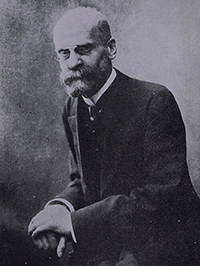
HAIFA, Israel — David Émile Durkheim was a French sociologist and philosopher, the founder of the French sociological school.
Durkheim was born on April 15, 1858, in the Lorraine town of Épinal into a religious Jewish family. His mother was the daughter of a merchant. His father, grandfather, and great-grandfather served as rabbis. Durkheim, in his youth, also prepared for a career as a rabbi, but at an early age he refused to follow the family tradition and transferred to another school.
Durkheim became a student at the École Normale Supérieure in 1879. Durkheim’s cohort became one of the most talented of the 19th century. Many of his contemporaries, including Jean Jaurès and Henri Bergson, later occupied central positions in the French intellectual milieu. Durkheim’s dissertation, written in Latin, was dedicated to the work of Montesquieu.
In his works, Durkheim argued that religion is largely determined by social factors. This was a challenge to the religious majority of society. Despite this attitude towards religion, he maintained connections with his Jewish family and even with the Jewish community.
His later life was entirely secular, and in his works, Durkheim repeatedly demonstrated that the phenomenon of religion was largely determined by social factors. Many of his co-authors and students were Jews, some were related to Durkheim, and the famous socio-anthropologist Marcel Mauss was his nephew.
Due to his controversial views, Durkheim was unable to secure an academic position in Paris. From 1882 to 1885, he taught philosophy at several provincial schools. In 1885, he decided to move to Germany, where he studied sociology for two years at the universities of Marburg, Berlin, and Leipzig. His efforts were aimed at establishing sociology as a science.
Durkheim’s articles received recognition in France, and in 1887 he was appointed to a teaching position at the University of Bordeaux, where he began working on the city’s first social science course. Durkheim was the first in France to give a course of lectures on sociology. His work at the predominantly humanities faculty became a symbol of the recognition of social sciences as a significant field of knowledge. But his opinion on the social determinism of religion made him the subject of many critical statements.
In 1887, Durkheim married Louise Dreyfus, the daughter of a foundry manager, who later bore him two children—Marie and André.
In 1892, Durkheim published his dissertation On the Division of Labor in Society, a foundational work on the nature of society and its development.
His interest in social phenomena was fueled by current political events. The defeat of France in the war with Prussia in 1870-1871 led to the fall of Napoleon III’s regime and the establishment of the Third Republic. These events led to a negative reaction towards the new secular republican government, as many citizens considered a nationalist approach the key to restoring waning French power.
Durkheim, a Jew and a supporter of the republic who sympathized with leftist ideology, found himself in a political minority. This fact, combined with the Dreyfus affair of 1894, created difficulties for Durkheim. He lamented: “Often, the most rejected people play the role of scapegoats. In this understanding, I am also convinced by the way the decision in the Dreyfus trial was received in 1894. It was an explosion of jubilation on the boulevards. As a great success, they celebrated what was supposed to be a public mourning…”
In 1895, Durkheim published The Rules of Sociological Method. In the same year, he founded the first European sociology department in Bordeaux. Three years later, he founded the country’s first social sciences journal, L’Année Sociologique (The Sociological Year). The publication featured works by a growing number of students dedicated to the subject, as well as reviews by Durkheim of German, English, and Italian articles. In 1897, the book Suicide was published, becoming a model of what a monograph in the field of sociology could be.
Parisian scholars long refused to accept Durkheim’s “sociological imperialism” and declined to include social sciences in their curricula. By “sociological imperialism,” his opponents meant the concept that sociology is the dominant scientific discipline capable of explaining all aspects of social life, including morality, religion, politics, and law. By 1902, Durkheim had become a lecturer in pedagogy at the Sorbonne. In 1906, he became a full professor, and in 1913, the title of his professorship included a mention of sociology.
Durkheim worked as an advisor at the Ministry of Education. In 1912, his last major work, The Elementary Forms of Religious Life, was published.
From the Jewish national and religious isolation characteristic of him in his youth, he transitioned to developing a universal approach to society. Jewish identity hindered the generalized analysis of human existence. He introduced the new concept of “collective consciousness.” His “collective consciousness” denoted the sum of common beliefs and moral norms of the members of society (or perhaps the Jewish community?), forming social solidarity. The Jewish solidarity he was well acquainted with in this concept was generalized into the universal solidarity of the members of society.
The outbreak of World War I tragically affected the fate of the scholar. He combined his leftist views with patriotism, but he was not an internationalist. Durkheim was a secular, rational man. As a result of the war, nationalist propaganda emerged, which he could not accept. He sought to help France, but did not wish to share primitive right-wing sentiments. In addition to this, his Jewish background automatically made him a target for the French right. His lessons were disrupted, his life was threatened.
Many of Durkheim’s students, called to defend the country, perished on the battlefields. He was horrified by the slaughter of the First World War, which embodied the catastrophe of the civilization for which he was creating sociology. In December 1915, his son André was killed at war. Apparently, this grief finally broke him. He passed away in Paris on November 15, 1917, from a stroke.
*
Alex Gordon is professor emeritus of physics at the University of Haifa and at Oranim, the Academic College of Education, and the author of 11 books.
The author left out the most important Durkheim book, SUICIDE,