By Karen Hall

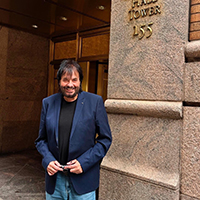
LOS ANGELES — On a gray morning in Auschwitz, Wolfgang Hildebrandt stood quietly, guitar in hand, before the gates that once marked the dividing line between life and death. For a musician whose life and work are woven with prayers for unity and healing, performing at the very site of humanity’s deepest wound shaped him in ways that linger to this day.
Born in Germany, Wolfgang carries his heritage as both a burden and a calling. He is acutely aware that his German background makes these acts of remembrance and reconciliation especially poignant.
“You cannot comprehend the brutality people inflicted on other people,” he says, his eyes tender with emotion. “I saw the bunks and the standing cells, and I felt deep shame. I can hardly believe that the Israeli people forgave the German people. We can be forever grateful for their forgiveness.”
He has visited Auschwitz three times and performed there twice. “After you walk out the gate, you are left with many questions. I couldn’t sleep all night afterwards. Every graduating class should visit once—so that extremist ideas are stopped at the root. I can’t believe people deny the Holocaust existed,” Hildebrandt declared. “We must work every day to ensure that such horror is never repeated anywhere in the world.” It has been proposed that a Peace Center be built next to the memorial and Hildebrandt said this would help people have open dialogue.
Even with the weight of history, he finds signs of hope. In Tel Aviv, he asked young Israelis which city they wished to visit someday. “They said, ‘Berlin.’ I didn’t expect that,” Hildebrandt said. “It made me grateful.”
Hildebrandt describes his visit to Israel as a sacred experience. “When I first stepped onto Israeli soil, I could feel the holy ground,” he recalls softly. “The warmth of the people greeted me, and even amidst layers of security and vigilance, I felt at home. “
Hildebrandt describes how thrilled he was to meet the late Leopold Kozlowski—often called “the last Klezmer of Galicia”—who served as musical director on Schindler’s List. “His piano touched me and brought me close to the Israeli soul as I felt the deep longing Leopold conveyed,” Hildebrandt said, describing this rare opportunity. “He was happy with my singing and urged me to keep working for peace through music. I promised him I would.”
Through his songs, Hildebrandt seeks what history has too often denied: connection, forgiveness, and shared humanity. “The present and the future cannot exist without the past,” he opined. “When people move from being against one another to being together and then forgiving one another, something beautiful happens. Those who forgive are happy, and those who are forgiven also feel lighter and happier.”
Hildebrandt participated in a walk for peace along the ancient path from Nazareth to Bethlehem, a symbolic journey in which people from all over the world come together to make a statement for peace and freedom. “It was a very emotional experience,” he remembers. “I had my guitar with me and sang during part of the walk. Music unites in grief, joy, and in hope.”
He continued: “Music knows no boundaries; no skin color, no race, no origin. It connects people. We all belong together.”
In places like Jerusalem, where centuries of heartbreak and hope meet, his work is dedicated to moving hearts towards togetherness.
Forgiveness, he believes, is the linchpin of healing. It is this spirit that animates both his music and his message, inspiring audiences from Tel Aviv to New York.
Today, his heart aches for the suffering in Israel and he hopes for freedom for the hostages still awaiting release. He advises that we each take steps to build peace-—one act of empathy at a time: “We don’t talk to each other enough. We send text messages instead of picking up the phone or visiting in person. We need to take more time to listen and share more love.”
That belief is mirrored in his latest single and EP, Let’s Stay Together, currently entered for multiple GRAMMY® categories including the Harry Belafonte Best Song for Social Change. The song captures Hildebrandt’s ongoing mission to unite hearts through music and faith.
From performances at the United Nations Headquarters in New York and Berlin, to speaking about peace to coalitions of world leaders in 191 nations, Hildebrandt doesn’t just talk about unity — he lives it.
Often called “a musician for human rights,” his lyrics echo his faith and compassion for the world. Singing on stage with Bishop T.D. Jakes, a Christian evangelist, Hildebrandt recalls how this reaffirmed his calling to use music as a ministry of love and healing. “Standing beside Bishop T.D. Jakes, seeing hearts open, was a reminder that music can be prayer in motion,” Wolfgang said. “It showed me again that my voice is meant to carry hope where words alone may not reach.”
Faith has guided Hildebrandt from a very young age. At just nine years old, Dr. Martin Luther King Jr.’s message, “I Have a Dream,” became his compass. He learned piano and guitar at six and later launched his musical career.
Later, gospel legend Andraé Crouch became not only a mentor but a dear friend. Together they wrote the bridge of Let’s Stay Together. “Andraé believed in me when I could hardly believe in myself,” Wolfgang remembers. “He told me, ‘You’re going to win a GRAMMY®.’ What he meant was that music should leave a legacy of love.”
That legacy continues to grow. Years ago, Hildebrandt declined a prestigious position as lead singer for a German Military Band — a decision that led to opportunities beyond his imagination, including performing at Carnegie Hall in New York, singing for the Nelson Mandela Foundation in Johannesburg, and a private concert for Archbishop Desmond Tutu in Cape Town. In Namibia, he left behind his electric piano so that music could live on after he left — a gesture born of his love for the African people and their culture.
His humanitarian work has earned international recognition—including the Global Civil Society Champion honor bestowed by the World Federation of United Nations Associations, the Deutscher Rock & Pop Preis in Germany, the Clown d’ Honneur Award from the World Parliament of Clowns, commendation from the Lord Mayor of Cologne, Germany, and a Certificate of Welcome from the City of Los Angeles.
His work has appeared in Billboard Magazine, on ARD-TV during his United Nations performances, and on the Times Square Billboard in New York City — each platform showcasing his enduring message of love, remembrance, and peace.
Wolfgang is the Founder and CEO of Hollywood Hills Records and The Hollywood Late Night Show, and a voting member of both the Recording Academy in Los Angeles and the Country Music Association in Nashville. He’s also an active member of the American Songwriter Community, where he was twice featured as “Member Spotlight of the Week.” But his fame does not define him; instead, he continues to give back and has been a two-time GRAMMY U® mentor. He uses every platform to connect heart to heart, and lead others to do the same.
In his lyrics for Let’s Stay Together, he bids the world: “Let’s stay together, because we only live once on this planet. Different colors, races, and religions are gifts that make us whole. Let’s hold onto love, hope, and peace—today, not tomorrow—for all our sakes, and for the future of our children.”
The nominations for the 68th GRAMMY Awards® will be announced on November 7. Learn more about Wolfgang and his mission to spread peace by visiting www.WolfgangHildebrandt.com.
*
Karen Hall is a journalist, producer, and publicist known as “The Queen of Empathy,” as well as the Publisher and Editor-in-Chief of The Los Angeles Tribune Women’s Journal and host of The Hero Within and The Empathy Advantage podcasts.
The “Last Klezmer of Galicia” came from the title of my documentary film about Leopold Kozlowski “The Last Klezmer: The Life and Music of Leopold Kozlowski.” Leopold told me that since the film was so well known in America and Europe (came out in 1994) he wanted to use a similar title for himself. I dare say my doc. film (premiered at Lincoln Center) made Leopold internationally famous. Still available on DVD or Vimeo from me.