By Alex Gordon
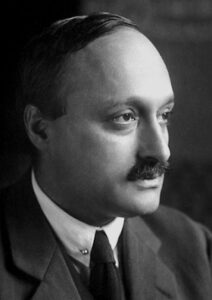
HAIFA, Israel — James Franck, a German-American experimental physicist, the 1925 Nobel Prize laureate in Physics, was born on August 26, 1882, in Hamburg and was the second child in a Jewish family. His father was a local banker and a religious man, while his mother came from a family of rabbis.
Hamburg was a free city where exiled Portuguese Jews, from whom the Franck family descended, lived. They received equal rights with the other residents of the city. There were no ghettos in Hamburg. There was an atmosphere of tolerance. Antisemitism manifested itself in the context of social and economic competition. James’s parents were deeply religious people, observing the commandments of Judaism. They wanted to raise James in the religious faith, but it was not easy, as the Jewish community showed little interest in religious education.
James enrolled in a public school where many Jewish children studied. From 1891, he studied at the local Wilhelm Gymnasium, where he learned Latin, Greek, English, and French. But he was not suited for the humanities; from an early age, he showed an aptitude for the exact sciences. His father insisted on a more conventional career for a Jew, and initially, James began studying law at Heidelberg University (1901), but attended lectures on natural sciences.
There he met Max Born, a future Nobel Prize laureate in Physics and one of the founders of quantum mechanics, with whom he remained friends for life. Born was also of Jewish descent. Under Born’s influence, Franck moved to Berlin, where he studied physics at the local university. In May 1906, Franck defended his doctoral dissertation on the topic On the Mobility of Charge Carriers in a Spark Discharge.
In the mandatory autobiographical note attached to his doctoral dissertation, he wrote: “I, James Franck, was raised in the Jewish faith.” Not in the “Mosaic faith,” as was customary for assimilated Germans at the time – but in the “Jewish” faith.
After his studies, Franck was called up for a one-year military service on October 1, 1906, and joined the 1st Telegraph Battalion. In December, he had an accident – he fell off a horse – and he was discharged for being unfit for service. As a decent Jewish child, he played the violin, but he had long since given it up – continuing, however, to attend classical music concerts. There he met the Swedish pianist Ingrid Josephson. The Josephsons were practicing Jews (Ingrid’s mother, like Franck’s, came from Portuguese Jews), but, like Franck’s family, they were well integrated into European cultural society. James and Ingrid had two children.
In 1907, Franck obtained a position as an assistant at the Physics Institute of Berlin University. In 1911, he defended his second doctoral dissertation and received the title of Privatdozent.
With the onset of World War I, James Franck volunteered to go to the front. At the beginning of 1915, he was transferred to the unit of Fritz Haber, a future Nobel Prize laureate in chemistry, a baptized Jew. The unit used chemical weapons in the form of gaseous chlorine. Together with Otto Hahn, a future Nobel Prize winner in Chemistry, he developed new gas masks and informed Haber about the results of using the new weapon against the French. Franck was awarded the Iron Cross 2nd Class. He was promoted to the rank of lieutenant.
In 1914, Franck, together with Gustav Hertz, conducted an experiment that proved that atoms absorb energy only in specific discrete portions, quanta. This observation proved the correctness of quantum mechanics. Both scientists were awarded the Nobel Prize in Physics in 1925.
On September 19, 1916, Franck was appointed as an associate professor at the University of Berlin. After being demobilized from the army, Franck returned to Berlin, where Fritz Haber offered him a position at the Institute of Physical Chemistry and Electrochemistry. In 1918, Franck headed the physics department at Haber’s institute and received the Iron Cross 1st Class.
In 1919, the Royal Swedish Academy of Sciences decided to award Fritz Haber the Nobel Prize in Chemistry for 1918. Scientists from the Entente countries expressed strong protest, stating that Haber was a war criminal involved in the creation of chemical weapons. On April 22, 1915, Haber first used the poison gas chlorine against French soldiers near the Belgian town of Ypres: five thousand were suffocated on the spot and ten thousand were incapacitated and became disabled. In 1916, Haber was appointed head of the German army’s chemical warfare service and responsible for the production of chemical weapons. Among the 150 scientists, Haber’s assistants, were James Franck and another Jewish Nobel Prize-winning chemist, Richard Willstätter. The orders awarded to Franck and Willstätter testified to their guilt in the creation and use of the first weapon of mass destruction in history.
At the request of Max Born, in 1920, Franck moved to Göttingen. There, he became a professor of experimental physics and the director of the Second Institute of Experimental Physics at the University of Göttingen. In 1929, James Franck was elected a member of the American Academy of Arts and Sciences.
In 1933, the Nazis came to power. Over the buildings of academic institutions, it was necessary to raise Nazi flags. The government began to implement anti-Jewish laws. Unlike his father, an Orthodox Jew, James was a liberal. He once said that his god was science and his religion was nature. But he was a German patriot and acutely experienced the monstrous transformation of Germany. Franck, unlike most Jews, was not affected by the “Law for the Restoration of the Professional Civil Service,” which required the dismissal or retirement of all Jewish civil servants but made an exception for World War I veterans.
On April 17, 1933, Franck was the first of the German scholars to resign. In a letter to the Minister of Science and Education, Rust, he stated that the reason for his resignation was the “government’s attitude towards German Jewry.” Franck, as a distinguished veteran of World War I, was not subject to the imposed bans, and his resignation was principled; he no longer had to go against his conscience and dismiss his Jewish colleagues and students from the institute.
In a letter to the university rector, he detailed the reasons for his resignation: “We, Germans of Jewish descent, are treated as foreigners and enemies of the homeland. It is to be expected that our children will grow up knowing that they will never be allowed to prove that they are worthy Germans.” A number of academics, Göttingen students, Jewish war veterans wrote to Franck that they were impressed by his act. A series of further voluntary resignations followed, but no German university openly expressed support for Franck.
In the fall of 1933, Franck moved to Denmark, to Niels Bohr’s institute. He invited Max Planck, the Nobel Prize-winning physicist and one of the founders of 20th-century physics, to come to Copenhagen from Germany for a few days. 77-year-old Planck sent a response that deeply moved Franck: “No, I cannot go abroad. In previous trips, I felt like a representative of German science and was proud of it – now I hide my face in shame.”
In 1935, Franck emigrated to the USA. He worked at Johns Hopkins University in Baltimore. In 1938, Franck became a professor of physical chemistry at the University of Chicago, and on July 21, 1941, he became a U.S. citizen. In February 1942, Arthur Compton, a Nobel Prize-winning physicist, established the Metallurgical Laboratory at the University of Chicago for work on the Manhattan Project to create the atomic bomb. Compton appointed Franck to head the department.
At that time, there were strong fears that the Germans would be the first to create nuclear weapons and be able to use them. But in early 1945, Franck said: “It is a matter of concern that humanity has learned to release atomic energy without being ethically and politically ready for its wise use.” He headed a committee of leading nuclear scientists to assess the political and social consequences of the nuclear bombing. The committee’s report included a call to demonstrate the bomb’s destructive power to the UN to force Japan to surrender.
However, the leading physicists at Los Alamos – Fermi, Lawrence, and Oppenheimer – believed that the end of the war could only be ensured by the use of the bomb. Perhaps Franco’s resistance to the use of nuclear weapons against Japan was also related to his pangs of conscience regarding his involvement in the development of another weapon of mass destruction—chemical weapons against France.
In 1942, Franck’s wife Ingrid passed away. In 1946, he married his colleague Hertha Sponer.
In 1951, James Franck was awarded the Max Planck Medal by the German Physical Society. In 1957, he was awarded the title of honorary doctor by the University of Heidelberg. On May 21, 1964, James Frank died of a heart attack while attending the University of Göttingen, which had rejected him and other Jews, and was buried in Chicago next to his first wife.
*
Alex Gordon is professor emeritus of physics at the University of Haifa and at Oranim, the Academic College of Education, and the author of 11 books