By Alex Gordon
HAIFA, Israel — The possession of nuclear weapons turns a country into a superpower. After the end of World War II, the powerful state of the Soviet Union, which had taken control of Eastern Europe, sought to acquire nuclear weapons to eliminate its lag behind the United States. The “Cold War” was heating up.
In December 1943, upon the recommendation of Jewish physicists Rudolf Peierls and Robert Oppenheimer, leading nuclear physicists of the Manhattan Project for the creation of nuclear weapons, British citizen of German descent Dr. Klaus Fuchs, a former member of the Communist Party of Germany, was included among its participants.
Fuchs was transferred to the Los Alamos laboratory under the strictest security measures. There, he worked in the group of Hans Bethe, a Nobel Prize-winning physicist, who was Jewish on his mother’s side, and achieved outstanding scientific results.
In January 1945, Fuchs had three meetings with Soviet intelligence officers, during which he transmitted extremely important information about both the progress of the work and the first atomic bomb test, in which he personally participated. Fuchs was sentenced on March 1, 1950, to 14 years in prison for espionage in favor of the USSR. After Fuchs’s exposure, Peirels said: “I know that Fuchs acted according to his convictions. He did it not for money and not under duress. He just thought that the communists should get all the information.”
Another leading member of the Manhattan Project, the Jewish Victor Weisskopf, remarked: “He was a convinced communist. He believed that the atomic bomb should not belong only to the Western world… Balance, obviously, must exist.”
On July 24, 1945, in Potsdam, U.S. President Truman informed Stalin that the U.S. “now has a weapon of extraordinary destructive power.” According to Churchill’s recollections, Stalin smiled. He smiled because the “balance” was beginning to be established. In the hands of Soviet scientists, who had long been working on creating the atomic bomb, were the data obtained from Fuchs.
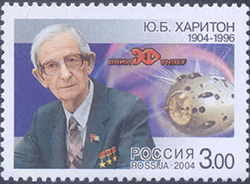
On April 1, 1946, the village of Sarov was chosen as the location for the first Soviet nuclear center, later known as Arzamas-16. A Soviet nuclear bomb was to be manufactured at this site. The chief designer and scientific supervisor of the project was appointed physicist Yuli Khariton.
Yuli Khariton, a nuclear physicist, Doctor of Physical and Mathematical Sciences, Academician of the Academy of Sciences of the USSR and the Russian Academy of Sciences, three-time Hero of Socialist Labor, laureate of the Lenin Prize and three Stalin Prizes, was born on February 27, 1904, in Saint Petersburg, into a family of assimilated Jews. His father, Boris Khariton, was a journalist and the editor-in-chief of the Constitutional Democratic Party’s newspaper Rech (Speech).
Boris was expelled from the USSR in 1922 by Lenin’s decree along with two hundred Russian intellectuals who were opposed to the Soviet regime. He ended up in Berlin, edited the magazine Sparks, and published in the newspapers Rul (Steering wheel) and Dni (Days). In 1923, he moved to Riga, the capital of Latvia. There he was the editor of the weekly newspaper People’s Thought, published by the Jewish People’s Democratic Party. From 1925 to 1940, he was the permanent editor of the largest Russian newspaper in the Baltic, Today, and its evening edition, Tonight.
After Latvia joined the USSR in 1940, Boris Khariton was sentenced to seven years in a labor camp and died in the Gulag on August 30, 1941. His mother, Mirrra Bourovskaya, was an actress in several Petersburg theaters, the Moscow Academic Small Theater, and finally the Moscow Art Theater (1908—1910). She divorced her husband in 1907, and in 1910 she moved to Germany, where she married the psychoanalyst and Zionist, a student of Freud, Dr. Max Eitingon.
In 1933, she moved to the land of Israel with her second husband. Yuli lost his mother at an early age. He was raised by his father until his exile from the USSR in 1922. After the establishment of Soviet power, Yuli was forbidden to communicate with his foreign parents.
In 1926-1928, recommended by the “father” of Soviet physics Abram Ioffe and with the participation of future Nobel laureates Peter Kapitsa and Nikolai Semenov, Yuli interned at the Cavendish Laboratory (Cambridge, England). Under the guidance of Nobel laureates Ernest Rutherford and James Chadwick, he obtained a Doctor of Science (D.Sc.) degree, with a dissertation on the topic: On the Counting of Scintillations Produced by Alpha Particles.
During his internship, he managed to meet his mother in Germany and understood the extent of the danger she faced there as a Jew. His arrival in Berlin was a scientific assignment from England. He asked his German colleagues how they felt about the Nazis. They just laughed: these “operetta boys” are not dangerous, they shouldn’t be taken seriously. Subsequently, Khariton recalled: “We were politically more informed than our German colleagues and fully understood the threat posed by fascism. But our concerns were not shared by the German intellectuals at that time. Unfortunately, they realized their mistake too late.”
In an atmosphere of utmost secrecy, work was being carried out in Sarov, culminating in the successful testing of the first Soviet atomic (August 29, 1949) and hydrogen (August 12, 1953) bombs. The name and surname of the chief designer and scientific leader of the Nuclear Project, Yuli Khariton, were classified.
On August 29, 1949, the day of the first successful test of the Soviet nuclear bomb, Khariton was in an underground bunker where the political leader of the project, the People’s Commissar of Internal Affairs Lavrentiy Beria, had come. When the explosion occurred, Beria grabbed him, lifted him up, held him tightly, and kissed him. Beria understood that thanks to this man, he was becoming the main figure in the eyes of Stalin in the Nuclear Project—he had fulfilled the leader’s assignment and “made” the nuclear bomb. Thus, the Soviet Union became a nuclear power.
Khariton characterized his attitude towards the grand task he had accomplished as follows: “We had a super task: to create ultra-powerful weapons in the shortest possible time that could protect our Motherland. When we managed to solve this problem, we felt relief, even happiness, because by mastering the new weapon, we deprived other countries of the ability to use it against the USSR with impunity, and thus, it serves peace and security.”
Khariton also mentioned the assistance of Klaus Fuchs: “As is known, we received quite detailed information from Fuchs. He provided a description of the first atomic bomb, and we decided to make ours similar to the American one.” But even copying the American bomb was difficult: “The work was tense and nerve-wracking. To calculate all the processes occurring in an atomic bomb, all the pressures, and they are different, because there is a detonation through the explosive material, – this is very delicate work.”
Khariton, like Klaus Fuchs, acted on ideological grounds: with his work, he wanted to promote “peace and security.” But he increased the quantity and improved the quality of the deadly weapons that totalitarian and fanatical regimes seek to possess. After the creation of nuclear and hydrogen bombs, the Soviet Union began to threaten peace and security and based its imperialist policy on the presence of a vast arsenal of its nuclear weapons. Its imperialist policy was inherited by modern Russia.
Yuli Khariton was under threat of destruction. During his work on the nuclear project, the main actions of Soviet state antisemitism took place: the “case of cosmopolitans,” the “case of the Jewish Anti-Fascist Committee,” and the “doctors’ plot.” He was the optimal candidate for elimination—a Jew, with émigré parents, a “criminal” father, and he himself had lived in England for two years and traveled to Germany, meaning he interacted with the enemies of the communists. But Khariton achieved tremendous success and extraordinarily strengthened the Soviet regime, which repressed his fellow tribesmen, isolated him from his parents, and carried out the import of “socialist revolution” to various corners of the globe.
Yuli Khariton died on December 18, 1996, in Sarov, at the site of his nuclear activities. In the last years of his life, Khariton went blind, but even when he could see, he wore the glasses of a Soviet patriot, whose ideology could not accommodate the aggressive nature of his country.
*
Alex Gordon is professor emeritus of physics at the University of Haifa and at Oranim, the Academic College of Education, and the author of 11 books