Ezra-Nehemiah: Retrograde Revolution; Koren Publishers; (c) 2025; ISBN 9781592-647071; 320 pages, $29.95.
By Rabbi Dr. Israel Drazin

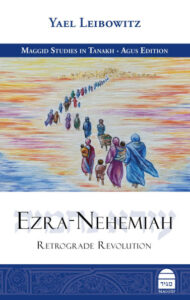
PIKESVILLE, Maryland — Rabbanit Yael Leibowitz presents a fascinating interpretation of the biblical books of Ezra and Nehemiah, relevant today, in her easy-to-read 2025 book, Ezra-Nehemiah: Retrograde Revolution. She writes that during the period of Ezra and Nehemiah, life was filled with disappointment, “but discontent and gratitude…can coexist. The difficulties of the period are conceded, but the sorrow generated by those difficulties is not granted the power to drown out the joy of its triumphs. The community described in Ezra-Nehemiah savors the historic moments it is witness to, imperfect as they may be.” This is a lesson we need to learn.
The title “rabbanit” is given to women rabbis in Orthodox movements. In this splendid, informative book, Rabbanit Yael Leibowitz shows that few male or female rabbis have the knowledge and understanding of biblical literature and secular scholarly works, as she does, and can communicate them in intelligible English that increases the reader’s knowledge and enjoyment. Her book not only informs readers about the Bible, the history and mindset of the times, but also about the effects of all of this then and today. Most of the 286 pages are composed with the primary text in the top half, with an abundance of intriguing, informative details in the notes below.
The title of this book, Retrograde Revolution, means moving backwards or reverting to an earlier stage. This is one of the volume’s central themes. The only way that the ancient Judeans could improve was by adopting the lessons of the past. This was what Ezra and Nehemiah emphasized. The past, especially Torah teachings, is a signpost that guides Judaism’s direction. It is the lesson we must not ignore. George Santayana wrote, “Those who cannot remember the past are condemned to repeat it,” a warning against forgetting history to avoid repeating mistakes.
There is scholarly disagreement about virtually everything in the books of Ezra and Nehemiah. For example, there is no historical consensus on Ezra’s existence or mission due to a lack of extrabiblical evidence and conflicting scholarly interpretations. The dating of events is debated. Some scholars even doubt that Ezra existed or that he was Jewish.
The books Ezra and Nehemiah were originally a single book, commonly distinguished in scholarship as Ezra-Nehemiah. The two became separated with the first printed Rabbinic Bibles in the early 16th century, when Jews copied the late medieval Christian tradition. That Jews copied a Christian idea should surprise no one. An example of many others is the fact that it was Christians who divided the Bible into chapters, and Jews accepted the idea. While the division of Ezra and Nehemiah posed no problems, the division of the Bible into chapters makes some readers think the innovators were drunk in many instances. An example is the second chapter of the Bible, where the opening verses speaking of the creation of the seventh day belong in chapter one, which describes the first period of creation.
The books are composed in Hebrew and Aramaic. They represent the final chapter in the historical narrative of the Hebrew Bible. Nehemiah is the last historical book of the Hebrew Bible. Although the book of Esther appears after Nehemiah in the canon, the events in Esther occurred during the period between Ezra 6 and 7, between the first and second returns of the people exiled to Babylon to Israel. The last prophet, Malachi, was a contemporary of Nehemiah.
Nehemiah was a layman, not a priest like Ezra nor a prophet like Malachi. He served the Persian king in a secular capacity before leading a group of Jews to Jerusalem to rebuild its walls. His story shows that even people with little religious background can make a successful contribution to Judaism.
The current single biblical book, Ezra, has eight chapters, and Nehemiah has 13. All 21 are challenging to understand. Scholars have different interpretations of the books. Rabbanit Leibowitz offers her own in her volume, and what she writes makes sense.
The history of the time, as she sees it, is as follows. In 539 BCE, Cyrus II (559-530 BCE) defeated the Babylonians, who had destroyed the first Jewish Temple in 586 BCE and brought many Judeans, living in Judea, later called Israel, into exile in Babylon. A year later, in 538, Cyrus allowed the Judeans to leave Babylon and return to Judea. Some Judeans returned in three waves, but the majority chose to remain. Cyrus was succeeded by Darius I (522-486).
That a sizable number of Judeans decided to remain in Babylon should surprise no one. The Judean exile to Babylon began with the destruction of Judea in 586 BCE. When Cyrus allowed them to return home to Judea in 538, the Judeans had been in Babylon for 48 years. They were a different generation from those who were exiled in 586. Most never lived in Judea. Even the older generation had little recall of Judea, which they had left as children.
The Judean situation in 538 was similar to that of American Jews in 1948 when Israel was reestablished. The Judeans were treated well and participated in cultural events like non-Judeans. They were not oppressed. Many, like Nehemiah, held high level government positions. They had no good reason to leave a happy existence to return to a land that had been devastated in 586, that was surrounded by enemies, and required much repair.
There were three movements home. Each movement had a leader or leaders, a mission, opposition to the mission, and the movement’s mission was only partially successful. The first return to Judea was led by three men and occurred around 538-515. They rebuilt the Temple complex between 520 and 515 and restored Temple ritual. The primary leader of the first return was Zerubbabel, a descendant of King David. Cyrus appointed him as the governor of Judah.
The second group of returnees, under Ezra’s management, reinstated religious law and the study of Torah in the Judean community. Nehemiah led the third which constructed the city walls around Jerusalem.
While scholars debate the dates, Leibowitz offers 458-457 as the year when Ezra the Scribe arrived in Judea. She gives the later dates for Nehemiah’s governorship over Judea as 446- 433.
While the leaders Ezra and Nehemiah emphasized the need to learn from the past — one of the main themes of Leibowitz’s book — another theme in her book focuses on Nehemiah’s second return to Judea and finding that much of what he had worked so hard to accomplish no longer existed. It was as if the people took three steps forward, then two steps back. As a result, the book of Nehemiah ends with disappointment.
Rabbanit Leibowitz focuses on this and reveals an insight that will startle many readers. She shows that this discouraging ending is not unusual. Many biblical books close in disappointment, including each of the five books of Moses. She writes that this reflects human nature. The dance of three steps forward, followed by two steps back, is a common occurrence among people. It can and does discourage many people. But if we look to the lessons of the past, as Ezra and Nehemiah stressed, we will find that people will succeed despite failures.
Thus, the books of Ezra and Nehemiah tell us an intriguing historical story and show that while the countries of Cyrus and Darius no longer exist, why Israel does. It was due to the Jewish focus not only on the future but also on the lessons, actions, and failures of the past, and the realization that there are many elements in Judaism, including the Torah, that are blazing, even flashing signposts indicating how life can be improved despite failures.
*
Rabbi Dr. Israel Drazin is a retired brigadier general in the U.S. Army Chaplain Corps and is the author of more than 50 books.