The Art and Practice of Living Wondrously edited by Ronit Ziv-Kreger; Maggid Publisher; ISBN 9781592-647118; 280 pages; $27.85 on Amazon.
By Rabbi Dr. Israel Drazin

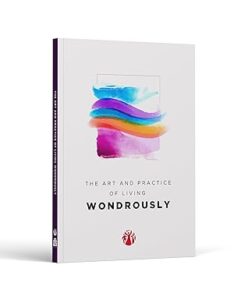 PIKESVILLE, Maryland — The Art and Practice of Living Wondrously, edited by Ronit Ziv-Kreger, is not just another inspirational book. It is a spiritual and psychological guide with a practical, well-stocked toolkit for navigating life’s messiness with grace, curiosity, and courage, leading to growth and joy. It is a remarkable collection filled with wisdom that brings together articulate and fascinating voices from across the spectrum of Jewish thought and modern psychology to explore a deeply relevant question: How can we be happy, even in times of pain, uncertainty, conflict with others, or despair?
The book clarifies that “living wondrously,” with feelings of joy, is not about escaping hardship. It is about engaging with life more fully, even in times of pain. Drawing on ancient wisdom and cutting-edge science, the contributors, all experts in their fields, make a compelling case that seeking happiness is not frivolous or naïve. It is a survival skill, a source of resilience, and a radical act of courage, hope, growth, pride, and joy.
For example, Dr. Edith Eger, a San Diego psychologist and Holocaust survivor, reminds us that even amidst suffering, beauty and meaning are within reach if we have sufficient sense to look and act.
The book is structured not just to inspire but to equip. Each of the 32 essays, stories, and insights is carefully chosen to guide readers through essential themes such as finding meaning in small moments, fostering and maintaining friendships, caring for parents, drawing wisdom from times of loss, managing work and family, and becoming a source of strength and hope for others.
The contributors include luminaries such as the renowned Rabbi Dr. Binyamin Lau, who leads a team focusing on 929, an Israeli initiative that fosters discourse across all sectors of society by reviving and making relevant the 929 chapters of the Tanach, the Hebrew Bible.
Lau writes about the importance of children escorting their elderly parents, helping them find meaning, inviting them to share their stories, making room for their contributions, helping them with technology, and seizing time to be together.
While not mentioning the concept, Lau, in essence, is telling readers that honoring parents requires lifnim meshurat hadin, “going beyond the letter of the law.”
A classic example of this requirement, also not mentioned in the book, is found in a Talmudic story in Bava Metzia 83 involving Rabbah bar bar Channah and a group of porters. Some porters were carrying a barrel of wine for the sage Rabbah bar bar Channah. They negligently dropped and broke the barrel.
Since the strict letter of the law (shurat hadin) held the porters liable for the damage, Rabbah seized their garments as payment for the ruined wine. The porters, having worked all day and being poor, went to Rav, a leading Jewish authority, to complain that they were hungry and had received nothing for their day’s labor.
Rav told Rabbah to return the porters’ garments. When Rabbah asked if this was the law, Rav reminded him of the verse in Proverbs 2:20: “You shall walk in the way of good people.” Based on this ethical principle, he instructed Rabbah to return their garments.
The porters then pleaded with Rav, “We are poor and have worked all day. Are we to get nothing?” Rav then ordered Rabbah to pay them for their work as well. Again, Rabbah asked whether this was the law, and Rav responded by quoting the second half of the same verse from Proverbs: “and keep the path of the righteous.”[1]
Harry Rothenberg, Esq., discusses the different reactions of the patriarch Jacob, who mourned what he thought was his son Joseph’s death for decades, while Moses’ brother Aaron remained silent when he heard that his two sons had died. We learn much from his analysis about human nature and dealing with pain.
Award-winning Dr. Erica Brown, director of a center for values and leadership, offers nine pages of crucial advice on listening to others. Among a wealth of information, she warns us that in our enthusiasm to connect with others, we often don’t allow them to finish a sentence. We regard a pause as an opportunity to jump in, to add, or to expand. She offers excellent advice, such as “mirroring,” repeating one word of the speaker as a question”
“That meeting was really rough.”
“Rough?”
“Yeah. All that arguing. It was pretty brutal.”
“Brutal?”
“Honestly. I felt really bad about what I said.”
Sivan Rahav Meir and Bruce Feiler, among others, offer a wide range of perspectives from spiritual leadership to positive psychology. Their collective wisdom makes the book feel both intellectually grounded and emotionally nourishing.
Whether you’re a parent, educator, leader, or someone searching for more depth in everyday life, this book meets you where you are. It doesn’t preach or offer pat answers—it invites you into a conversation grounded in Jewish values that resonates universally.
The Art & Practice of Living Wondrously is a rare book—deeply soulful, immediately practical, and enduringly relevant. It deserves a permanent place on your nightstand, and, perhaps even more importantly, in your daily practice. Perfect as a gift, a guide, or a source of solace, this book reminds us that even in uncertain times, we should not search for miracles, but act appropriately with others because this is a powerful and transformative act.
*
[1] There are many other discussions of Lifnim meshurat Hadin. Another is found in the next chapter.
*
Rabbi Dr. Israel Drazin is a retired brigadier general in the U.S. Army Chaplain Corps. He is the author of more than 50 books.