By Jerry Klinger

LIVINGSTON MANOR, New York — Another memory not forgotten, another pin prick in the hides of the antisemites.
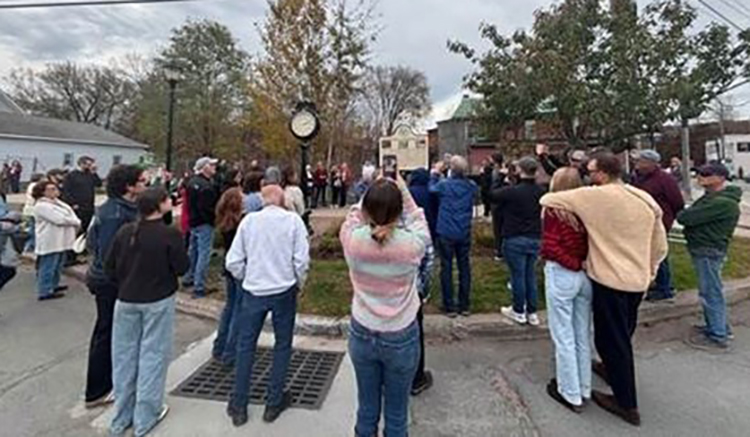
Dedication of the Marker
When Life gives you lemons, make lemonade. And that is exactly what the Jews did when the antisemites hung out the signs on their hotels in the early 20th century, No Hebrews Wanted.
The lemonade adage was first attributed to Elbert Hubbard, who used it in a January 1909 edition of the Literary Digest. Hubbard wrote, “A genius is a man who takes the lemons that Fate hands him and starts a lemonade-stand with them.”
Many years later, Dale Carnegie, the author of the best-selling personal life improvement book, How to Win Friends and Influence People, popularized the phrase. Carnegie credited the inspiration to do so to Julius Rosenwald, the Jewish American businessman and philanthropist. Rosenwald said, “Education is the key to unlocking a better future for all.”
Rosenwald used his immense wealth to transform America by building over 5,000 schools for Black children in the 15 States of the deeply racist Jim Crow South. Rosenwald observed, “A good education should not be a privilege, but a basic human right.”
Antisemitism was, and, regretfully, today is again, an ugly reality for Jews, a blight on America.
In the late 19th century and into the early 20th century, millions of Jews, primarily from Eastern Europe, emigrated, a better term would be escaped, from rabid European antisemitism to the Goldene Medina of comparative freedom in America. Many settled in New York City, where they struggled amidst deplorable socio-economic conditions in the tenements. Conditions began improving as Jews acculturated. They sought a bit of respite, clean air, water, peace, mini-vacation escapes outside the city to the countryside. The No Hebrews Wanted signs smacked them in their faces, denying them the hard-sought and earned American freedoms.
Jews responded to the bitterness of discrimination by building a Jewish vacation world in the Catskills Mountains, 90 miles north of New York City, that would richly transform America. Some nicknamed it the Jewish Alps, the name that stuck was the Borscht Belt.
Between the 1920s and 1970s, Jews built over 500 hotels, 50,000 bungalow communities, and 1,000 rooming houses in Sullivan and parts of Ulster County, New York. The world they created was incredibly dynamic, open, tolerant, and diverse. The Borscht Belt transformed American entertainment, music, sports, recreation, and culture in many ways.
The positive changes to American culture that the Borscht Belt nurtured also led to the factors that led to its demise. The Civil Rights struggles, in which Jews were heavily involved, generational changes, American mobility, and changing life patterns had their impact. The Borscht Belt faded into history as the hotels, the bungalows, and the rooming houses were torn down.
The Borscht Belt Historical Marker Project was created by Marisa Scheinfeld, a noted Catskills photographer, and Louis Inghilterra.
Marisa and Louis refused to let something so special, so important, just disappear. Scheinfeld enlisted fellow historical memory preservationists, such as Isaac Jeffries, also a noted Catskill photographer. Twenty interrelated historical interpretive markers, a complete system for cultural tourism, a physical trail through the Borscht Belt, interpreting and preserving the Borscht Belt story, were envisioned.
Funding for the Borscht Belt Historical Marker Project was secured from the Jewish American Society for Historic Preservation.
October 18th, the Project’s 15th marker was dedicated in Livingston Manor. It was the fifth marker of the 2025 season, stretching from May to October. The final five markers will be dedicated in 2026.
Each double-sided marker in the series is unique, and each marker in the series shares common themes linking to the story of the Jews and Lemonade.
Side one text of the Livingston Manor Marker:
During the Borscht Belt’s Golden Age (1940-1965), Livingston Manor was home to about 41 hotels and 12 bungalow colonies. In an area largely dominated by family hotels, some destinations were designed for socialization and romance. The White Roe was a unique resort on a lake with camp-like amenities for people under 35. The Waldemere was a mid-century resort overlooking Shandelee Lake catering to singles and couples of all ages.
Many hotels employed tummlers, a Yiddish word for someone who “stirs up excitement.” Tummlers acted as jesters, entertainers, and emcees, keeping guests amused throughout the day. In 1929, Danny Kaye began his career in comedy as a White Roe tummler before rising to Hollywood stardom. Other notable tummlers were Mel Brooks, Lenny Bruce, Sid Caesar, Jan Murray, and Henny Youngman. Jewish composer Irving Berlin stayed at the Edgewood Inn before moving to Lew Beach where he wrote the song “White Christmas.” Livingston Manor was also home to Capitol, Chan-Al, Lake Rest, Kaplan’s, Kenmore Lake, Menges Lakeside, Paradise Lake, Parkston Hotel, Sand Lake, Sunrise, Switko’s, and Trojan Lake Lodge.
Side two uses the identical text for every marker in the series.
From the early 1920s through the 1970s, the Borscht Belt was the preeminent summer resort destination for hundreds of thousands of predominantly East Coast American Jews. The exclusion of the Jewish community from existing establishments in the 1920s drove Jewish entrepreneurs to create over 500 resorts, 50,000 bungalows, and 1,000 rooming houses in Sullivan County and parts of Ulster County. The Borscht Belt provided a sense of community for working and vacationing Jews. The era exerted a strong influence on American culture, particularly in the realm of entertainment, music, and sports. Some of the most well-known and influential people of the 20th century worked and vacationed in the areas. Beginning around 1960, the Borscht Belt began a gradual demise due to many factors, including the growth of suburbia, inexpensive airfare, and generational changes.
*
Jerry Klinger is the President of the Jewish American Society for Historic Preservation