By Eva Trieger

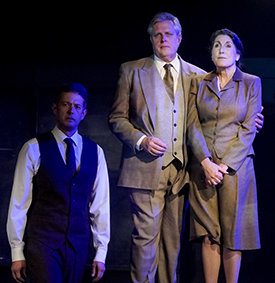
LA MESA, California- The one thing that may be said about an experiment is that the outcome is not always expected. Further, I was always taught that the very definition of a successful experiment is one that is replicable. Copenhagen, Michael Frayn’s play does not challenge this idea, although that may not be obvious at first glance.
Lamplighters Community Theatre treats audiences to a very thought provoking, tense play about an historic visit between Danish physicist Neils Bohr (Steve Murdock) and his young friend and mentee, Werner Heisenberg (Jim Miller). The play explores not only the relationship between the two men, but the interplay of science, politics, history and ethics.
Through a series of re-enactments and reimaginings, three characters recall and replay a visit that took place in 1941, when Heisenberg came to visit his old friends Margrethe (Jena Joyce) and Neils Bohr. The exchanges range from tense awkward moments to warm camaraderie as the trio remember their intertwined lives. They talk about skiing trips, the children and of course, scientific formulas and physicists.
There is an ever present undercurrent of the plight of Jews in Europe under the Nazi regime. The Bohrs fled Denmark and went to Los Alamos. Those who could not escape persecution perished, while so many promising scientists and professors were forced to leave their posts or were only permitted to use their training for theoretical physics.
Through these conversations the three explore the dilemma posed by using scientific innovation to cut short the life of men. This creates ethical concerns for Heisenberg, who is heavily involved in the German efforts to build atomic weapons. His association to Bohr is complicated for both men. Bohr may be seen as a collaborator, while Heisenberg risks the scrutiny of the Gestapo and the Nazi party.
To avoid “bugs” or listening devices, the men take long walks together to discuss their interpretation of events. Margarethe often acts as a stoic reality check for both men. Her additions to the conversations reveal her great understanding of the political climate and her deep understanding of her husband. She appears to have clarity about seeing Heisenberg for his true self, and she does not restrain from direct comments to her guest.
We may never truly understand Heisenberg’s motivation for returning to visit Bohr, but the conundrum each character faced is crystalline. Given the non-linear path of the play, audience members are invited to revisit and reinterpret the past with each of the characters to form their own conclusion. Is Heisenberg the enemy? Is Bohr a hero? The answers to these questions are left up to the viewer.
Jena Joyce as Margrethe Bohr maintained an authentic accent throughout. Her facial expressions and bearing brought the character to life in the Danish home. Her mannerisms, whether serving tea or challenging her visitor, demonstrated the intelligence and grit of her character. Steve Murdock morphed into the deliberate, sometimes paternal physicist and teacher. His demeanor was appropriately controlled and agitated when he parried with his friend and colleague about the science and humanity of their shared past. Jim Miller’s Werner Heisenberg maintained the stress of his necessary balancing act. It seemed evident that he loved this couple, and yet was walking a tightrope to keep his career and livelihood amidst the political climate of the day.
Copenhagen won a Tony award in 2000 and in 2002 was made into a television film. That version starred Daniel Craig, Stephen Rhea and Francesca Annis.
Produced by Becky Cisneros and directed by Rhiannon McAfee and Tyler Richards Hewes, the play is provocative and ponderous. If the intended experiment was designed to see how the control group, Lamplighter audiences, would react to challenging stimuli, it can only be said it was a good experiment. No doubt, with each performance, the result will be repeated. People will be thinking about the intersection of humanity and science, wisdom and responsibility. Well done!
Copenhagen will run through November 9th and tickets may be purchased at www.lamplighterslamesa.com or by phone at 619.303.5092
*
Eva Trieger is a freelance writer specializing in the coverage of the arts.