
Maus by Art Spiegelman; Pantheon; © 1996; ISBN 9780679-406419; 296 pages; $26.90 hardcover Amazon.
By CeCe Acosta in La Mesa, California
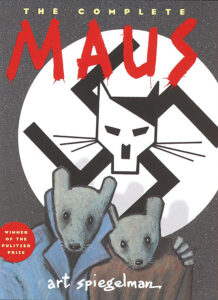 Maus by Art Spiegelman is a Pulitzer Prize-winning graphic memoir about the Holocaust, but it is very different from the history books I have read in school.
It tells the story of Spiegelman’s father, Vladek, a Polish Jew who survived the Holocaust, while also showing Art interviewing his father years later. The book is about the Holocaust, but it is also about family, memory, trauma, and how the past can affect people for generations.
One of the first things I noticed was that Spiegelman draws Jews as mice, Nazis as cats, Poles as pigs, French people as frogs, and Americans as dogs. At first, I thought this was kind of weird. But as I kept reading, I understood how the drawings showed the different groups and the power they had over each other. The animal characters also made me think about how the Nazis tried to dehumanize Jewish people.
What I liked most about Maus was that Vladek isn’t shown as a perfect hero. He is smart and resourceful, and he does whatever he can to survive, but he can also be cheap, stubborn, and difficult. Sometimes I didn’t really like him. That actually made the story feel more real to me. Surviving the Holocaust didn’t turn him into a perfect person.
I also liked that the book shows Art’s relationship with his father. Art gets frustrated with Vladek and sometimes has a hard time understanding him. He also feels guilty because he didn’t experience the Holocaust himself. It made me think about how something that happened to your parents or grandparents can still affect you, even if you weren’t there.
The artwork is another reason I liked the book. It is black and white and looks pretty simple but the pictures can be really powerful. Some pages show huge numbers of prisoners crowded together, which makes the camps seem almost endless. The drawings helped me understand the story in a way that a regular textbook probably couldn’t.
Maus is not an easy book to read. Some parts are really upsetting, and there were times when I needed to take a break. It also deals with difficult family issues and the lasting effects of the Holocaust. There has been controversy about Spiegelman’s use of animals, especially the way he represents different nationalities, but I think the unusual artwork is part of what makes the book so memorable.
I would recommend Maus to other young readers, especially teenagers who are interested in history or want to understand the Holocaust from a personal point of view. It isn’t a fun or comfortable story, but I think that’s part of why it is important. Maus shows that the Holocaust wasn’t just something that happened in a history book. It happened to real people, and its effects continued long after the war ended.
Overall, I thought Maus was powerful, sad, and sometimes difficult to read, but also very meaningful. It made me think about history, family, and how people remember the past. I think it is a book that stays with you after you finish it.
*
CeCe Acosta is a ninth grader attending Helix Charter High School.
This review aptly describes the generational pain and trauma of the horrors of the holocaust.
Especially, the reference to Jewish people as vermin to be exterminated as was Hitler’s treatment of the Jewish people.
Sadly today we see History repeating itself as innocent Jewish people in America and Abroad face attacks daily.
A very insightful young lady. Very mature for a 9th grader.