By Alex Gordon
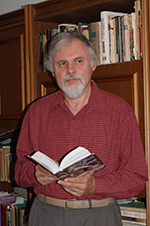
HAIFA, Israel — In 2024, the Jerusalem publishing house Carmel published my book in Hebrew, My Dear Dissonances: Kiev Stories. In this book, I recounted the history of my family in pre-Soviet and Soviet Ukraine against the backdrop of the history of Ukrainian Jews. My Dear Dissonances is presented in two forms – stories and essays. I wrote my book in the genre of tragicomedy, as the tragic and comic in the history of this people are inevitably intertwined.
The dramatic duality of Jewish existence encompasses a combination of the funny and the frightening – tears of laughter and tears of sorrow. In Soviet life, I was an outsider not only in society but also in my family. Therefore, my dear dissonances were caused by a discord not only with the societal system in which I lived but also with my own family members, who poorly understood what they had endured. They, the key figures in my life, with whom my worldview crystallized in arguments, became characters in this book. I am grateful to them all, even those who erased me from their lives despite our close kinship.
The book also includes an essay about post-Soviet Ukraine. When I wrote this book, I did not know the fate or even the existence of two members of my family. In this essay, I want to supplement my book with a story about them. One story is connected to the history of Soviet Ukraine, the other is part of the history of post-Soviet Ukraine.
From the History of Soviet Ukraine
For a long time, I thought I knew everything about the manifestations of state antisemitism and its victims in our family. But it turned out that I was wrong both about the start date of the Soviet state’s antisemitism policy and the number of its victims among my relatives.
Just recently, I read an article by Russian historian and literary scholar Efim Melamed about the closure of the Institute of Jewish Proletarian Culture in Kiev and the repressions against its employees, among whom I found the name of my maternal great-uncle, Jonah Hinchin. I knew nothing about the existence of this Institute, and the fate of this person was unknown to his nieces, my mother and her sister, who was repressed in the cosmopolitanism case. Therefore, I did not include the history of this institute and Jonah Hinchin in my book.
The Institute of Jewish Proletarian Culture was established in 1926. It was a center of Jewish studies of international level. It had six specialized departments (historical, philological, ethnographic, literary, socio-economic and pedagogical). In addition, the Institute included a number of auxiliary institutions: the Central Archive of the Jewish Press, which received hundreds of publications on Jewish studies from all over the world; the Jewish Library had a collection of more than 60,000 volumes; and the Museum of Jewish Modernity.
After its closure in 1936, the Institute was reopened in a greatly reduced form under the name of the Cabinet of Jewish Language, Literature and Folklore at the Academy of Sciences of Soviet Ukraine. The section of musical folklore was headed by my aunt’s colleague Moses Beregovsky, who was repressed together with her in the cosmopolitanism case.
Jonah was accused of anti-Soviet activities and of supporting Trotsky. Investigators claimed that in his practical, editorial work, Hinchin “stood on anti-Soviet positions” and allowed the printing of books “imbued with nationalist interpretations, idealization of counterrevolutionary Trotskyism and the Bund.”
The Bund was a Jewish socialist party active in Eastern Europe and banned by the Bolsheviks. Hinchin was a member of the Bund from 1917 to 1919, but joined the Bolshevik Party and served as head of the Jewish department of the Kiev Regional Historical Archive before working at the Institute. The records of the People’s Commissariat of Internal Affairs showed that in 1923 Hinchin, then a student at Moscow State University, voted in favor of a Trotskyist resolution and was expelled from the Bolshevik Party in 1924.
Investigators determined that, “having in his possession the archives of former anti-Soviet parties – Poalei Tzion and others – he destroyed a number of documents compromising current members of the Communist Party of Bolsheviks of Ukraine, former figures of these anti-Soviet parties.” One witness testified that Hinchin kept archival documents of the defeated and banned Jewish section of the Central Committee of the Bolshevik Party, which contained a complaint against Stalin.
Proof of his “counter-revolutionary Trotskyist work” was “a collection for the party school system entitled ‘General Rehearsal of 1905’” in which “in translating into Jewish the works of Lenin and Stalin, in order to propagandize nationalist-Menshevik and Trotskyist ideas, he deliberately distorted their text.”
Jonah Hinchin was sentenced to five years in the camps by the Special Council, an administrative punitive body under the People’s Commissariat for Internal Affairs, without trial. He died in a camp in Vorkuta on March 7, 1940. He was 48 years old. In 1956 he was rehabilitated. In total, 20 employees of the Institute were repressed, eight of them were shot.
From the history of post-Soviet Ukraine
On May 13, 2025, I received an email from an unknown woman with a familiar last name. Her name was Victoria Gordon. It turned out that she was the daughter of my cousin Valery Gordon from Kharkov, whom I had seen once in my life in 1961 and had no contact with him. I had no idea that Valery had two daughters and that one of them had read my story on the subject of our family.
Victoria asked me questions about my grandmother and her great-grandmother and introduced herself. She is an international master among women in chess, the champion of the Maccabiade in 1998 and a coach of the Kharkov chess club Pawn.
On July 20, 2022, her 13-year-old son Dmitry was killed by a Russian missile at a bus stop in Kharkov, and her 15-year-old daughter Kseniya was seriously injured. Kseniya underwent two surgeries. The diagnosis read “mine blast trauma.” The girl had wounds to the neck, face, parietal fossa, one of the debris was stuck in the lung. Ksenia was discharged in early August, but the healing process, doctors warned, would last about three more months.
In the book My Dear Dissonances: Kiev Stories, I described the murder of my great-grandfather on my mother’s side and my grandfather on my father’s side in the anti-Jewish pogroms in pre-Soviet Ukraine. I told the story of the extermination of my relatives by the Nazis during their occupation of Kiev. The book presents the story of the rescue of my grandmother’s brother from Babi Yar.
I described in detail the phenomena of Soviet state antisemitism, the victims of which were my father and my mother’s sister. I did not know that in post-Soviet Ukraine, too, there were victims in my family of the war that former suzerain Russia imposed on former vassal Ukraine to restore the former Soviet configuration. Now I know about the victims in my family in pre-Soviet, Soviet and post-Soviet Ukraine.
*
Alex Gordon is professor emeritus of physics at the University of Haifa and at Oranim, the Academic College of Education, and the author of 12 books.