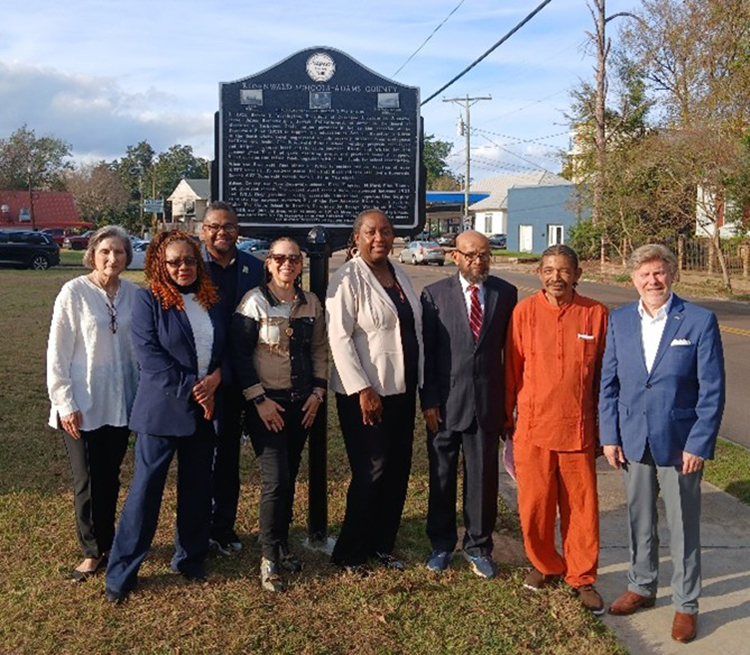
(Photo Courtesy of Bobby Dennis)
By Jerry Klinger

NATCHEZ, Mississippi — Bobby Dennis is the Executive Director of the Natchez Museum of African American History and Culture. A year and a half ago, I reached out to him about placing a historical interpretive marker in Adams County, Mississippi, to interpret, remember, and honor the struggle for Black American educational opportunity and the Rosenwald Schools in Adams.
I told Bobby that the Jewish American Society for Historic Preservation is willing to gift the marker to the Natchez. We are not looking for funding. JASHP is willing to fund and custom-fabricate the marker. We are looking for partners to tell the story.
It would seem the expensive, free historical marker gifts would be actively welcomed wherever they were proffered. That is not the case. Finding contemporary partners to tell the story of how Julius Rosenwald, a wealthy, self-made Jewish businessman and philanthropist, partnered with a Black former slave, Dr. Booker T. Washington, who had risen to national prominence as an educator and advisor to Presidents of the U.S., to jointly fight bigotry, ignorance, and hatred through educational opportunity, is not that simple.
Many offers are made. Many are not accepted.
Bobby Dennis grasped the hand of friendship and the opportunity that JASHP extended. As a lifelong Natchez resident, he remembered that obtaining educational opportunities for Black children in Mississippi was not easy. He knew the story needed to be told visibly and permanently. A marker would be a perfect medium.
Rosenwald was a first-generation Jewish American. His family had been refugees from vicious antisemitism in Europe. He knew all too well the distance between bigotry against Black Americans and Jewish Americans was very, very close.
In 1911, Rosenwald wrote:
“The horrors that are due to race prejudice come home to the Jew more forcefully than to others of the white race, on account of the centuries of persecution which they have suffered and still suffer.”
Rosenwald never wanted his money to be his legacy. He said, “Investing in the future of others is the truest form of legacy…By lifting others up, we also elevate ourselves.”
Rosenwald, through the Rosenwald Fund he established, built 637 schools and school-related buildings in Mississippi. They were Tuskegee College-designed, generally modest two-room wood structures. For the Black children in Mississippi, the schools were magnificent edifices of learning, considering most had nothing before. Education for Black Children in Jim Crow Mississippi was not a priority. It was a priority for Black parents willing to do what they had to for their children.
Rosenwald wanted to build a better America for all Americans together.
JASHP and The Natchez Museum of African American History and Culture formed a shiddach – a partnership. The first-ever interpretive Rosenwald marker in Adams County was created, sited, and dedicated adjacent to the Natchez School Board on November 20, 2025. Bobby had secured the perfect spot.
The text of the marker:
In 1911, Booker T. Washington, President of Tuskegee Institute in Alabama, asked Julius Rosenwald, a Jewish Philanthropist, to serve on the board of directors at Tuskegee. Their unique partnership led to the creation of the Rosenwald Fund (1917) to support the education of African American children in the South, where rural, segregated schools severely suffered from inadequate facilities and books. The Rosenwald Fund’s school-building program encouraged and helped organize local collaboration between Black and White communities for the common good. The Fund gave matching grants and provided technical support. Local communities raised funds together with public funds for school construction. When the Rosenwald Fund closed in 1948, it enabled the construction of over 4,977 schools in 15 southern states. 1/3 of all Black children attended a Rosenwald School. 637 Rosenwald schools were built in Mississippi. Adams County had five Rosenwald schools: Fitts, Kingston, Milford, Pine Mount, and Roseland schools. The modest rural schools were constructed between 1921 and 1927. They provided locally accessible educational opportunities, helping alleviate the extreme overcrowding of the few Adams’ Black schools, such as Union. The Union School in Natchez, Principled by George Washington Brumfield in 1925, had 948 children, with as many as 120 children crowded into a single room.
Erected 2025 by Natchez Association for the Preservation of Afro-American Culture, Jewish American Society for Historic Preservation, Regions Financial.”
JASHP has placed more Rosenwald school markers than any national organization in the country. And… we plan to do more.
We are very privileged and appreciative to have been able to meet, work with, and befriend special people like Bobby Dennis, who share the vision of the commonality of good.
*
Jerry Klinger is the president of the Jewish American Society for Historic Preservation.
www.JASHP.org
I’m not sure if my last email went through.
What is the address and location of this marker?