What Emerged When I Sat Down with Blair Kaplan Venables, and Why It Matters as We Enter 2026.
By Michael Adam Cohen in San Diego

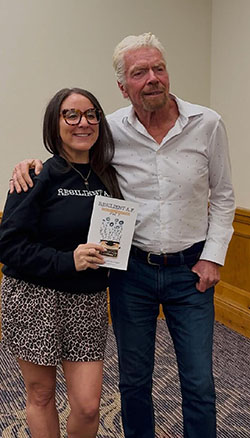
Blair Kaplan Venables is a grief and resilience expert, author, and founder of The Global Resilience Project. Her work has been featured in Forbes, Psychology Today, Entrepreneur, Thrive Global, and the Canadian Broadcasting Corporation Radio. She has spoken on international stages and facilitated grief work across borders. Yet it became clear early in our interview that credentials are not the center of her authority.
Presence is.
I went into my conversation with Venables expecting insight. What I did not expect was how much the interview would slow me down.
This was not a conversation that moved briskly from question to answer. It unfolded deliberately, with pauses that mattered, with space for emotion, and with an honesty that resisted polish. What emerged was not a neatly packaged narrative about resilience, but something far more truthful. A portrait of resilience as it actually lives in the body, in grief, and in responsibility.
When I asked Venables what truth about resilience the world has not asked her to share, she answered without hesitation. Resilience, she said, is not noble while you are living it. It is messy, isolating, and often deeply confusing. We celebrate resilience once the story is complete, when pain has been shaped into meaning. But in real time, resilience feels like anger, numbness, self-doubt, and survival. One moment at a time.
That framing stayed with me, not only because it was honest, but because it was unmistakably Jewish.
In Jewish life, grief is not rushed or hidden. We sit shiva. We tear a garment. We interrupt the forward motion of life and say, “This mattered.” Pain is not privatized. Loss is witnessed. Venables’ understanding of resilience mirrors this ancient wisdom. It does not bypass suffering. It honors it.
As our conversation continued, Venables spoke about the cost of carrying strength alone. Just before being named the Top Grief and Resilience Expert of the Year in 2024, she found herself exhausted. She was grieving, leading, creating, and holding space simultaneously. She had internalized the belief that she needed to be the steady one for everyone.
The breakthrough, she told me, came when she allowed herself to ask for help. That moment did not weaken her work. It refined it. What I heard was a shift that felt deeply relevant now, as we approach a new year. A shift from endurance to alignment.
Judaism understands this transition well. Endurance is how we survive. Alignment is how we live.
Venables’ books, now international bestsellers, reflect this same truth. When I asked whose story in those pages should make readers wince before they flourish, she explained that the discomfort comes from recognition. Readers see their own unspoken grief, their buried losses, their survival patterns reflected back to them. That wince is not failure. It is the doorway.
In Jewish learning, discomfort has always been a companion to growth. We wrestle. We question. We sit with what does not resolve easily. Venables’ work invites that same honesty. You cannot flourish without first telling the truth about what hurts.
Much of Venables’ work focuses on grieving high performers, people who appear capable and composed while carrying immense internal strain. Through her science based Navigating Grief Framework, she challenges one of the most deeply ingrained assumptions of modern life: that productivity equals healing.
Grief, she told me, is not intellectual. You cannot think your way out of loss. The nervous system must feel safe before progress is possible.
Listening to her describe this, I was struck by how relevant it is within Jewish communities, where responsibility, contribution, and achievement are deeply valued. Venables does not dismiss these values. She reframes them. Resilience, she insists, does not require toughness. It requires honesty, flexibility, and support.
We are all born resilient. Resilience is a muscle. And like any muscle, it strengthens through care, rest, and repair, not through constant strain.
As founder of The Global Resilience Project, Venable created a global platform that amplifies stories of loss, growth, and perseverance. The Project’s award-winning books remind readers that they are not broken. They are grieving. And grief, in Jewish consciousness, is not a weakness. It is evidence of love.
When I asked Venables what question she wishes audiences would ask before leaving the room, her answer was simple and unsettling. What is my real story? Unacknowledged pain eventually finds a voice, often through burnout, illness, or disconnection. Jewish tradition teaches that truth-telling is an ethical responsibility. What we refuse to name does not disappear. It waits.
In her certification trainings, Venable emphasized that some inner work cannot be taught through frameworks alone. Facilitators must be willing to sit with their own discomfort without trying to fix it. You cannot guide someone through grief if you are afraid of your own emotions. This principle reflects a deeply Jewish ethic. Leadership begins with self-awareness.
One of the most poignant moments in our interview came when Venables spoke about anticipatory grief. Loving someone while knowing loss is inevitable. She described how trying to remain functional and composed did not strengthen her. The resilience muscle only grew when she allowed herself to grieve before the goodbye, honoring reality instead of bargaining with time.
Venable does not believe any part of grief is too sacred to be spoken publicly. We grieve deeply because we love deeply. When people misunderstand resilience as “bouncing back,” she explained, they often try to return to a version of themselves that no longer exists.
Jewish wisdom teaches otherwise.
After loss, we are changed. Resilience is not returning. It is integrating. It is carrying forward wisdom we did not ask for but now hold.
As our conversation turned toward the year ahead, Venables spoke about the importance of slowing down around nervous system regulation. Acceleration without regulation leads to burnout disguised as ambition. Slowing down does not mean doing less. It means building capacity before demand.
This feels like an essential message as we approach 2026/
Judaism has always honored rhythm. There is a time to build and a time to pause. Even creation required rest. Not because the work was incomplete, but because rest is what makes life sustainable.
As a Jewish woman doing grief work globally, Venables is guided by remembrance. Not to remain in the past, but to stay anchored in truth. She carries stories, names, and responsibility forward. She leaves behind the pressure to make pain palatable or tidy. Honoring loss, she told me, does not require dimming one’s light. It requires integrity.
I left the interview with a clear impression.
Blair Kaplan Venables is not teaching resilience as a skill to acquire. She is restoring it as something remembered. Something ancient. Something Jewish.
As we step into 2026, this feels like the invitation many are quietly waiting for. To move from survival into meaning. From endurance into alignment. From speed into presence.
If those before us endured, mourned, and rebuilt so that we could be here, then our responsibility is not just to exist, but to live awake. To love loudly. To grieve honestly. To build lives we do not want to escape from.
In a world that rewards certainty and pace, Venables offers presence and witness.
And that, I now understand, may be the most resilient act of all.
*
Michael Adam Cohen is a freelance writer based in San Diego.