By Rabbi Dr. Michael Leo Samuel in Chula Vista, California
Imagine opening a book that doesn’t just sit on your shelf gathering dust—it walks with you through the chaos of everyday life, whispering (and sometimes shouting) that holiness isn’t reserved for mountaintops or monasteries. It’s right here, in the messy, miraculous grind of being human.
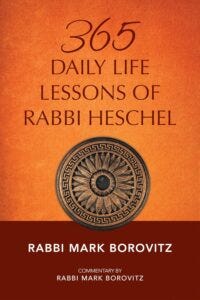 That’s the electric promise of 365 Daily Life Lessons of Rabbi Heschel, a soul-stirring new work by Rabbi Mark Borovitz. Picture this: Rabbi Abraham Joshua Heschel (1907–1972), the towering 20th-century thinker born into a Hasidic dynasty in Warsaw, who fled the Nazis, rebuilt his life in America, and became one of Judaism’s most luminous voices. His books—The Sabbath, God in Search of Man, The Prophets—aren’t dry theology. They’re poetic explosions of wonder, insisting that to truly live is to stand in perpetual awe before the mystery of existence.
Heschel marched arm-in-arm with Martin Luther King Jr. from Selma to Montgomery in 1965, his feet “praying” as he put it. He protested the Vietnam War, got arrested for justice, and taught that piety without ethical action is a hollow shell. God, for Heschel, isn’t a distant monarch—He’s a passionate, searching partner, chasing humanity across history. His signature idea? Radical amazement: the wide-eyed shock that we exist at all, that the world bursts with meaning if only we’d stop scrolling long enough to notice.
Now enter Rabbi Mark Borovitz, the co-author and interpreter who makes this wisdom feel urgently alive. Borovitz’s story could fill its own gripping memoir. Once a con man, alcoholic, and repeat offender, he hit rock bottom in California’s prisons. There, Judaism—raw, real, demanding—pulled him back. He founded Beit T’Shuvah in Los Angeles, a pioneering recovery center that fuses Jewish spirituality with addiction treatment. Residents don’t just talk recovery; they live it through Torah study, Shabbat observance, and honest confrontation with their souls. Borovitz’s earlier books, like Finding Recovery and Yourself in Torah, pulse with street-smart honesty. He knows brokenness intimately—and he knows redemption is possible.
His personal story is wonderful.
In this 365-day companion (a hefty 378 pages, with room for intros, indices, and breathing space), Borovitz becomes the bridge. He distills Heschel’s profound, sometimes dense ideas into daily doses: a quote or excerpt from Heschel, followed by Borovitz’s gritty, heartfelt reflection, probing questions, and concrete actions. Think of it as Rashi meets a recovery sponsor—clarifying, challenging, and refusing to let you off easy.
The structure is brilliantly simple yet deeply rhythmic. One entry per day, numbered from Day 1 to Day 365. You can start on January 1st, on your birthday, or on the day life knocks you sideways. The curation feels seasonal in spirit: wonder blooming in the starkness of winter, justice surging like spring, prayer deepening in summer’s heat, repentance ripening in autumn’s introspection—echoing the Jewish calendar’s cyclical dance. It’s not a rigid march; it’s an invitation to meet the divine wherever your life happens to be.
What turns this from a good book into a transformative companion is the electric dialogue between the two rabbis. Heschel writes like a poet on fire: “Just to be is a blessing. Just to live is holy.” Borovitz lands it like a punch: “Yeah? Tell that to your inbox at 7 a.m., your screaming toddler, your bank account that’s gasping for air. How do you live holy when everything feels unholy?”
Suddenly, reading isn’t passive. It’s a workout for the soul.
Take radical amazement, Heschel’s cornerstone. One entry (say, around Day 15) pulls from God in Search of Man: “The beginning of our conquest of the world is the sense of wonder.” Borovitz doesn’t leave it hanging. He shares a memory from his prison days: a thin shaft of sunlight slicing through iron bars, landing on the concrete floor like a promise. In that moment, despair cracked open into hope. The takeaway? Start small. Pause for a sunset. Really look at your child’s face when they laugh. Borovitz’s challenge: “Today, list three things that amaze you. Tomorrow, act on one—thank someone, help a stranger, savor your coffee like it’s the first time.” This isn’t fluffy positivity; it’s Heschel’s antidote to the “spiritual obtuseness” of our screen-saturated age, where we scroll past miracles every day.
Then there’s prayer—not begging for favors, but radical attunement. Heschel calls it “our humble answer to the inconceivable surprise of living.” In a mid-year reflection, Borovitz recounts a client at Beit T’Shuvah, hardened skeptic, who starts with the simplest gratitude: “Thank you for this breath.” Over months, that tiny practice rebuilt a life. The prompt? “Pray not for what you want, but for awareness of what you already have.” Prayer, for both rabbis, spills into action—Heschel’s “praying with our legs” on the Selma bridge becomes Borovitz’s call to show up for others in recovery meetings, protests, or quiet kindnesses.
Social justice burns bright here too. Heschel’s line from The Insecurity of Freedom—”Few are guilty, but all are responsible”—hits like a gavel. Borovitz connects it to today’s battles: inequality, climate crisis, division. “Heschel didn’t pontificate from an ivory tower; he got arrested. What’s your excuse?” He urges micro-marches: volunteer at a shelter, call your representative, listen without interrupting. For younger readers especially, this links Heschel’s Vietnam-era courage to contemporary movements, proving timeless truth doesn’t age.
The Sabbath gets its own loving spotlight, drawing from Heschel’s masterpiece. “The Sabbath is more than rest; it is a palace in time.” Borovitz, channeling his Hasidic roots, gets practical: unplug, share a meal without phones, reflect on the week. He confesses how Shabbat stitched his once-fragmented life back together. The challenge? A “Sabbath experiment”—one day to reclaim time from the tyranny of productivity and consumerism. Readers report it feels revolutionary in a world that equates worth with output.
My only suggestion for improving the book would be for Rabbi Borowitz to write the Heschel sections in bold print separated by a line; his commentary should be in a different font. It is very important that the words of the master be more prominent than the words of the student.
All and all, it’s a fine book.
This 365-day companion is a terrific book for the daily meditations of one of the great teachers of the 20th century.
*
Rabbi Dr. Michael Leo Samuel is spiritual leader of Temple Beth Shalom in Chula Vista, California.