By Eileen Wingard in San Diego, California
The San Diego Symphony, conducted by its Artistic Director, Raphael Payare, whose contract was just renewed until the 2029-30 season, delivered a stunning performance of Gustav Mahler’s 7th Symphony to a full house on Sunday, February 1, in the newly named Miller Family Theater of the Jacobs Music Center.

It is interesting how Mahler’s music has become so popular with classical concert goers that it ranks along with Beethoven’s symphonies as the most frequently programmed. However, among Mahler’s nine symphonies and the incomplete tenth (performed in versions completed by others, such as British composer and musicologist Deryck Cooke), the 7th is less often heard.
The first movement and last movement of the five-movement symphony are long, sprawling, and complex, with neurotic exclamations contrasted by sublime passages of infinite beauty. The three middle movements are charming and more easily appreciated on first hearing.
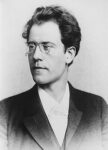
During the summer of 1905, while vacationing at his lakeside retreat, Maiernigg, in the Carpathian Mountains, Mahler did not at first find inspiration for his 7th Symphony. Toward the end of his stay, on his return from a visit to a favorite lake in the Dolomites, he finally got inspired by the night and the rhythm of the oars, bringing him back to Maiernigg. Ta-ta-ta-tum, ta-ta-ta-tum, became the opening rhythm of the first movement of the 7th Symphony. One of the most interesting elements of that movement is the initial theme, scored for the tenor horn, representing, in Mahler’s words, “nature roaring.” These passages were beautifully rendered by the San Diego Symphony Orchestra’s principal trombonist, Kyle R. Covington, on the euphonium.
The second movement, “Nachtmusik I,” written the previous year, features a lovely melody that sounds like a Yiddish Lullaby. Perhaps it was influenced by Mahler’s early childhood.
Gustav was the second of Bernhard and Marie Mahler’s fourteen children. Born July 7, 1860, in Kalischt, Bohemia, Gustav was circumcised on July 14, and his birth registered by the Israelite Community at Unterkralowitz. His parents were members of the increasingly assimilated Jewish petit bourgeoisie.
Within a couple of months of Gustav’s birth, Bernhard moved his family across the Bohemian border into Moravia, joining a flourishing German-speaking Jewish community at Iglau (Jihlava), where Bernhard opened a tavern and distillery, and the family lived in quarters above their business. With a piano in the apartment, Gustav’s talent was soon recognized and nurtured. He was known as a “Wunderkind,” and even played on the occasion of the 1873 marriage between Archduchess Gisele and Prince Leopold.
Mahler began studies at the Vienna Conservatory at age 15 and held posts in Prague, Budapest, and Hamburg before being named conductor of the Vienna Court Opera. Although his main source of income was conducting, he reserved summers for composing.
The second and fourth movements of the 7th Symphony were composed during the summer before the two outer movements and the third movement, the Scherzo. The“Scherzo: Schattenhaft (shadowy)” is a sardonic waltz.
The fourth movement, titled “Nachtmusik II,” is a serenade with reduced instrumentation. There is no percussion, and the only brass instruments are two horns. Added are a guitar and a mandolin. It is marked Andante amoroso, music of love, and it ends with the soft chords of the guitar.
Although some of his music may reflect his Jewish childhood, Mahler converted to Catholicism as a condition of being offered the conductor’s post of the Vienna Court Opera.
He was still faced with anti-semitism, especially an anti-semitic press. He once said, “I am thrice homeless, as a native of Bohemia in Austria, as an Austrian among Germans, and as a Jew throughout the world. Everywhere an intruder, never welcomed.”
Although he was considered to be the greatest conductor of his time, he was very dictatorial and unloved by the musicians. Julius Chajes, the Detroit-based Jewish composer, once told me that his uncle, Chief Cantor of Vienna during Mahler’s directorship of the Vienna Court Opera, reported that Mahler required all of his Jewish musicians to convert. Perhaps Mahler was pressured to do that.
One of the greatest champions of Mahler’s music was the American-Jewish conductor, composer, and pianist Leonard Bernstein. Our own San Diego Symphony Conductor, Raphael Payare, is also a great Mahler conductor and devotee.
In fact, there is even a marked resemblance in the facial features of Gustav Mahler and Raphael Payare. Have you noticed?
*
Eileen Wingard, a retired violinist with the San Diego Symphony Orchestra, is a freelance writer specializing in coverage of the arts.
always fun to read what you know, what you have learned and what you can share with all your faithful readers, dearest Eileen!