By Rabbi Dr. Bernhard Rosenberg
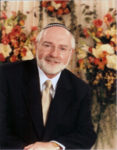
EDISON, New Jersey –I cannot sleep. One thought passes throughout the night. I, a second generation survivor, am only a few years younger than the youngest Holocaust survivors. Who will be the voices of the Holocaust when we are gone? Some answered our children and grandchildren. Wish it were so.
I believe we second generation survivors have the strongest attachment to the survivors and that after we are gone all the museums, books, and movies will not stop the Holocaust from just becoming a date in history, another genocide. It hurts me to say so. I have spent my life writing Holocaust books, curriculum, articles and teaching Holocaust studies but soon the survivors will be gone, and the revisionists will go to work with vigor.
It is already happening today. What is the solution to safeguard Holocaust memory? The Shoah must be incorporated into religious ritual. It must be part of the Haggadah, the machzor, High Holiday and other Jewish holidays. I have redesigned the website for The Rosenberg Holocaust Haggadah and Siddur, Prayerbook . This updated site, at https://holocausthaggadah.com/, offers a clearer layout, improved navigation, and easier access to the rich content and resources that celebrate and preserve this deeply meaningful work.
The essence of this project is simple yet profound: to make Rabbi Dr. Rosenberg’s contributions more accessible to people around the world — whether they are scholars, students, families, or anyone called to reflect on memory, tradition, and resilience. It is free on the internet.
Eventually, the Shoah should become part of the Tisha B’Av service and other fast days.
Perhaps the Shoah should be a day of fasting with the lighting of six candles and reciting Kel Moleh and Kaddish, and special Holocaust orientated prayers. I ask that no one be upset at me for predicting the future observance of the Shoah, but this is what I truly believe.
January 27 marked the anniversary of the liberation of Auschwitz, a date designated by the United Nations to honor the memory of Europe’s Jews, who were targeted for annihilation.
Evil and unwarranted hatred are a reality that exists in our world. The human being has an infinite capacity for evil that, left unchecked, can destroy the world.
The Torah itself tells us that the “impulse of man’s heart is evil from his youth” (Gen 8:21). Man is not born good. He has to become good – by forging his character, by bending his baser instincts, by learning that there is another beside him and an Other above him.
The Holocaust shows what can become of human beings when they permit the beast within them to control them.
It teaches us that we must be alert to the existence of evil, both in others and in our own selves. Once we are aware of its reality, we can work to uproot it. The mitzvot of the Torah are designed to help the spiritual qualities within us dominate the beast within.
Further, we learn from this tragedy that to be silent in the face of evil is to acquiesce in it, encourage it, and help it grow strong. History teaches us that evil triumphs when good people remain silent. But when good people rise up against evil, evil will ultimately perish and the good will prevail.
*
Rabbi Dr. Bernhard H. Rosenberg is rabbi emeritus of Congregation Beth-El in Edison, New Jersey and is the author of Theological and Halachich Reflections on the Holocaust, among other books
Thank you, Rabbi.
Absolutely agree with you. Unless Holocaust memory is mandatory, incorporated into religious observance, it will vanish into the dark future.
A few years back, Yom Kippur, our Congregational Rabbi, realized he was running very late. He arbitrarily eliminated the Holocaust Memorial section to speed things up.
I was shocked. My wife and I went to see him a few days later. He was quite nervous. First, he knew about my deep ties to Holocaust memory. The second thing was that I was the synagogue president, and he was afraid of his walking papers.
He did the mea culpa and never eliminated the Holocaust again from our service.
One of my synagogue jobs was as the school board president. We followed the Board of Jewish Education guidelines for Holocaust education by having one day a school year dedicated to learning about the Holocaust.
Invariably, at the next school board meeting, parents would come in outraged. “How dare we traumatize their children? Holocaust education, where, when and how is up to them. Not the synagogue school.”
The reality is that Yom Hashoah attendance has been reduced from every synagogue to one site, region-wide. And then it is not heavily populated except by seniors. In Israel, I have seen the two-minute siren on Yom Hashoah when all the cars are supposed to stop, and people get out and stand in silence, become an opportunity to make the light while others are sitting. Now with Oct. 7, the second Holocaust, people, confusedly, do not know how to honor the memories of the first Holocaust or the second mini one. They end up not doing much for either.
I have long advocated for a simple Holocaust prayer that all branches of Judaism will recite, even the Haredim. The fly in the ointment, the Haredim do not respect Holocaust memory. El Moleh Rachamim and Tisha b’Av is enough for them.
As one Rabbi put it to me, Why can’t we remember the Holocaust? He said it was because it was too soon to remember and interpret. Maybe in 200-300 years there will be something. What he was really saying is that all generational memory will have died. No one will be asking where was God? Without saying so, it was better for that Rabbi for the Holocaust to go away rather than answer the existential questions.
Again, thank you for what you are doing. I fully support your efforts.