By Shor M. Masori in Encinitas, California
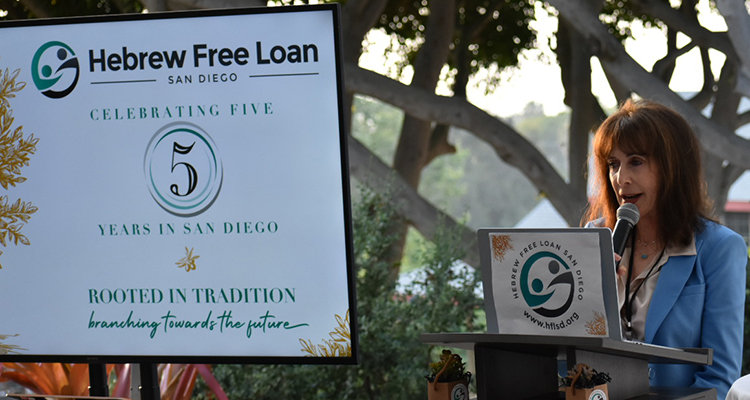
Chocolate gelt caught the light across the tables, succulents waited to be carried home, and clusters of donors, staff, volunteers, rabbis, and loan recipients moved easily through Hebrew Free Loan of San Diego’s (HFLSD’s) fifth anniversary celebration at the Leichtag Commons Saturday evening, March 28.
Selwyn Isakow, who helped found the organization after concluding that the community was falling short in its obligations to Jews in financial distress, set the emotional frame for the evening early. He told San Diego Jewish World this work grows out of a Jewish duty to help people in need, and an interest-free loan belongs to the form of tzedakah that Maimonides placed at the top: giving someone a way to regain their footing and support themselves.
Nancie Vann, a member of the Legacy Circle whose husband serves on the board, said the evening functioned as a thank-you rather than a fundraiser in the usual sense. She described it as a thank-you to the people who have supported and funded the work, and to the recipients for trusting the organization enough to let it help them. She also named one of HFLSD’s hardest challenges: finding the people who need help and making sure they know the organization is there for them.
The organization grew out of a specific communal failure the Isakows believed San Diego needed to confront. Selwyn said a local poverty study confirmed that about 20 percent of 56,200 San Diego Jewish households were living in poverty or on the edge of it. He began developing the Kindness Initiative to address the broader landscape of need.
Hilary Isakow, now HFLSD board chair, had proposed bringing a Hebrew free loan organization to San Diego, drawing on her years on a similar board in Detroit. She recalled reaching out to David Contour in Detroit, being connected to San Francisco, and suddenly sitting in her backyard during the Covid pandemic, sorting through loan documents, guarantor forms, and other startup materials from free-loan organizations around the country. She said Selwyn quietly reworked much of what she was doing and built the framework that became HFLSD.
HFLSD is part of the International Association of Jewish Free Loans, a network of more than 50 Jewish free-loan agencies built around the same basic idea: helping people remain self-supporting and self-respecting through access to interest-free loans.
Selwyn drew a useful distinction between the two organizations. The Kindness Initiative supports people who cannot repay in the short term and need broader support. Hebrew Free Loan serves people who can repay and want the dignity of rebuilding through a loan. The people being honored and interviewed were described as community members whose circumstances had shifted and who needed a way back to stability.
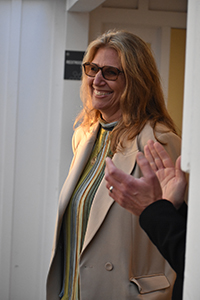
Both Isakows credited HFLSD Executive Director Mindi Frankel with turning their framework into a functioning institution. Frankel described Hebrew Free Loan as “Not offering a hand out, but extending a hand up,” one that helps people regain their footing. Frankel used the symbolism of five to describe where the organization now stands. Five, she said, evokes Torah and the hamsa, the open hand of protection and strength. In five years, HFLSD has made more than 220 loans and lent more than $2 million, with Selwyn later saying the number is now closer to $2.2 million. Frankel said loan volume grew from 17 loans in the first year to 63 last year, with a goal of 80 in 2026. She also returned to one of the evening’s central ideas: community trust can matter more than a credit score.
Every borrower meets with a financial planner, and every repayment helps fund the next loan. Frankel said HFLSD has maintained a 0% loan loss rate, with more than $887,000 repaid since inception.
Those ideas became most tangible once recipients began describing what the loans had actually done in their lives.
A recipient, Deborah, spoke with startling clarity about how quickly a crisis can knock a person sideways, describing a season of cascading bad luck. She had lost her job. Six months later, her savings were gone. Then the transmission blew on her Cadillac XT5, leaving her staring at a $9,000 repair bill. She needed her car to work, but she had already exhausted help from family and friends and had been rejected elsewhere. Her son urged her to call Hebrew Free Loan. About two weeks after applying, she was funded. The loan carried no interest, and the payments were $250 per month.
Deborah said the process was simple, the interview took about an hour on Zoom, and her low credit score did not define the conversation. What mattered was her ability to repay the loan. Now she’s working on commission getting back on her feet.
Another recipient, who asked to remain anonymous, described being buried in credit card debt incurred during a series of personal crises. Hebrew Free Loan consolidated the debts and paid the banks directly, turning crushing, compounding interest into three years of interest-free repayment. “It was a life-saving thing for me,” the recipient said.
If the personal loans showed how HFLSD helps stop a financial slide, the business loans showed what stability can make possible. Deanna Moore spoke about the loan her wife Brooke received for Catching H2O, a rainwater and greywater capture business she had run for 17 years and was ready to expand. A $20,000 loan helped the business buy rainwater tanks in bulk, improve efficiency, create educational workshops, install an irrigation pump, and expand to the point where crops could be irrigated entirely with stored rainwater. It also helped bring on a foreman and move the business into its next stage. Hilary Isakow said she wants to grow the small-business side of the portfolio in particular because helping someone start or sustain a livelihood can be especially powerful.
Education and fertility loans filled in the rest of the picture. Natalie Valentine said an education loan helped her attend California Western School of Law and move into legal practice. Hilary Isakow related that two babies have already been born through IVF loans made possible by the program. In the evening’s video, other recipients described debt consolidation, unpaid internships that led to full-time work, fertility treatment, and small businesses that grew because someone stepped in when it mattered most.
The partner organizations in the room showed how deeply HFLSD is now embedded in San Diego Jewish communal life. Jenny Camhi, VP of Philanthropic and Community Engagement at the Jewish Community Foundation of San Diego, said several members of The Hive, the nonprofit co-working space she started at Leichtag Commons, have used Hebrew Free Loan for school, fertility, and small-business loans. She also noted that some loans are available to people who work for Jewish communal organizations, even if they are not themselves Jewish.
Betzy Weinblatt-Lynch, CEO at the Lawrence Family Jewish Community Center, said the JCC saw in HFLSD a partner grounded in shared values of dignity, access, and financial literacy. Stephanie Lahat, Hillel San Diego’s Advancement Director, said the partnership has already helped students, staff, and families and is likely to deepen through future family weekends and parent outreach.
Darren Schwartz, Chief Planning & Strategy Officer of Jewish Federation of San Diego, said HFLSD performs the kind of work that Jewish tradition has long held up as especially powerful, the kind that restores stability by helping recipients stand on their own feet again. The Federation created a community guarantor fund because some applicants could repay a loan but had no guarantor. Schwartz said that kind of fund is among the riskiest, since repayment rates are strongest when a borrower has a personal connection standing alongside them. Without that connection, recouping the money becomes a greater burden on staff. The Federation therefore provides operating dollars as well. Schwartz’s reasoning was straightforward: the smart people doing this work deserve to be paid, and HFLSD cannot function without them. He also floated the possibility of a future track for younger Jewish professionals or staff early in their careers, especially at a time when Jewish organizations are struggling to attract top talent.
Andrew Gottlieb, who volunteers to help HFLSD’s marketing, described the organization’s outreach challenge as reaching Jews in San Diego who are disconnected from synagogues and formal Jewish life but may still need one of the loan programs. Adam Rudder, listening as a business-minded outsider, said the interest-free model sounded compelling and suggested that startup and tech networks would be a strong platform for promoting business loans.
The evening’s Havdalah service brought that same idea into religious language. Graeme Gabriel, on the board of directors, reflected on the transition out of Shabbat by noting that while for some Jews it is a day of rest, for others it is “another day of scrambling and just trying to make it through.” Rabbi Avi Libman then offered his own deeply personal story. More than 20 years ago, while in rabbinical school, he was not sure he could afford to continue. A Hebrew Free Loan in that city allowed him to finish his studies. Without it, he said, he doubted he would be standing there as a rabbi that night.
For people who may want help but remain on the fence, Alison Prager had the simplest answer of the night. Ask. She stressed that everything the organization does is confidential and that funds are available to help. She made the donor argument just as plainly: one of HFLSD’s funds, she said, has already recycled more than 260%, proof that a contribution here keeps returning to work.
Selwyn Isakow put the problem more plainly. One of the hardest parts of the work, he said, is getting people in need to come forward in the first place. For readers who need help, he urged them to start at hflsd.org. In plain terms, HFLSD’s loans are available to Jewish San Diego households, people who work for local Jewish communal organizations, and some business applicants who partner with a Jewish San Diego resident.
Readers whose needs are broader or who are not in a position to repay a loan can turn to kindnesssd.org. “There’s someone that wants to help you,” Isakow said. Not everyone is in the same position, he said, and Jews have an obligation to help one another. Even people who cannot donate, volunteer, or offer professional expertise can still do something meaningful. “Every day think of one unexpected act of kindness that you can do for someone else,” he said, “and it could change their lives.”
Walking out of the room, I kept thinking about how rare it is to attend an event where so many people so plainly and sincerely care about doing good.
*
Shor M. Masori is a freelance writer based in San Diego.