By Barrett Holman Leak in La Jolla, California
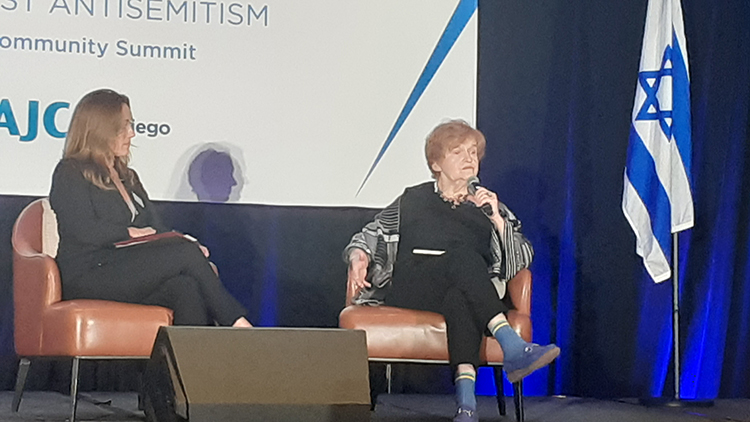
Once again on Sunday, San Diego’s Jewish community gathered for the American Jewish Committee’s Standing Together Summit and this year the focus was on education and collaboration – especially with youth
Former U.S. Ambassador Deborah Lipstadt, with great humor and a serious message, shared at a special brunch and then at the general plenary session of several hundred people, that it is necessary to have courage to speak up and speak out, but also to educate yourself. She used the example of Black American women speaking up: “You know what they call a Black woman when she speaks up (about injustice)? “Uppity.”
But that is exactly what she encouraged the audience at the Hyatt Regency La Jolla at Aventine to do. Lipstadt is the former United States special envoy for monitoring and combating antisemitism.
One of the workshops that I attended on media advocacy called for the same courage. Led by two men named Noah, they shared their personal and professional experiences in dealing with antisemitism.
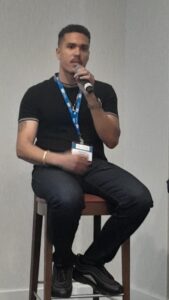
One of them, Noah Shufitinsky, is better known as 26-year old Black Jewish hip-hop/rapper and activist Westside Gravy – who has a San Diego connection. His music is defined by the intersection of his identities—his mother is African American and his father is a Russian Jewish refugee. His transition into writing specifically against antisemitism was a natural evolution of his lived experience, moving from personal reflection to active advocacy.
Born in Hawaii and raised in San Diego, he frequently moved around as a Navy brat. He shared with us about the isolation of often being the only Jewish voice in many spaces and dealing with both racism as a Black American and antisemitism as an American Jew.
He began rapping in middle school, but his focus sharpened in college at George Washington University. He experienced that many social justice movements were excluding Jewish identity or, worse, promoting antisemitic tropes. In high school, he discovered the organization StandWithUs, which provided him with tools to counter misinformation about Israel and Jewish history. He eventually made Aliyah at 18 after graduation and began working as an educator for the organization. He offered three pieces of advice for Jews seeking to more effectively deal with antisemitism:
“The first is know what you’re fighting for, not just what you’re fighting against,” he said, “Know who you are” His second insight is that you should not isolate yourself. Don’t go it alone. “Find yourself a community” he advised. Finally, he suggested, it is wise to educate yourself. “Learn how to stand-up against this hatred.”
Noah Abrahams, a 22-year old former sports journalist for the British Broadcasting Corporation shared how he left the BBC and the United Kingdom due to biased media reporting of the October 7, 2023 Hamas attack on Israel and increasing threats on his life. That began his personal decision as a Jewish man and a media professional, to become a media advocate in the fight against antisemitism. He agreed with Shufutinsky: “Educate yourself (about antisemitism) and then someone else.”
Abrahams’ full story is chilling: he spent three days telling his employer that it was not reporting the truth and showing them who and why. They would not listen and two days after that he resigned. His departure was a widely publicized protest against the broadcaster’s editorial guidelines regarding the reporting of the October 7 attacks.
He resigned citing the BBC’s refusal at that time to refer to Hamas as a terrorist organization. He argued that the use of “freedom fighters” and “militants” or other descriptors was inaccurate and contributed to a hostile climate for Jewish people. He told the BBC that “words have the power to fuel hate” and that the BBC’s stance was a matter of moral integrity for him. He described working for the corporation as his dream job but felt he could no longer represent the brand. His resignation sparked a significant debate about the BBC’s impartiality guidelines. Since then, more than 200 Jewish staff members and contributors signed a letter in 2024 accusing the BBC of institutional problems regarding its handling of antisemitism.
The other workshop I attended, with a panel that included Congregation Beth Israel’s Senior Rabbi Jason Nevarez, gave an update on efforts in San Diego to form relationships between the Jewish and other communities. He cited the recent Passover Seder put on by the Anti-Defamation League that included members of San Diego’s Black clergy and civic leaders.
The summit closed out with three ways participants could advocate in the fight against antisemitism by sending emails to federal, state and local elected officials. The local one held a special meaning for the crowd as it was a suggestion to send an email of gratitude to San Diego Mayor Todd Gloria – who earlier in the program was given two standing ovations for his advocacy for the Jewish community and Israel.
*
Barrett Holman Leak is a freelance writer based in San Diego.