By Alex Gordon in Haifa, Israel
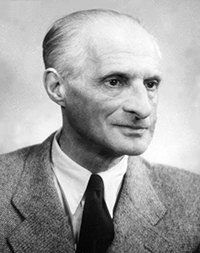
Julian Tuwim, a Polish poet, was born on September 13, 1894, in Łódź, which was then part of the Russian Empire. He was born into a family of assimilated Jews. The surname comes from the Hebrew word “tovim,” meaning “good.” His parents, Isidor and Adela, provided Julian with a comfortable upbringing in a middle-class family. Julian graduated from the Russian gymnasium in Łódź. In 1905, the family had to flee from Łódź to Wrocław (Breslau) to avoid the possible consequences of Isidor’s participation in the 1905 revolution. Julian studied law and philosophy at the University of Warsaw (1916-1918).|
The poet made his debut in 1913 with the poem “Request,” published in the Warsaw Courier (Kurjer Warszawski). The optimism reflected in his early poems was gradually replaced by a bitter and desolate worldview. His poem “Bal w Operze” (“Ball at the Opera”), satirically depicting the Polish government, was banned by the censors. After Poland gained independence in 1918, Tuwim became a co-founder of the group of experimental poets Scamander. He was an outstanding figure in Polish literature, making a significant contribution to children’s literature. He was a laureate of the prestigious Golden Laurel Branch of the Polish Academy of Literature in 1935.
From the very beginning and throughout his artistic career, Tuwim was inclined toward satire. He wrote sketches and monologues for numerous cabarets. In his poems and articles, he mocked obscurantism and bureaucracy, as well as militaristic and nationalist tendencies in politics. In his works, Tuwim displayed caustic humor and an indomitable individuality.
In 1939, at the beginning of World War II and the German occupation of Poland, the poet emigrated thru Romania to France, where in August 1940 he obtained a visa to Portugal. In 1942, he traveled to Brazil via Portugal and eventually ended up in the United States, where he remained until the end of the war. In 1939–1941, he collaborated with the émigré weekly Wiadomości Polskie (Polish News) but ended his collaboration due to disagreements over views on the attitude toward the Soviet Union. From 1942 to 1946, he collaborated with the London monthly publication Nowa Polska (New Poland) and with leftist Polish American newspapers. He was associated with the Polish branch of the International Labor Organization since 1942.
Tuwim returned to Poland in 1946 but wrote almost nothing in Stalinist Poland. He died on December 27, 1953, in Zakopane from a heart attack at the age of 59.
In April 1944, Tuwim published an article titled “My, Żydzi Polscy” (We, Polish Jews). The always ironic and witty poet mourned the murdered Jews of Poland, among whom was his mother, killed in the ghetto. This was his Jeremiah Lamentations. The prophet Jeremiah mourned the destruction of Jerusalem and the exile of the Jewish people from Judea. Tuwim mourned the fate of the Jews of Poland, who were completely exterminated during World War II.
In this article, the poet expressed his Polish-Jewish duality: “I will immediately be asked: where does this ‘we’ come from? The question is natural. I was asked this question by Jews, to whom I always stated that I consider myself Polish, and now Poles will start asking me questions, most of whom consider me Jewish. And I will remain a Jew. […] I am Polish because I was born, grew up, studied, was happy and unhappy in Poland. They will say to me: but if you are Polish, where does “we, Jews” come from? The answer is simple: it’s all about blood. […] Blood comes in different forms: the one that flows in the veins, and the one that is drawn from the veins. […] But there is another blood. The chieftain of the international fascist gang releases it from humanity in the name of the imagined superiority of his race over mine. The blood of the innocently slaughtered millions does not hide in the arteries but flows before everyone’s eyes. […] Abundant, deep streams of Jewish blood flow (not “Jewish blood”). Brown and darkened, they merge into a turbulent, foamy river, […] and in this new Jordan, I accept baptism – a bloody, fervent, martyred brotherhood with the Jews. […] Only a few Polish poems that will outlive me and whose memory will be associated with my name as a Polish Jew. […] With pride, with sorrowful pride, we, miraculously saved, will accept the high title of Polish Jew. […] A heap of shattered, ground-to-dust bones, mutilated, slashed bodies, filling deep ditches and ravines. […] We, Polish Jews. […] Those who perished in the ghettos and camps. […] Shadows of the tormented brothers. […] Suffocated in gas chambers. Rendered into soap. […] Those whose brains are splattered on the walls of shabby dwellings. Shot just for being Jews. […] We are the Cry, the Moan, the Choir, howling the El-Male-Rachamim, whose echo will resound from century to century.”
In this lament, the poet included the hope for the revival of the Magen David in Poland: “I believe in such a future Poland, where the Magen David will become one of the highest distinctions.” Tuwim was mistaken in his prediction: the Magen David did not become the highest distinction in Poland. Three and a half million of its Jews were exterminated. The large Jewish community of Poland has irretrievably disappeared and has not been restored.
*
Alex Gordon is a professor emeritus of physics at the University of Haifa and at Oranim, the Academic College of Education, and the author of 12 books.