By Donald H. Harrison in San Diego
Somewhere I Belong: A Story of Country, Family, Home and Jewish Identity by Jo-Anne Berelowitz; Diaspora Press; © 2025; ISBN 9781966-981046; 205 pages plus appendices; $19.99.
By Donald H. Harrison in San Diego

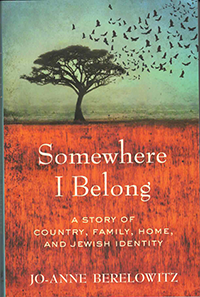 The author was raised in the South African port city of Durban during South Africa’s repressive apartheid era. Jo-Anne Berelowitz’s father, Morris, told her that the family had no future in South Africa, yet because his Man-About-Town clothing factory was so successful, he hesitated for many years to move elsewhere.
“One day there’ll be a bloody revolution here: revenge, massacres, a bloodbath of whites that’ll make Kenya and the Mau Mau look like a picnic. Goddammit, I thought we Jews were done running!” her father predicted to her as a child. (Luckily instead, Nelson Mandela came to power, sponsoring a national reconciliation.)
Berelowitz, who went on to become an art historian and a professor at San Diego State University, combines her personal experiences with meticulous research to paint a portrait of South Africa under the heel of the racist Nationalist party. She never felt she belonged in the country of her birth.
As a schoolgirl, she was alienated by the requirement that she learn the Afrikaans language, even though the state of Natal was predominantly English-speaking. Similarly, she resented the exclusion of Jewish students from Christian holiday observances. Owing to her father’s rejection of religious Judaism, she felt discomfort in synagogues, although in adult life she embraced religious Judaism.
“I resented and resisted having to study Afrikaans because it was more than a language; it was an ideology and the medium of the administration of apartheid,” Berelowitz writes.
She attended a school affiliated with the Church of England: “Jewish students were admitted on a quota system, and ‘excused’ at Easter and Christmas from participating in festival-specific events. From elementary through high school, it was as though I had a yellow Star of David pinned to my bottle-green uniform announcing this student does not belong,” she recalled.
Berelowitz writes of her frightening surreptitious visit to a non-white township, and also of wanting to hug and caress a young Indian man who under the strictures of apartheid was verboten to her. The object of her fantasy failed to reciprocate. He was engaged to be married.
It was as a student at the University of Witwatersrand in Johannesburg that Berelowitz had her first sexual experience with “Steven.” The short-lived affair came after a group skinny dipped in the backyard swimming pool of a famous South African author, whom she declined to identify.
A few years later, she married “H,” a hippie non-conformist with whom she believed she could belong, only to be disappointed by his extramarital affairs, and worse, the certainty that her beloved father respected “H” more than her. Her father even shared a secret with “H” that led to her being extorted in to giving up her house in her divorce settlement.
While their marriage still was unraveling, she and “H” emigrated to California, where he had a job waiting for him and she was accepted as a graduate student in art history at Stanford University. She didn’t realize that she had become pregnant in South Africa. She suspected that “H” was continuing his philandering, and when their son was 14 months old, she moved out of their San Francisco house—which she had purchased with money her grandfather had left her — and moved to an apartment as a single mother.
Moving from San Francisco, she earned a doctorate in art history at UCLA, went on to several short-term academic positions, and was hired at SDSU, where she became a tenured professor. She was remarried at age 48 to Alan, a pediatric psychiatrist with a Jewish mother and Italian Catholic father. At Alan’s insistence that he wanted to visit her old home, they honeymooned in South Africa and were surprised at all the security measures that were taken by white homeowners.
Berelowitz found happiness in La Jolla, to which her parents had emigrated after a sojourn in Israel. She taught at San Diego State from 1979 until her retirement. She and Alan were chased to Austin, Texas, in 2019 by San Diego’s high cost of living. They live in the Texas capital city today.
After a rough start in life, Berelowitz finally found acceptance and belonging for which she had so long searched. Now, she is affiliated with a congregation and has become active in Austin’s Jewish community.
This evocative book paints a picture of what it was like to grow up as part of a privileged family in South Africa, and how her attraction for a family-owned copy of a painting by Dutch painter Johannes Vermeer influenced her subsequent career.
*
Donald H. Harrison is publisher and editor of San Diego Jewish World