By Shor M. Masori in San Diego
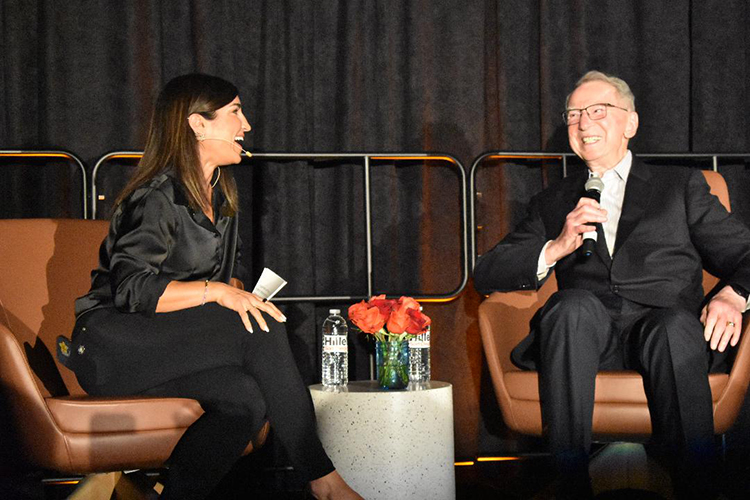
Irwin Jacobs, the co-founder of Qualcomm, reflected on nine decades of his life and works Thursday night, April 30, at the Melvin Garb Hillel Center at San Diego State University. It was Hillel’s final Jewish Networking Hub event of the year
Jacobs’ story, guided in an on-stage interview by Karen Parry, the CEO of Hillel of San Diego, covered a wide range of topics but consistently returned to the idea that life changes when a person recognizes an opportunity and is willing to act on it.
Jacobs came to San Diego after writing a textbook on digital communications and taking a one-year leave from MIT. He, Joan, and their children drove cross-country in an old van and spent time at The Jet Propulsion Laboratory (JPL) and Caltech. They fell in love with California, but after returning to Cambridge, Jacobs initially turned down an opportunity to come to San Diego and help build UCSD’s engineering program. The family had friends, roots, and careers on the East Coast. Moving across the country did not seem like the right move.
Then came a rainstorm in Boston. Jacobs recalled taking the subway to Harvard Square and then a bus home. When he arrived, Joan met him at the door with a description of a contemporary home she had found. The couple had been looking for a house in the Boston area.
There was one problem, she told him. The house was in La Jolla.
That was enough to flip the conversation. They packed up their four boys in the old van and drove west again. Jacobs said that once they arrived in San Diego, it took “about six minutes or so” to feel comfortably at home.
The Jewish World of San Diego
Jacobs and Joan met at Cornell University’s Hillel, where Joan was deeply involved and helped create bagel-and-lox breakfasts. An event many Hillels still host. They married in 1954 in New York City, and the Cornell Hillel rabbi married them.
That partnership became part of San Diego’s civic story. Joan Jacobs, who died in 2024 at age 91, was widely recognized as a philanthropist in her own right, and together the couple supported education, science, health care, the arts and Jewish community life across the region.
Hillel had been an important part of their story as a couple, and he encouraged students to enjoy the bagel-and-lox tradition. He also mused that “Lox from Costco is very good by the way.” This was met by thunderous laughter from a crowd who knew this all too well.
Jacobs recalled that before the mid-1960s, Jewish families could not easily buy homes in La Jolla. He said that began to change with the growth of the university and institutions such as the Salk Institute. When Congregation Beth El eventually came to La Jolla in the early 1970s, the Jacobs family saw it as an important place for early support.
Before Qualcomm, there was Linkabit.
Linkabit began after Jacobs moved from Boston to San Diego and found that many local companies wanted to learn about digital communications. On a flight back from visiting NASA Ames Research Center, he mentioned the consulting requests to friends from UCLA, who suggested starting a company and sharing the work. Jacobs had to decide whether to return to teaching or stay in business. He had spent years telling students that communications theory would be useful in the real world, and Linkabit gave him a way to prove it. The company grew 50 to 60 percent a year profitably, he said, and mostly did government work for its first nine years.
Linkabit also offered stock options to all employees, which Jacobs said was quite unusual at the time. But options had limited value unless the company went public or merged. Linkabit was sold to M/A-COM in 1980, Jacobs stayed for five more years, but after a leadership change, he decided it was time to leave.
He left on April Fool’s Day in 1985, but the timing was so awkward that he had to convince people the announcement was real. After leaving M/A-COM, Jacobs considered returning to teaching, entering venture capital or doing something else. Then six former Linkabit colleagues wanted to “do it again.” A couple of Jacobs’ sons were also involved in the early office, and after testing a few names, Qualcomm was born.
The name stood for “Quality Communications.” Jacobs joked that he always regretted the two m’s at the end, because with one m it might also suggest computers and communications, which was where the company eventually went.
Qualcomm did not begin as the company most people now know. They expected to do government work again, but government procurement had changed and had become far more difficult. So, the company shifted toward commercial work.
One early moment came when Hughes Aircraft asked Qualcomm to review a proposal related to mobile satellite communications. Within a couple of months, Jacobs realized that code division multiple access, or CDMA, which was pioneered by Qualcomm co-founder Andrew Viterbi, could be a better approach than the systems then in use or under consideration. TDMA lets users share a frequency by taking turns, while CDMA allows multiple users to share the same frequency at the same time by separating their signals with codes. Think of TDMA like people taking turns at one microphone, while CDMA is more like many conversations happening in the same room, with each listener tuned to the right one.
This sparked a “religious war” with other companies making 2nd-generation cell phones. CDMA and TDMA cannot interoperate, so Qualcomm had to press on before it could communicate with most other phones. Much of the industry was already moving toward TDMA and related approaches, so Qualcomm had to prove that CDMA could work commercially. Jacobs said they could demonstrate the technology, but at first it required a van and was not yet a product people could carry in their pockets. Qualcomm needed chips, staff and money. That forced the company to innovate not only in technology, but in its business model.
Qualcomm convinced operators that CDMA could allow them to support far more subscribers than competing systems. Those operators pushed manufacturers to work with Qualcomm, and licensing contracts helped fund research and development. The first commercial CDMA network, Jacobs said, was in Hong Kong, where heavy mobile phone use had overwhelmed the available spectrum. Because Qualcomm could not persuade others to build the phones at first, it manufactured them in San Diego and shipped them to Hong Kong. South Korea followed.
Jacobs said the company never wanted to work on something that was only a small step ahead. It wanted to do something significant. But significant ideas rarely move in a straight line.
“You think you have a path ahead,” he said, as the world changes around you, you have to “jig and jag,” but he preferred to call this “dynamic programming.”
He pushed back against the common entrepreneurial idea that failure is simply part of the process. His view was different: It is better not to fail. Find the jig or jag that keeps the effort alive and eventually makes it successful.
The company also understood the importance of intellectual property. Jacobs said that while at Linkabit, they had built the first commercial TDMA phone under contract with another company. At Qualcomm, the company focused on securing 1-2 critical patents early and then built a field of protection around its inventions.
As technology moved toward the third generation of mobile phones, which included voice and data (internet access) Qualcomm made difficult strategic choices. It sold its infrastructure division to Ericsson, a major TDMA-based competitor, with the stipulation of keeping work in San Diego for 5 years. Qualcomm’s stock jumped by a factor of 27, even as revenue dropped to about 30% of the previous year because of the sale.
Asked how he stayed grounded while Qualcomm grew, Jacobs said it came down to finding very good people, giving them a good environment, and keeping communication open through email and meetings. In a small company, a leader can walk the floor and talk to people. In a larger one, communication becomes harder, but no less important.
Family Foundation
Jacobs connected the instinct to give with Jewish family life. He recalled the little tzedakah boxes Jewish families kept for coins, while joking that you can’t find coins today. He and Joan had benefited from scholarships and fellowships while studying. Once they were in a position to pay it forward, they jumped at the chance.
That giving began through the companies. Linkabit and Qualcomm both made charitable contributions. Jacobs said he used to worry that a shareholder might ask why company money was being given away instead of being kept as profit. He had an answer ready, but nobody ever asked. His answer was rooted in the employees and the community. The greatest cost to a business, he said, is losing good employees. A company benefits when the surrounding community is strong, and employees are proud of where they work. They also used to set up meetings during lunch hours and bring in various charitable organizations for employees to help as well.
Personally, Jacobs said he was most proud of his family, including 14 grandchildren and five great-grandchildren, and of seeing older grandchildren become involved in philanthropy. Asked what he was most proud of professionally, Jacobs recalled speaking to professional groups in the late 1990s about putting a camera on a phone. The reaction was always the same: Why would anyone want that? Now one of his greatest pleasures is that, no matter where you go these days, you see people taking pictures with their phones.
His greatest surprise was learning that the Mars mission included a helicopter that needed intelligence, navigation, and communications capability, for which it used Qualcomm technology. Who, he asked, would have expected when Qualcomm began that one day it would have a chip on Mars?
His advice to the students was not to overplan the future. Qualcomm did not operate from a fixed business plan or spreadsheet, but it did believe in thinking about five years ahead. Beyond that, the world changes too much. Over five years, the available technology will change around you, as we are now seeing with AI.
He urged young people to stay open to new ideas and encouraged them to look for places where they can make a significant difference and take risks, because ordinary work is not exciting. If you’re doing something exciting, he said, good people will want to join. Also, having an idea and later seeing it become useful gives an exceptionally enjoyable high.
At the close of the interview, Hillel presented Jacobs with a challah made by a Druze Israeli fellow and student leaders.
Parry sent a letter to attendees on Friday morning. It said, in part: “With our largest turnout yet, our building was filled with energy, curiosity, and meaningful connection across generations. We hope you walked away inspired by Dr. Irwin Jacobs’ insights and his remarkable journey. He reminded us all to take risks, be open to new ideas, and try to make a difference. His leadership has shaped the fabric of our San Diego community, and we were so honored to learn from him.”
After a round of attendees posing for pictures with Jacobs, the Thursday-evening event broke into affinity groups by professional interest. Students and community members were divided into areas, including technology, real estate, business marketing and finance, law, medicine, psychology and social work, entertainment and art, Jewish professionals and education, and biotech. Hillel leaders said the goal was to build regular networking opportunities within those affinity groups. Attendees were encouraged to connect on LinkedIn and return to Hillel as part of the community.
Attendees were asked to put three dates in their calendars. Hillel announced an Oct. 10 signature event at the Melvin Garb Hillel Center, described as its first fundraising event in more than 10 years. Hillel also announced Jewish Networking Hub events for Nov. 5 and April 15.
Next week is Hillel Global Giving Week. Donations are being matched up to the next $55,000, to raise $250,000 by the end of the year to support programming and the students. Those interested should go to hillelsd.org/donate.
Sharleen Wollach, Executive Vice President of the Jewish Community Foundation, in an interview after the program, said that Hillel gives young people a gathering place and that seeing students show up, pay attention, and engage with their community gave her hope. Asked where someone should begin if they want to become more involved in Jewish life, she said the best entry point is wherever their needs and interests meet the community: Hillel, Jewish Federation of San Diego, a local synagogue, Coastal Roots Farm, Jewish Family Service, or another organization.
“Just volunteer and show up,” she said. “When you show up, things happen.”
Throughout the night, the message was the same: stay curious, take the risk, build the connection, and be willing to jig and jag when the path changes.
*
Shor M. Masori is a freelance writer based in San Diego.