By Sandi Masori in San Diego

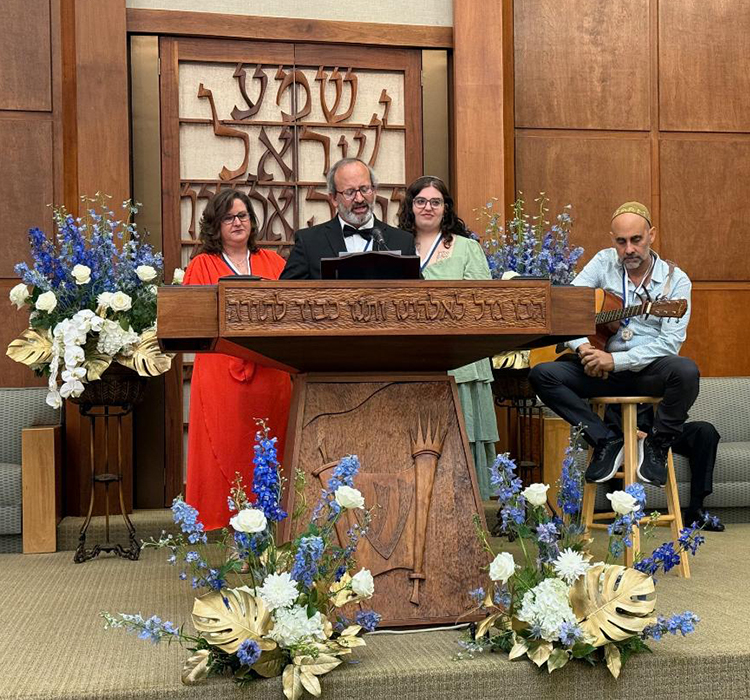
It’s not every day that you get to see the color guard inside a synagogue, but on Sunday, May 3, three members of the San Diego Police Department joined Ohr Shalom congregants to celebrate a milestone, the 100th anniversary of a synagogue at Third and Laurel.
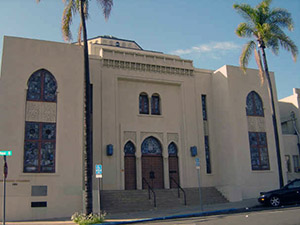
For the first 75 years since it was built and occupied in 1926, the domed building was home to Temple Beth Israel, the oldest Jewish congregation in San Diego and part of Judaism’s Reform movement. For the next 25 years, up to today, it has housed Ohr Shalom Synagogue, part of the Conservative movement.
After Beth Israel moved in 2001 to a campus in the University City neighborhood, Ohr Shalom moved in, rescuing the historic building from the wrecking ball that preceded intended site redevelopment. The congregations may have changed over the years, but the Jewish heart never left.
After the presentation of colors, Ohr Shalom’s choir sang the national anthems of the U.S. and Israel (Star-Spangled Banner and Hatikva) as well as the Hebrew songs Mah Tovu (taken from Numbers 24:5) and Or (“Light,” composed by Naomi Shemer.)
Then Supervisor Monica Montgomery Steppe from the County Board of Supervisors presented a proclamation congratulating Ohr Shalom on the century its building has been in use, signed by board chair Terra Lawson-Remer.
Once the opening remarks and pageantry were concluded, Jewish historian Dr. Joellyn Zollman treated everyone to some facts about the Third and Laurel location.
Why Third and Laurel? she asked? In 1889, Beth Israel was sited at Second and Beech where it served the Jewish community for 37 years. In 1926, the congregation traded its tiny facility for something bigger and grander. (The original Beth Israel has since been relocated to Heritage Park in Old Town San Diego, where it is a well-photographed sightseeing attraction.)
So why Third and Laurel? Well, “Location, location, location.” It was near an attractive uptown neighborhood (Bankers Hill) and close to a major attraction, Balboa Park. It allowed the Jewish community to build for the future by providing three times more space than they had.
You can see the influence of the geography in the architecture, Zollman noted. The design was inspired by the architecture at Balboa Park and by the First Church of Christ Scientist that was across the street.
She pointed out the Byzantine style designs, and the stained-glass windows that use a lot of blue, in a nod to San Diego’s local landscape of sea and sky.
Rabbi Cantor Emerita Arlene Bernstein reminisced about her time as a cantor at Beth Israel. She is the only member of Beth Israel’s current clergy whose tenure traces back to the Third and Laurel building. She said she immediately fell in love with the stained-glass windows in the sanctuary and felt sad about leaving them when the congregation moved to University City. However, when she took possession of an office at the new site, there waiting for her was a photograph of the windows, which she has kept until this day.
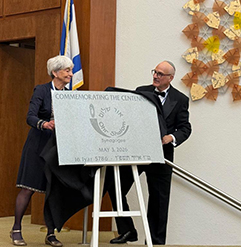
Ohr Shalom’s Rabbi Scott Meltzer talked about imagining the babies just recently born celebrating the next 100-year anniversary in that very sanctuary. Before turning it over to Zeji Ozeri, Jennifer Meltzer and Rabbi Brianna Caplan to Sing the Shechechiyanu thanking God for allowing us to reach this moment, he noted that the prayer is usually said the first time you do something in a cycle. That was likely the first time the Shechechiyanu was said in San Diego for a 100-year cycle.
I have to admit I got a little verklempt.
At a time when antisemitism in the United States is at its highest ever, to think about San Diego’s Jewish community congregating for over a century and to plan for our people to congregate for the next 100 years, no matter what, made me feel made me kvell with pride in our community.
As Zollman said, “The fact that this synagogue still stands is a victory!”
*
Associate Editor Sandi Masori specializes in theater and restaurant reviews.