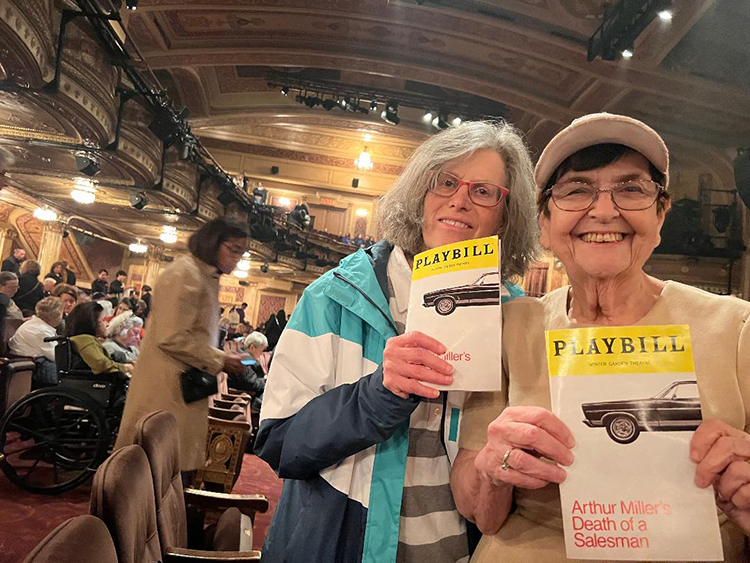
By Susie Rosenbluth and Sue Weston in New York City
The Jewish Voice and Opinion
In the late 1990s, on the 50th anniversary of his 1949 play, Death of a Salesman, Arthur Miller confessed to an interviewer that Willy Loman and his family were intended to be Jews. Further, he said, the title character was inspired by one of his uncles and a suicidal colleague of his father’s, both of them salesmen.
Even knowing this in advance, the Two Sues sat through the spellbinding current production of the play, showing at the Winter Garden Theater on Broadway through August 9, and just didn’t see the Jewish angle. Is it enough to imagine a Yiddish inflection when Willy’s long-suffering wife, Linda (played with self-effacing diffidence by Laurie Metcalf—until the hidden lioness emerges) says: “Attention, attention must be finally paid to such a person”? Good grief, when Willy (Nathan Lane in a performance that will never again pigeonhole him as a song-and-dance comic) steps out of his car at the very opening, he sighs like a man after a hard day’s work—but with nary a cadence that even sounds like “oy.”
So what makes them Jewish? Nothing. Not even the names they give their children, football star Biff (Christopher Abbott, and as a teenager, Joaquin Consuelos) and Happy—short for Harold (Ben Ahlers).
In other productions, the next-door neighbors—hardworking, nerdy Bernard (Michael Benjamin Washington) and his good-natured, nurturing father, Charley (K. Todd Freeman )—have been unequivocally Jewish. But Messrs Washington and Freeman are Black, and it all works just as well—until Charley offers Willy a job and Loman refuses, saying he can’t accept it “from you.” Although nothing in the script suggests any of the Lomans are bigoted, the racial component here has to make one wonder if Willy declines because he doesn’t want a job offered out of pity or if, as intimated here, he doesn’t want to work for an African American.
In any case, there is no denying that Willy has built his life on pretenses and appearances, building a fantasy world in which he is well-liked and successful. When his sons lie to him about their prospects for employment or future families, they create unrealistic images of themselves based on their father’s exaggerations. In the meantime, Bernard becomes a highly successful attorney with a wife and children. See, hard work does pay off. Could anything be more Jewish?
The same is true of other themes of the play that coalesce to break even the most calloused of hearts. These strains are Jewish, but not singularly so. Salesman explores the cycle of inherited expectations that rely on social status and financial success to measure self-worth. The middle-class Lomans reside in Brooklyn, where the parents hope their sons will live better than they do. Eighty years after the play was written, American families still struggle with the same issues and fears, living paycheck to paycheck and pushing their expectations on their children—who, all too often, fall short. If there’s a way to break the cycle of shattered hopes, despair, and depression, neither the Lomans nor the playwright know what it is. What is it that Charley did right and Linda and Willy did wrong?
One thing is certain, if, as the Jewish Bible tells us, we are all our brother’s keepers, then surely, Salesman teaches us that those in positions of power (bosses/owners of businesses) over the vulnerable (sick, aging, or otherwise needy employees) must avoid pushing the powerless beyond their limits. One of the Sue’s saw Willy’s final straw not in the realization that his kids must find their own pathways that will probably have nothing to do with sales, business, or financial success. That Sue saw being fired as Willy’s crushing blow. After decades of loyalty, Willy is denied a reason to get up in the morning by Howard (John Drea), the son of the original owner of the business. Willy and Linda believe the original owner would realize the debt of gratitude he owed his long-time employee, but Howard simply assumes Biff and Hap will “take care of their father.” Thus, Howard dismisses any guilt he may feel about telling Willy to drop off his samples. While Jewish law permits firing, it places a slew of ethical and procedural limits on how and when it may be done, explaining why many rabbis equate sacking an employee with murder.
The consequences of Howard’s transgressing this Jewish principle override everything else for Willy, who believes the secret to success is “to be liked” in order to close deals over the phone. Though he begs for a fraction of what he and Linda need to pay their expenses, he can’t talk himself back into his job.
The other Sue found Willy’s inability to recognize his talents besides selling—carpentry, agriculture—that could have been pursued as late-in-life career changes, unfathomable. For her, Willy’s real tragedy is that he passes on his misguided mindset of exaggeration and deceit.
In both its language, themes, and character studies, Salesman is a high school classic. Performance have been filled with students, there to follow the conflicted Loman family for 24 fateful hours, filled with Willy’s thoughts and memories as he and Linda confront Biff’s homecoming. As a youngster, their older son idolized his father, but now all they do is fight. What happened between them seems, at first glance, an incident as stuck in time as Willy’s falling-apart car or one of Linda’s planned-obsolescence appliances. However, when seen through the eyes of a hero-worshipping high school senior, it resonates just as clearly today.
The current production, directed by Joe Mantello, is nothing short of exemplary. Even the Sue who knew the play found it riveting, the escalating tensions mesmerizing. The other Sue experienced the script, its issues, and the performances as the recreation of a familiar tragedy happening to close friends. Like passersby watching a trainwreck, the audience was immersed in the plight of a family caught in a web of lies, unable to find a way out.
*
Susie Rosenbluth and Sue Weston write under the rubric of Two Sues on the Aisle. Mrs. Rosenbluth’s novel, Blurred Vision, will be out this July from Red Adept Publishing