By Alex Gordon in Haifa, Israel
From August 1937 to November 1938, during an NKVD operation to repress “anti-Soviet elements,” several prominent geneticists and most of the staff of the Central Committee of the All-Union Communist Party (Bolsheviks) who oversaw genetics were arrested; many were shot or died in prison.
In 1939, genetics was definitively denounced in the Soviet media as bourgeois doctrine contradicting Marxist dialectics. Genetic research was curtailed, and a few institutes were closed. After the end of World War II, the debate resumed with renewed vigor. Geneticists, relying on the authority of the international scientific community, once again attempted to tip the scales in their favor; however, with the onset of the Cold War, the situation deteriorated significantly.
In 1948, at the August session of the All-Union Academy of Agricultural Sciences named after Lenin, Academician Trofim Lysenko declared the scientific conclusions of Western geneticists to be pseudoscience. With the support of the authorities, Lysenko began to speak out against classical genetics. His ideas were based on pseudoscientific theories about the “transformation of one species into another” (for example, rye into wheat) and the possibility of inheriting acquired traits. He “promised the Party” the rapid creation of new, highly productive grain varieties.
The only Soviet geneticist who openly refused to capitulate to the then-all-powerful Lysenko was the Jewish scientist, Iosif Rapoport. Since Lysenko enjoyed Stalin’s patronage, speaking out against the pseudo-scientist Lysenko was an act of rare courage. Rapoport was a fearless man. He was a combat officer in the Soviet Army, a paratrooper who fought against the Nazis who invaded the USSR in 1941.Iosif, who was unafraid of the Nazis, also stood up against the Soviet anti-science obscurantists.
Iosif Rapoport was born in 1912 in Chernigov to a Jewish family. His father was a physician. After graduating from high school in 1930, Rapoport was admitted to the Biology Department of Leningrad State University, where, after defending his thesis, he completed a course of study in genetics. At the Institute of Genetics of the USSR Academy of Sciences, he defended his dissertation for the degree of Candidate of Biological Sciences in 1938. In mid-1941, he was preparing to defend his doctoral dissertation, but Nazi Germany attacked the USSR. Although Rapoport was exempt from military service as a candidate of sciences, he volunteered for the front. He rose through the ranks from platoon commander to head of the operations section of the division headquarters.
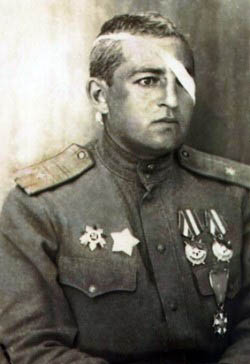
He was seriously wounded twice; in December 1944, during the battles near the city of Székesfehérvár (Hungary), he lost his left eye. Despite his serious injury, he returned to duty and fought until the end of the war. For the courage and bravery he displayed in battle (notably, Rapoport’s rifle battalion successfully repelled a German tank attack in Hungary using bazookas captured from the Germans themselves) Rapoport was awarded a second Order of the Red Banner (the first having been awarded for the crossing of the Dnieper) and the Order of Suvorov, 3rd Class.
For a deep raid into enemy rear areas, culminating in a link-up with allied American forces in the Amstetten area, Major Rapoport, head of the operations section of the headquarters of the 7th Guards Airborne Division, was nominated for the title of Hero of the Soviet Union. After 1945, the antisemitic myth that “Jews did not fight” spread widely in the USSR. Rapoport was nominated three times for the title of Hero of the Soviet Union, but he never received the Star, since “Jews did not fight.”
On May 5, 1943, Rapoport defended his doctoral dissertation while undergoing treatment for one of his wounds. The dissertation itself had been written before the war, and its defense had been scheduled for late June 1941 but was postponed due to his conscription into the army.
In 1949, for disagreeing with the anti-scientific policies that had prevailed in Soviet biology and for “failing to acknowledge mistakes,” Rapoport was expelled from the All-Union Communist Party of Bolsheviks (he had joined the party at the front in 1943). Expulsion from the Communist Party was not only a blow to his scientific career but also a threat to his life—a life he had risked time and again during the war against the Nazis and continued to risk in the war against the pseudo-scientists representing the Soviet authorities.
The Communist Party “graciously” rewarded its brave soldier—by expelling him from its ranks and firing him from his job. For nine years, he was cut off from his life’s work. At first, the Doctor of Science tried to find a job in the metro, then took temporary work with geological expeditions, determining the geological age of samples as a geologist and paleontologist at various geological and oil-producing organizations, and under a pseudonym did translations for the Institute of Scientific Information.
Shortly after Stalin’s death, in 1954, he wrote a scathing letter to the new party leader, Nikita Khrushchev. The scientist demanded (!) of “Citizen Khrushchev” “a clear and detailed statement of the intentions of the political and administrative leadership to which you belong and which is responsible for the complete destruction of several biological sciences in 1948.” Rapoport insisted on an audience with the First Secretary of the Central Committee—he was not pleading for the fate of a jobless Doctor of Science forced to scrape by on odd jobs, he argued, but for the future of genetics in the USSR!
The dark period of persecution against genetics came to an end, and in 1957, Rapoport returned to scientific research in the field of genetics: at the Institute of Chemical Physics of the USSR Academy of Sciences. Together with a group of scientists, he searched for chemical mutagens, analyzed their properties in comparison with radiation mutagens, and conducted experiments in the field of phenogenetics. Rapoport’s main scientific achievement was the discovery of chemical substances that possessed strong mutagenic properties (mutagens and supermutagens) and the conduct of corresponding experiments on fruit flies, which confirmed the scientist’s initial hypotheses and insights, eventually leading to the emergence of an independent branch of genetics known as chemical mutagenesis.
In 1962, the Nobel Committee informed the Soviet authorities about the nomination of Rapoport (jointly with Charlotte Auerbach, a German-British geneticist of Jewish descent) for the Nobel Prize for the discovery of chemical mutagenesis. Rapoport was summoned to the science department of the Central Committee of the Communist Party of the Soviet Union, and he was offered to apply to join the Communist Party so that the authorities would not object to awarding him the prize. However, Rapoport insisted that his expulsion from the party be recognized as unlawful, and that he be reinstated with preserved seniority, rather than being newly admitted. He was denied this, and as a result, the award for the discovery of chemical mutagenesis was not granted at all.
In the early 1970s, Joseph Rapoport was awarded the Order of the Red Banner of Labor; in 1979, he was elected a corresponding member of the USSR Academy of Sciences in the biology section. In 1984, he was awarded the Lenin Prize. By a decree of the President of the USSR dated October 16, 1990, Iosif Rapoport was awarded the title of Hero of Socialist Labor with the wording “for his special contribution to the preservation and development of genetics and breeding, and the training of highly qualified scientific personnel.”
On December 25, 1990, Iosif Rapoport was hit by a truck while crossing the road, as he did not notice the approaching truck on the left due to the absence of his left eye. On December 31, he passed away in the hospital.
*
Alex Gordon is professor emeritus of physics at the University of Haifa and at Oranim, the Academic College of Education. He is the author of 12 books.