By Cailin Acosta in San Diego, California

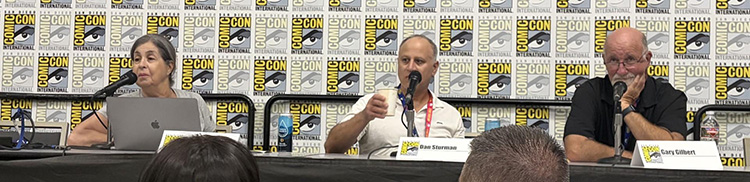
For the eighth consecutive year, San Diego Comic-Con featured a Holocaust-themed panel, with this year’s presentation titled “Art from the Holocaust: Holocaust Stamps: History in Miniature.”
The panel featured Gary Gilbert, a writer for Seinfeld and co-creator of The Stamp Thief; Academy Award-winning documentary filmmaker Dan Sturman, who co-created The Stamp Thief; and Sandra Scheller, founder of RUTH: Remember Us The Holocaust and author. Together, they explored how Holocaust- and World War II-era postage stamps serve as miniature works of art and historical witnesses. The panelists shared the stories behind these remarkable stamps while presenting exclusive clips and behind-the-scenes insights from The Stamp Thief.
Scheller opened the discussion by explaining how Holocaust-era stamps often carried hidden messages while documenting the movement of mail through places where Jewish families were being rounded up, persecuted, and murdered. Their journey serves as a reminder that these victims were targeted solely because they were Jewish.
Among the stamps shown were examples featuring the Imperial Eagle, a symbol dating back to the Roman Empire that represented imperial power and authority, as well as a rare 1938 stamp depicting Italian dictator Benito Mussolini and Nazi German Führer Adolf Hitler together.
The panel also examined the strict postal regulations imposed on prisoners in Nazi concentration camps. Although inmates were permitted to send postcards to family members, they could only correspond with registered relatives and only on designated “writing days.” Letters had to be written in German and were forbidden from mentioning working conditions, politics, or daily life in the camps. Prisoners who did not know German had to find—and pay—someone to help them write their letters. Every piece of correspondence was reviewed by the Block Leader before being censored by the camp’s censorship office. Violating these rules could result in confiscation of the letter and punishment. Prisoners were only allowed to keep the most recent letter they had received.
The panelists discussed “Operation Mail,” a Nazi initiative launched during the summer of 1942 that used prisoner correspondence as both propaganda and a means of gathering intelligence. Prisoners were required to state that they were in good health and that their “resettlement” was going well, creating the false impression that conditions in the camps were humane.
By collecting the addresses of family members through this correspondence, the Nazis transformed personal information into a weapon of persecution. Detailed records enabled them to trace relatives, monitor movements, locate homes and businesses, and ultimately carry out arrests and deportations with devastating efficiency. What appeared to be ordinary mail became another tool in the systematic destruction of Jewish communities across Europe.
The audience also learned about post control cards, which were used to track incoming and outgoing mail for concentration camp prisoners. These records often contained additional information, including prisoners’ occupations and the camps from which they had been transferred. In many cases, however, no correspondence was recorded because prisoners no longer knew where their relatives were or whether they were still alive.
Additional slides featured postal markings and stamps associated with concentration camps, including Majdanek, Auschwitz, and Treblinka.
Another fascinating collection highlighted stamps produced by the Łódź Ghetto Judenrat in Nazi-occupied Poland. These stamps featured symbols such as the Star of David, a compass, scissors, and a wheel. The profile of Mordechai Chaim Rumkowski, head of the Łódź Ghetto, appeared on the left side. The panel noted that several ghettos, including Warsaw and Litzmannstadt, created their own local postage.
One post-war commemorative stamp, issued on the 30th anniversary of the liberation of Theresienstadt (Terezín), was designed to ensure that the memory of the Holocaust would continue to be preserved for future generations.
The presentation also examined both Nazi propaganda stamps and anti-fascist propaganda. One anti-fascist design depicted a skull wearing a Hitler mask. The panelists explained that, during the war, some recipients discarded mail bearing Hitler propaganda stamps out of fear that possessing them could draw unwanted attention or suspicion from authorities.
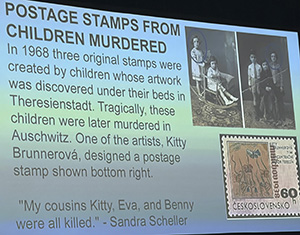
Another memorable slide featured three stamps issued in 1968 in what was then Czechoslovakia. The stamps reproduced artwork created by children imprisoned in Theresienstadt, along with each child’s name and age. The original drawings had been hidden beneath mattresses before many of the children were murdered. One of the artists, Kitty Brunnerová, later designed a postage stamp that was also displayed. Scheller shared that Brunnerová was her mother’s cousin, and that her other cousins, Eva and Benny, were murdered during the Holocaust.
The panel concluded with a discussion of The Stamp Thief (2025), a Holocaust documentary produced by Gilbert and directed by Sturman. Gilbert, an avid stamp collector, explained that he was contacted by a psychiatrist regarding a patient’s story about a Nazi officer who had secretly preserved a large collection of stamps confiscated from concentration camp prisoners. According to the account, the officer hid the collection in a basement in Poland. Although Adolf Hitler demanded to receive the finest examples, the officer allegedly kept the pristine stamps for himself while giving Hitler those that were slightly damaged.
Gilbert said he became fascinated by the story, describing it as a modern-day treasure hunt to recover priceless historical artifacts. He approached Sturman about producing a documentary, but the filmmakers encountered political obstacles because they were Americans seeking access to the site in Poland.
To overcome these challenges, Gilbert and Sturman devised what they described as an “Argo”-style plan. By posing as a film crew producing a fictional movie, they hoped to gain access to the basement where the stamps were believed to be hidden. They likened the mission to a heist—not to steal, but to recover and preserve stolen Holocaust artifacts with the goal of eventually returning them to their rightful owners whenever possible.
Attendees were treated to an exclusive teaser clip from The Stamp Thief, which was scheduled for a later screening at Ohr Shalom Synagogue in a special presentation sponsored by RUTH: Remember Us The Holocaust.
Before concluding, Scheller announced that the RUTH: Remember Us The Holocaust exhibit will open at the San Diego Central Library in September, where it will remain on display for the next two years, continuing its mission of Holocaust education and remembrance.
Click here for more information on the RUTH: Remember Us the Holocaust exhibit.
*
Cailin Acosta is the assistant editor of the San Diego Jewish World.
Thank you Cailin for a great article.
Wow! This is an amazing article! All the information was new to me.
Thank you Cailin Acosta.