By Shor M. Masori in La Jolla, California
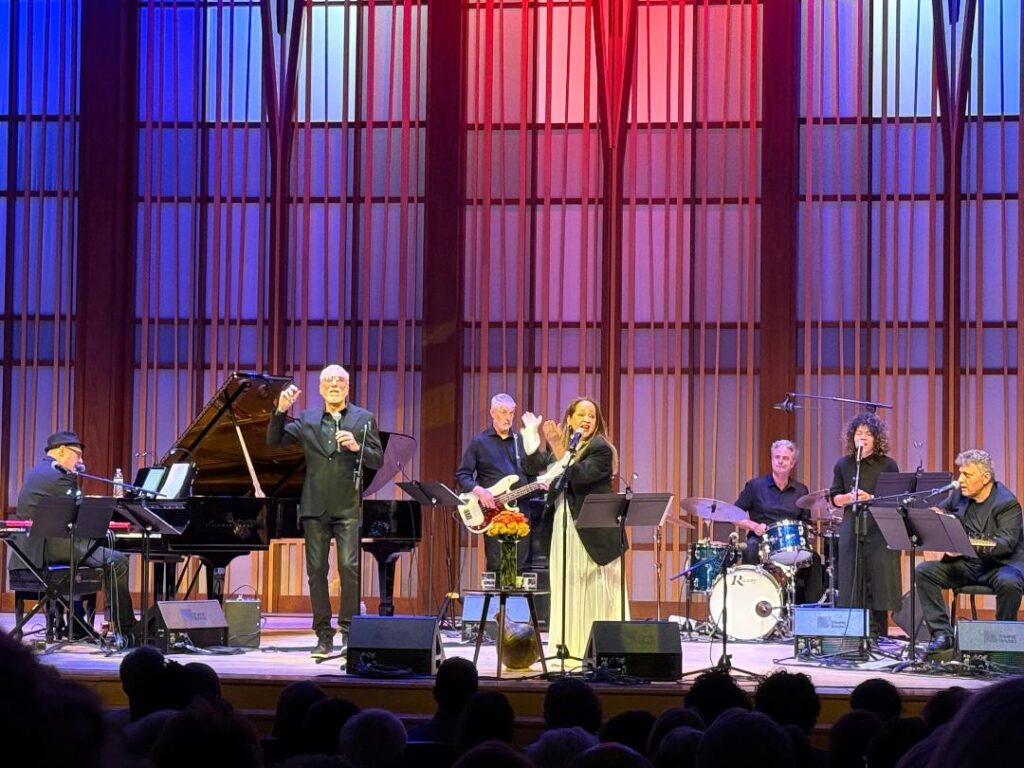
Patrick Page and Perla Batalla brought Looking for Leonard to JFest. The evening was presented as a tribute to Cohen’s music and life, with its strongest material from the personal connections to him on stage. Batalla was a backing singer who toured and recorded with Cohen, which offered great insight into him. Page, a Grammy winner and Tony nominee known for playing Hades in Hadestown, joined her as a vocal and theatrical partner in Cohen’s repertoire.
Cohen once asked Batalla if she may continue to sing his songs after he was gone, to which she responded, “try to stop me.” Since his death, she’s taken it upon herself to keep his music alive and to convey his words with as much honesty as possible.
Someone in Batalla’s band had urged her to contact Page after hearing his deep Cohen-esque voice. Batalla listened to the Hadestown soundtrack and was struck by it. She sent Page an Instagram message about how she was blown away by his performance and asked if he would want to do something in honor of Cohen, whom he had fallen in love with just before. Page suggested they do a show together in New York. Thus began Looking for Leonard.
Batalla said the title came from her own experience after Cohen’s death. Since he passed away, she has felt as though she has been looking for him. She feels his presence whenever she is performing, especially when something goes wrong.
Batalla later described a shared love of Spanish and introduced a Spanish-language version of ‘Dance Me to the End of Love,” with her and Page taking turns on verses. She invited the audience to sing along in any language they wanted.
Once finished with their rendition, Page remarked that the language was “Spanish, but it’s still a Jewish song.”
Batalla also pointed the audience to her album A Letter to Leonard Cohen, available in the lobby and online through various streaming platforms, which Page also sings on.
One of the evening’s most vivid stories came before “Bird on the Wire.” After touring together, Cohen asked her to put together a band for a special party he was giving for his Zen teacher. When he asked her to sing one of his songs, she said no at first. Batalla was unable to imagine singing one of Cohen’s songs by herself, let alone in front of him. He asked her to live with the song for a while before deciding.
Batalla said she worked on the song for hours with a guitarist. At one point, she told Cohen, “I think I own this song now.”
He replied, “Don’t kid yourself. This song owns you.”
Batalla noted that in 2026, Yom Kippur falls on Cohen’s birthday. The following song, “Who by Fire,” was based on the prayer Unetanneh Tokef. He wrote it after the improvised concerts he gave IDF soldiers during the Yom Kippur War.
For “Who By Fire,” Batalla introduced the udu, an African water drum, and the guitar-like Middle Eastern oud played by Dimitris Jimmy Mahlis, who toured with her and Cohen. Batalla said Cohen’s touring band always had an oud player and said in the hands of a master it has been called a direct line to God.
Thursday night’s band included Willie Aron, Kevin Jarvis, Victor Krummenacher, Jade Hendrix, and Mahlis, with Claud Mann credited for the visual direction. Batalla said the musicians had come together only about a week earlier and that all had a connection to Cohen. Willie Aron’s connection was especially notable. He used to be the cantor for Cohen’s synagogue while he was there.
Before singing “Anthem,” Batalla recalled singing at a 1993 event connected to a Canadian Governor General’s honor for Cohen. She said she and Julie Christensen were invited to perform, and that she was pregnant, sick, and nervous when she discovered the segment involved a large orchestra and choir.
Batalla said she saw Cohen smiling under the balcony, wearing a large medallion. The sight made her laugh, she said, because he looked to her like a Jewish lounge singer. After that, she said she got through the performance without making any mistakes.
Before the final number, Batalla spoke about what drew her to Cohen’s work. His work did not deny the world’s horror and brokenness, nor did he let that horror disrupt the music. That idea led into “Hallelujah,” with the audience invited to sing.
The audience had been invited to participate several times through the evening; often, they hesitated at first. By the final ‘Hallelujah’ in the song, the invitation had become part of the performance. Page took the last verse, closing the evening as a communal act.
Batalla ended by thanking JFest, saying she had performed there many times and had always felt welcomed.
*
Shor M. Masori is a freelance writer based in San Diego.