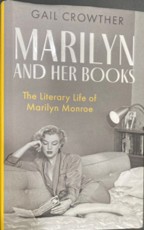
Gail Crowther, Marilyn and Her Books, The Literary Life of Marilyn Monroe (London: Corsair, 2026) 291 pages.
By Oliver B. Pollak in Richmond, California
 I come to this story through my interest in readership. When Oakland’s Womb House Books announced the forthcoming zoom program featuring Gail Crowther’s Marilyn and Her Books, The Literary Life of Marilyn Monroe I immediately purchased the volume. Like Crowther I am a “book snoop.” What do books on the shelf tell about the person who owns them? Monroe’s books featured several Jewish authors.
My 2025 story about the books my aunt and mother took out of Germany in April 1939 has a cover depicting two young women playing with a dollhouse-like city street being used as book ends. I was intimately struck by the dustjacket photograph featuring Marilyn Monroe sitting languidly on a couch reading a The Poetry and Prose of Heinrich Heine by Frederic Ewen (1948). Heine (1797-1856) born into a Jewish family became a Lutheran in 1825, was one of the authors my aunt and mother took to England in the wake of the Kristallnacht in November 1938.
Marilyn’s bookshelves housed other prominent German writers including several volumes by Thomas Mann who moved to the Pacific Palisades in the 1930s, and the lionized Austrian poet Rainer Maria Rilke. All Quiet on the Western Front (1929) by Erich Maria Remarque was not on her shelf. There were two books by Willa Cather but not her World War One 1923 Pulitzer Prize classic, One of Ours (1922), about a young Nebraska farmer who volunteered for the American Expeditionary Force and was killed in France. Monroe’s few books on World War Two included a biography of Adolf Eichmann.
Marilyn Monroe was born in 1926 and took her life at the age of 36 in 1962. In 1999 what was left of Monroe’s long-in-storage estate was auctioned by Christie’s Auction House. They published a profusely illustrated 415 page catalog, The Personal Property of Marilyn Monroe Auction Catalog listing about 400 books. The catalogue editor identified 30 categories several of which contained books by Jewish authors. Sales at the two-day October 1999 auction totaled $13,404,785, the books realized about $600,000, about $1500 per book, which mitzvah-like was donated to the non-profit Literacy Partners.
Monroe’s trove is a spellbinder with opportunities for many discoveries about intellectual growth, social connections, political views and the literary milieu between author, publisher, and reader. Monroe, an autodidact, self-directed her education aided by purchases, gifts from authors and friends, and World Literature extension courses at UCLA. She visited Powell Library before it was called the Powell Library. Marilyn did not graduate high school, she wanted to “better” herself.
Jewish authors included Albert Einstein, Sigmund Freud, Erich Fromm, Benjamin Ginzburg, her third husband Arthur Miller, Robert Oppenheimer, six volumes by Marcel Proust, Leo Rosten, Norman Rosten, and Dr. Benjamin Spock. Monroe a disciplined reader was not a fan of Norman Mailer or Bernard Malamud. She read Ulysses by James Joyce.
Christian Science, the faith of her mother, Judaica, Prayer, Religion were separate but overlapping categories. American literature was well represented by Mark Twain, Clifford Odets, Eugene O’Neill, John Steinbeck, and Tennessee Williams. Russian literature featured Chekhov, Dostoevsky, Pushkin, Tolstoy, and Turgenev, and evocatively From Russia with Love by Ian Fleming.
Monroe’s connection to Judaism included marrying Arthur Miller, her third husband (1956-1961), converting to Judaism, and method acting mentoring, drama coach and friendship of Lee and Paula Strasberg, Natasha Lytess, Michael Chekhov, Anton’s nephew, and her roommate Shelly Winters. She had a Jewish psychiatrist, Dr. Ralph Greenson. She identified herself an “atheist Jew.”
Her choice of Jewish authored and themed books, marriage to Arthur Miller, conversion to Judaism, and learning some Yiddish, represent a constellation within the galaxy. Her collection included The Union Prayer Book inscribed by Robert Goldberg the rabbi who oversaw her conversion.
Readers of this book of nonfiction would benefit from a better designed Contents page, the adequate identification of sources with footnotes or endnotes, and an Index. Most important, the reader will learn a valuable lesson, learning how Marilyn Monroe learned.
Coda. Readers interested in “book snooping” may enjoy Clara Shapiro’s on line July 10, 2026 essay appearing in the July 12 Forward “What I learned from 180 pounds of Yiddish books, one ‘interesting and complicated’ Jewish man, and Jorge Luis Borges.”
*
Oliver B. Pollak, Ph.D., J.D., professor emeritus of history at the University of Nebraska at Omaha, a lawyer, a member of the Institute for Historical Study, and is a correspondent based in Richmond, California.