Three Musicians Find Refuge from Nazi Persecution in Iceland, A review of a review
By Oliver B. Pollak in Reykjavik, Iceland

We witnessed the August 12 solar eclipse from a cruise ship near Iceland. A retired rabbi led Friday services for about 20 Jews. Iceland with about 400,000 people contains about 300 Jews mostly living in the capital Reykjavik where about 2/3rds of the Icelanders reside.
Chabad established an Iceland presence in 2018. In July 2026 they opened the two-story 9,000 square foot Beit Shvidler Jewish Cultural Center of Iceland.
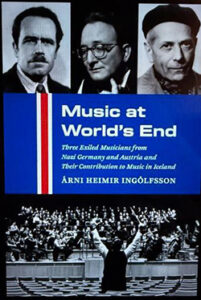 Almost 100 years ago Iceland became a refuge for three persecuted musicians. Music at World’s End: Three Exiled Musicians from Nazi Germany and Austria and Their Contribution to Music in Iceland (State University of New York Press) by Icelandic musicologist Árni Heimir Ingólfsson appeared in 2025.
Ingólfsson earned his PhD in historical musicology at Harvard University in 2003. The refugee subject was suggested to him while a graduate student at Havard. He published three newspaper profiles of the men in 2001. Two decades later he began research for a book “tracking down archives, and just as often, tracking down people.”
The daily online Forward email made me aware of Music at the World’s End. Jenna Katrin Gottlieb, a journalism graduate from the University of Connecticut and freelance journalist, fell in love with Iceland in 2006 and relocated from New York to Reykjavik in 2012. Her August 10, 2026 Fast Forward book review, “How 3 Jewish refugees from the Nazis built Iceland’s classical music scene from scratch” appeared fortuitously while I was in Iceland. Her story also appeared in Times of Israel, South Africa Jewish Report and the JTA, an example of spreading popular culture to the diaspora.
I have not yet read Music at World’s End and my presentation here is based on Gottlieb’s review including her interview of the author and other online sources. Gottlieb’s account is captivating, compelling and instructive. My observations are a twist of a late 1960s intellectually eye-opening graduate school exercise of reading three published reviews of a book you were assigned to read.
Iceland had a population of about 115,000 in 1935. By the end of the decade Reykjavik’s population of about 28,000 included three “Jewish” musicians from Germany and Austria. Iceland like many other countries was not keen to admit Jews fleeing Nazi persecution. Reykjavik in 1935 had no concert hall, national orchestra or conservatory.
Berlin pianist Robert Abraham (1912-1974) arrived in 1935. He adopted the last name Ottosson.
Abraham had been raised Protestant by his Jewish parents; he was no longer religious.
He was followed by Viennese conductor Victor Urbancic (1903-1958), raised Catholic, who arrived with his wife, Melitta who came from a Jewish family.
Heinz Edelstein (1902-1959), a cellist and teacher arrived with his wife and two sons. Edelstein was an atheist. By the time they reached Iceland, none of the three was a practicing Jew, the Nuremberg laws notwithstanding.
The three immigrants contributed to the development of classical music in Iceland. Urbancic became chief conductor of the Reykjavík Orchestra, which grew into the Iceland Symphony Orchestra. He also taught piano at the Reykjavík School of Music and played the organ in the city’s only Catholic church.
Abraham conducted the Iceland Symphony Orchestra, founded the Philharmonia Choral Society and served as director of music for the Church of Iceland.
Edelstein helped build the music schools. Today according to Ingólfsson “there are as many as 100 descendants of these three men living in Iceland.”
Our visit to Reykjavik included the stunning almost honeycombed geodesic glass Harpa Concert Hall poised on the North Atlantic Ocean. It is in part a legacy of Abraham’s, Urbancic’s, and Edelstein’s pioneering work introducing Iceland to continental classical music education and performance.
Árni Heimir Ingólfsson and reviewer Jenna Gottlieb are to be applauded for rediscovering crucial cultural history by merging Iceland’s historical musicology and Holocaust musicology.
*
Oliver B. Pollak, Ph.D., J.D., is a professor emeritus of history at the University of Nebraska at Omaha, a lawyer, a member of the Institute for Historical Study, and San Diego Jewish World’s correspondent based in Richmond, California.