The Rebbe of Baton Rouge by Jennifer Anne Moses and Stuart P. Green; © 2026: University of Louisiana at Lafayette Press; ISBN 9781959-569381; 202 pages; $19.95; Publication date: October 15. 2026.
By Michael R. Mantell, Ph.D., in El Cajon, California

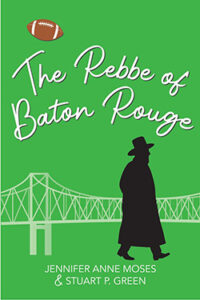 I picked this up mostly because of the title. A rebbe in Baton Rouge? I said that out loud to my wife, Paula, and she just looked at me. Then I found out what was actually in it, a Yiddish-speaking Hasid who may or may not be a ghost, a rabbi trying to keep his congregation from bleeding members to the synagogue across town, a Yiddish professor coming home after some kind of scandal, an old boyfriend, LSU football players in a composition class, and okay, fine, I was in.
Jennifer Anne Moses and Stuart P. Green have written a genuinely strange book, and I mean that as a compliment. It’s not strange in the “look how clever we are” way. It just keeps sliding between things, a little mystery, a little romance, a synagogue power struggle, a scene that’s straight-up funny, and about a third of the way in I gave up trying to guess where it was going.
Anna Zisk teaches Yiddish literature, or did, until an accusation involving a graduate student blew up her career in Boston. So, she’s back in Baton Rouge, where she grew up, and where, this is the part that felt true to me, nothing is actually resolved just because she left. Her sister’s still there. So is the old boyfriend who never really got over her. She also somehow ends up teaching composition to a room full of LSU football players who have already decided, before she opens her mouth, that they don’t care. That section made me laugh more than I expected a Yiddish-lit subplot to make me laugh.
I liked Anna. She’s not trying to rebuild her old life, she’s trying to figure out if she even wants it, which is a different and harder thing, and the book doesn’t pretend otherwise.
Rabbi Adam Kluger is the other half of this. New to the community, congregation shrinking, a rival synagogue circling, and his engagement just ended, so, a lot. And then there’s the Hasid. Elderly, speaks only Yiddish, shows up in Adam’s life with no explanation, and, I’ll just say it, is probably dead. I don’t love ghost subplots as a rule. They usually either take over the book or get explained to death by the last chapter, and either way it’s disappointing. This one does neither. It just sits there, unresolved, tangled up with everything the book is actually about — memory, tradition, what you owe people who came before you — and I was fine with never getting a clean answer.
Where the book is really good, though, is the synagogue politics, which sounds like a strange thing to praise a novel for. But anyone who’s spent time around a small congregation knows how quickly this stuff gets personal. People have been going there for thirty years. Their kids had their bar mitzvahs there. So when another synagogue starts poaching members, it isn’t really about theology, it’s about feeling replaced, and Moses and Green don’t flatten that into a good-guys-bad-guys thing. Everyone has a reasonable case. Everyone is also, at some point, kind of a pain to deal with. That’s just how small communities work, I think. There aren’t enough people for anyone to be anonymous.
Anna and Adam’s relationship develops slowly, which I appreciated. Neither of them goes looking for it. She’s still sorting through Boston, he’s trying to hold a congregation together, and they just sort of end up occupying the same space at the same rough moment. It never feels bolted on, which, for a subplot that could easily have felt like an obligation — is more than I expected.
The more interesting question, to me, was what Anna actually believes. She’s spent her whole career inside Yiddish literature, inside the culture and the history of it, and none of that tells her where she belongs now, which is a different question than the one her career answers.
Baton Rouge does real work in this book, and I want to give it credit for that. Most Jewish fiction happens in New York, or LA, or Miami , places where being Jewish is just weather, it’s everywhere, you don’t have to think about it. Baton Rouge is the opposite. The community is small enough that everyone actually knows everyone, which means keeping it running takes real effort, not the passive kind where a community sustains itself just by being large. Moses clearly knows this world firsthand, she wrote about Louisiana Jewish life before, in “Bagels and Grits: A Jew on the Bayou,” and it shows. This doesn’t read like a setting picked for novelty. Green’s background in law and philosophy shows up too, mostly in how carefully the congregation conflict is argued out from both sides.
The humor is the thing I keep coming back to, honestly. A Yiddish professor teaching football players. A rabbi panicking about a membership drive like it’s a hostile takeover. A possibly dead man wandering through all of it, speaking a language nobody in Baton Rouge expects to hear. None of that should work together. It does.
None of the characters get let off easy, either, they make bad calls, say things they regret, want things that are bad for them, and the book doesn’t rush in to fix that for them.
I finished it liking the people in it more than I expected to going in. Which is probably the best thing I can say about a novel where a ghost shows up to a congregational board meeting, and nobody thinks that’s the strangest part.
*
Michael R. Mantell, Ph.D., is a freelance writer based in El Cajon, California.