By Cailin Acosta in San Diego, California

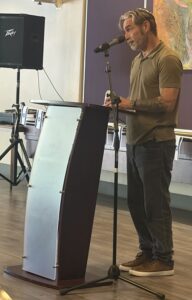
Frank Meeink’s journey from teenage neo-Nazi to civil rights activist and advocate against antisemitism was neither quick nor straightforward. Speaking Tuesday, November 3, at Tifereth Israel Synagogue as part of the San Diego Center for Jewish Culture’s East County Lecture Series, Meeink described how a childhood marked by instability and abuse led him to embrace white supremacy, how the kindness of a Jewish employer challenged his beliefs, and how discovering his own Jewish ancestry eventually became a central part of his identity.
Meeink grew up in Philadelphia in a financially struggling household. His mother remarried when he was young, and he described his stepfather as abusive and openly hostile toward Italians, the ethnic background of Meeink’s biological father. His family circumstances left him feeling isolated and without a reliable sense of belonging.
His surname had also been changed from Bertolini to Meeink when he was a child, an effort by his family to spare him ethnic discrimination in the predominantly Irish neighborhood where he grew up. He recalled being embarrassed by his family’s use of food stamps and feeling that he had few places where he was accepted.
When he was sent to live with his father in another Philadelphia neighborhood, he struggled to fit in at a new school. During the summers, he spent time with an older cousin in rural Pennsylvania. The cousin had become involved with neo-Nazi skinheads, and Meeink was introduced to the movement through the people who gathered at his cousin’s home.
At 14, Meeink was drawn to the group’s attention and acceptance. He said the young men asked him questions about growing up around Black people, making him feel that his experiences and opinions mattered. He also recalled being impressed by the fear the group seemed to inspire in others.
The movement offered him something he felt was missing at home: a sense of importance and belonging. He began attending gatherings, adopted the group’s ideology and eventually became deeply involved in organizing and recruiting. He recalled that antisemitic stereotypes were already familiar from conversations in his childhood neighborhood. At his first neo-Nazi Bible study, he heard conspiracy theories blaming Jews for controlling the Federal Reserve. Rather than recognizing the claims as antisemitic propaganda, he accepted them as explanations for prejudices he had heard growing up.
By age 17, Meeink was traveling, recruiting young people and appearing on a cable-access television program promoting the movement. His involvement also led to serious criminal consequences. After participating in the kidnapping of an anti-fascist activist, he was arrested and charged as an adult with aggravated kidnapping. He served a prison sentence of three to five years.
While incarcerated, Meeink began encountering people whose lives contradicted the stereotypes he had accepted. He said he met incarcerated men from different backgrounds and recognized qualities in them that his ideology had taught him to dismiss. His experiences also exposed him to racial disparities in the criminal justice system.
His transition away from extremism developed gradually. He recalled questioning the claims made by younger members and recognizing that he had once repeated the same uninformed statements. He also struggled to find employment because of his criminal record and visible neo-Nazi tattoos.
A turning point came in 1994, when a friend arranged temporary work for him at an antique furniture business in New Jersey. The owner, a Jewish businessman named Keith, knew about Meeink’s background and tattoos before hiring him. When Meeink asked whether Keith knew who he was, he was told that Keith did not care what he believed as long as he did his job.
Keith eventually offered him full-time employment. Over the following months, the two developed a working relationship that challenged Meeink’s assumptions about Jewish people. They spent time together transporting furniture, sharing meals and talking about life, prison and current events.
Meeink remembered breaking merchandise at work and immediately calling himself stupid, repeating the negative messages he had heard throughout his childhood. Keith stopped him and told him that he was one of the smartest people he knew. He also paid Meeink in full rather than deducting the cost of the damaged merchandise.
The incident stayed with Meeink. He began to question why he continued to hate entire groups of people when individuals he knew personally did not fit the stereotypes he had been taught. Keith’s treatment of him offered an experience that arguments alone had not: a person he had been taught to hate showing him dignity and compassion.
Meeink eventually left the neo-Nazi movement. Following the 1995 Oklahoma City bombing, he contacted the FBI and shared information about extremist organizations. He began speaking with civil rights groups and young people about his experiences, hoping to prevent others from following a similar path.
He also found a way to use his love of hockey for community outreach. Working with the Philadelphia Flyers, he developed a program called Harmony Through Hockey, which brought Black and White children together through the sport. Meeink said the program created opportunities for children who might otherwise have had little contact with one another. He later worked in professional hockey with the Dallas Stars, Anaheim Ducks and Minnesota organizations.
Another significant chapter began in 2014, when a rabbi in Des Moines, Iowa, encouraged Meeink to investigate his family history. The rabbi had noticed that his surname might have Ashkenazi Jewish origins. Meeink’s uncle also reminded him that he had once told him their family had Jewish ancestry.
Family genealogical research identified an ancestor named Elizabeth Zelman, and DNA testing provided further evidence of Jewish roots. Meeink said the discovery was meaningful because it helped explain a connection he had felt but never understood. By then, he had been out of the neo-Nazi movement for approximately 20 years and had spent much of that time working in civil rights and community outreach.
His connection to Jewish life had begun even before the discovery. In 2010, while attending a recovery meeting, he met an older Jewish man who recognized something familiar about him. Meeink initially insisted he was not Jewish and explained that he was there as a former neo-Nazi speaking about his experiences. The two remained in contact, and the man eventually became an important spiritual guide and mentor.
Meeink began studying Judaism more seriously, learning about Jewish history and tradition and developing a personal Shabbat routine. He spoke about the importance of education in Jewish life, saying that he came to understand the value placed on learning and the ability to carry knowledge across generations and circumstances.
In 2020, Meeink testified before Congress about white supremacists in law enforcement, drawing on his firsthand knowledge of extremist organizations and individuals who had entered police departments. He said threats followed his testimony and that he spent two years living on a boat while keeping a low profile.
During that period, he devoted more time to Jewish study, particularly the story of King David. Meeink related to David’s experiences of hardship and periods spent in hiding, finding encouragement in the biblical figure’s perseverance and faith. He said his Jewish practice had since become an important part of his family’s routine.
Meeink also discussed the importance of removing visible symbols of his former ideology. In 1996, the University of Pennsylvania Hospital offered to remove some of his tattoos at no cost, allowing medical residents to gain experience with the emerging laser treatment. He recalled that the woman who arranged the treatment had family members who died in the Holocaust and wanted to help him leave those symbols behind.
Today, Meeink is studying human services and addiction studies, with the goal of becoming an addiction counselor and eventually a chaplain. Having experienced recovery himself, he hopes to work with people struggling with substance-use disorders and help them find support and a stronger sense of purpose. He said his Jewish faith has encouraged him to approach that work with humility and an open mind.
During the discussion, Meeink also addressed the challenges facing Jewish communities and the importance of maintaining relationships with other civil rights advocates. He cautioned against assuming that antisemitism belongs to only one political movement and encouraged listeners to recognize prejudice wherever it appears. He spoke about the historic cooperation between Jewish and Black communities in the civil rights movement and urged attendees to continue building those alliances.
One audience member described efforts to rebuild a Black-Jewish civil rights alliance and the difficulties faced by Jews who also identify with other communities. Meeink encouraged continued engagement and emphasized that shared work on issues such as civil rights and criminal justice reform can help sustain relationships even when disagreements arise.
He also spoke about the First Amendment, saying that he believes in protecting freedom of speech even when people express views others find offensive. For Meeink, confronting hatred requires more than silencing disagreement; it requires education, direct engagement and a willingness to challenge false ideas.
Looking back, Meeink described his former belief in racial superiority as a form of false pride rooted in insecurity. He said he no longer wants to define himself by the ideology that once consumed his life. Instead, he sees his Jewish identity, commitment to recovery and work for social justice as the foundation for what comes next.
His story offered the audience a reminder that prejudice can be learned, but it can also be challenged. Through relationships, education and a willingness to reconsider deeply held beliefs, Meeink said, people can begin to move beyond hatred and build a different future.
*
Cailin Acosta is the assistant editor of San Diego Jewish World.