By Sam Ben-Meir

NEW YORK — The current exhibition of Eugène Delacroix (1798-1863) at New York’s Metropolitan Museum of Art – the first of its kind to be mounted in North America – is indeed an extraordinary revelation. Delacroix was one of the great creative minds of the nineteenth century: an artist who embodied the spirit of Romanticism, a dramatist and virtuoso of coloration who never ceased to experiment, to take inspiration from the old masters – from Veronese and Rubens, Rembrandt and Caravaggio – whose works he would often copy at the Louvre, “that book from which we learn to read,” as Cézanne put it.
From January to July 1832, Delacroix journeyed to North Africa, accompanying a diplomatic mission to Morocco, followed by a visit to Algiers. The trip would prove to be a transformative one for the painter, who by that time had already made a name for himself. It was, for Delacroix, a journey back in time, a vibrant encounter with “living antiquity” as he put it, writing to a friend while in Tangier: “Imagine… what it is to see lying in the sun, walking about the streets, cobbling shoes, figures like Roman consuls, like Cato or Brutus…”
One of the many great works to emerge from his experience of North Africa is the Women of Algiers in Their Apartment (1834), a large-scale painting that depicts three Algerian women seated comfortably on the rugs that cover the floor of their private quarters. To the left, one reclines casually on a pillow, gazing out towards the viewer and drawing us irresistibly into the picture. The other two incline their heads towards each other, apparently engaged in some quiet conversation; while to the far right a female black servant takes her leave.
The painting is especially notable for its use of flochetage – a technique that Delacroix developed, which involves the application of complementary, closely related colors next to one another, so that the colors mix in the eye and brain rather than on the palette. Such a technique recognizes and utilizes the active role of the viewer in constituting the work of art as an aesthetic object. This assertion of the constitutive activity of the mind – its vital participation in creating the object – is in many ways the essential thread that runs through and unites Delacroix’s work, and places him squarely at the forefront of that shift which would mark the advent of modern art. It is no accident that Delacroix would have a profound influence on impressionists and post-impressionists, from Renoir and Cézanne, to Seurat and Van Gogh.
Given his keen awareness of the active role of the mind it is not so surprising that we should find Delacroix returning repeatedly to the scene of Hamlet and Horatio in the Graveyard (in 1835 and again in 1839). In many ways, Hamlet is the quintessential modern subject, bearing witness in virtually everything he says and does to the infinite nature of consciousness. In the 1835 painting, a gravestone has literally become Prince Hamlet’s throne, and the graveyard his kingdom – in other words, his surroundings are a reflection of his melancholic and perhaps even suicidal thoughts.
Cleopatra and the Peasant (1838) revisits some of the themes we encounter in the scene of Hamlet and Horatio. Delacroix does not depict the queen of Egypt at the moment when she is dying, as baroque painters typically would have done (Guido Cagnacci provides such an example). Rather, Delacroix chooses instead to render the queen when she is contemplating her death, which would be accomplished through the poisonous asp – brought to her, in this case, by a burly peasant who has hidden the serpent in a basket of figs. Like Hamlet, Cleopatra could be said to be pondering the vanity and transience of worldly power, wealth and fame. The crucial point is that it is her state mind, not her death throes, which interests the painter.
The show includes two versions of the Death of Sardanapalus – an oil sketch from 1826-27, which served as a study for one of the largest, most violent and controversial works of Delacroix’s career. The other, from 1845-46, is a reduced replica of the massive 16-feet wide Salon painting which was shown in 1826-27. The scene is one of unmitigated violence: during the siege of his palace, Sardanapalus, the last king of Assyria, had ordered the destruction of all his possessions, including the women of his harem, and even the horses. We behold this murder and mayhem unfolding all about the king, clothed in white robes, reclining impassively on a red-draped bed, as the violence engulfs his lavish hall. Moments later, the suicidal king would take his own life, rather than be vanquished by his enemies.
One of the great highlights of the show is its inclusion of oils, watercolors, graphite sketches and lithographs that record Delacroix’s fascination with animals – including especially lions, tigers, and horses. Some of these works were produced during his visits to the menagerie at the Jardin des Plantes in Paris, where he seems to have studied the features of the lion in particular. It is particularly notable that Delacroix is sensitive to the way that animals and humans echo through one another – observing in his journal, for example, how “the foreleg of the lion was like the monstrous arm of a man.”
For Delacroix, human-animal intertwining was much more than just a pictorial theme. Look at the Lion Hunt, for example, of which there are several versions; including a monumental painting from 1855 which was partially destroyed in an 1870 fire (visitors will at least have a chance to see the bottom half of the painting). Delacroix’s admiration for animals was immense, as is clear from a painting such as Young Tiger Playing with Its Mother (1830): the dignity of the mother’s pose is unmistakable and striking – even suggestive that, for Delacroix, the relation between humanity and animality is fundamentally not a hierarchical, but rather a lateral relation.
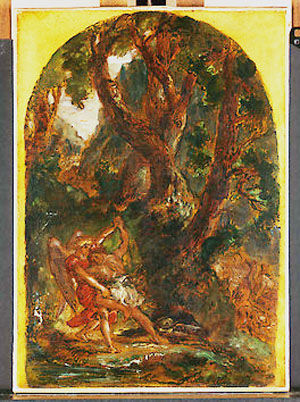
Delacroix produced a number of studies in preparation for what would be his final mural commission: the decoration of the Chapel of the Holy Angels in the church of Saint-Sulpice, Paris. An appropriate subject from the book of Genesis, Jacob Wrestling with the Angel (1861), was to adorn one wall to the side of the altar, and the Met has three small works that provide us with the rare opportunity to peer into Delacroix’s artistic process in developing this scene. The first is a watercolor depicting an oak tree almost certainly painted while Delacroix was out in the woods. Elements of that work make their way into the forest backdrop of Jacob and the Angel, as we can see from a preparatory sketch in black chalk. The third picture is a pen and ink drawing probably traced from the chalk version. Delacroix added oils to the drawing, including the distinctive red of the angel’s robes, which would later be changed to violet in the immense mural painting. The biblical episode has been widely interpreted with much of the debate concerning the identity of Jacob’s opponent: does he wrestle with an angel (as Jewish commentators such as Rashi claimed) or with God Himself? Judging from the large wings on the figure that Jacob is striving with, it would seem that Delacroix adopted the former interpretation.
This exhibition has immense riches in store for the visitor who is able to take their time in each gallery. Delacroix is an artist who produced works that are indeed a “feast for the eye”, which he once stated is the primary merit of a painting – with patient and prolonged viewing however one discovers that his art is as much a feast for the mind. “Painting is life itself,” he once wrote. More than a genius of color, and imaginative narrative compositions, Delacroix’s greatness is inseparable from his acute attention to the inner life, the interiority, of his subjects – be they human or animal – and his ability to engage the viewer so that he becomes more than a passive spectator. At his best, Delacroix’s work is able to touch us at the deepest level, to make us feel the mystery at the heart of existence, and quicken our sense of the unity of living things.
*
Sam Ben-Meir, PhD is an adjunct professor at Mercy College. His current research focuses on environmental ethics and animal studies. sam@alonben-meir.com