Story and Photos by Donald H. Harrison
Additional Photos by Bob Lauritzen


SAN DIEGO –Quite a bit of information overlaps in the exhibits on San Diego’s water supply, conservation, and runoff at the Reuben H. Fleet Science Center and the San Diego Museum of Natural History, two museums that face each other in Balboa Park. The “Fleet” and the “Nat” are “separated”—or perhaps, given their mutual interest in water— “joined” by the landmark Bea Evenson Fountain, one of Balboa Park’s most photographed venues.
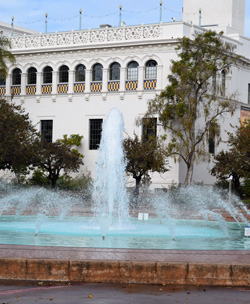
The fountain recycles 55,000 gallons daily. It was named in 1981 for Bea Evenson, one of San Diego’s far-seeing civic leaders, who led the Committee of 100’s efforts to maintain and improve upon the Spanish colonial buildings in Balboa Park. It was designed by the late architect Homer Delawie, a member of the Jewish community.
The thrust of the two museums’ exhibits is to encourage San Diegans to be far-seeing about this area’s water and ecological needs and to improve upon the status quo.
Both museums explain that most of San Diego’s fresh water is transported by pump stations and aqueducts from northern California and from the Colorado River. Both exhibits urge water conservation. The Reuben Fleet Science Center dwells a bit more on the technology of moving water to San Diego, whereas the Natural History Museum focuses more on what effects that water has on the ecology after it is used by San Diego County residents.
The Nat makes the point that 97 percent of the water on earth is too salty for natural consumption, while another 2 percent is either tied up in ice or is buried deep underground. “Water that we can get to and use is a rare and precious resource, amounting to only 1 percent of Earth’s water.”
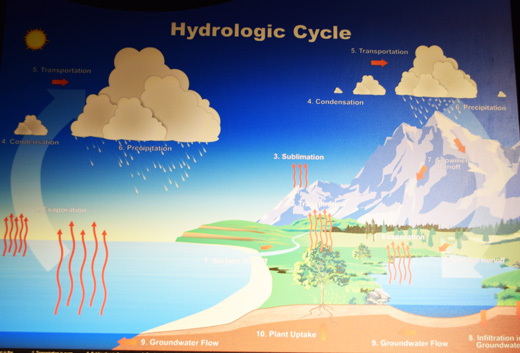
The Fleet’s exhibit includes a 10-step explanation of the water cycle, along with an illustrated flow chart showing such steps as evaporation, transpiration, sublimation, condensation, transportation, precipitation, infiltration, groundwater flow, and plant uptake. The Fleet’s glossary of these terms may be found at the end of this article.
While these natural processes provide approximately 10 percent of San Diego County’s water supply, far more is delivered via the California Water Project and via the Colorado River. Both sources of water are mixed together, then sent via pipeline to the San Diego Water Authority, which disseminates it to local water districts. Those districts, in turn, pipe the water to San Diego County homes, businesses, and agricultural lands.
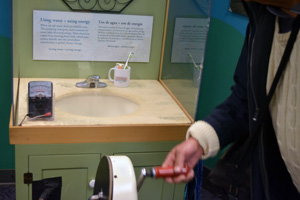
According to the Nat, “San Diego County imports up to 90 percent of its water supply from the Colorado River and northern California. … A vast infrastructure, pumping stations, canals, aqueducts and treatment plants—delivers water to millions of users every day.”
The Fleet explains that the California Water Project was built in the 1960s to connect Northern California to Southern California. “The Project includes 34 storage facilities, reservoirs and lakes; 20 pumping plants; 4 pumping-generating plants; 5 hydroelectric power plants (and) 700 miles of canals and pipelines.”
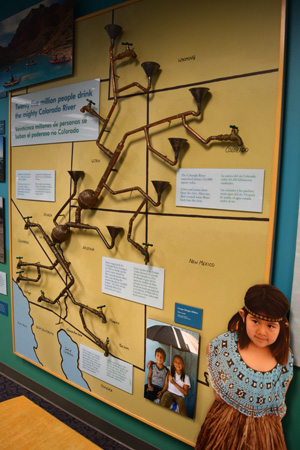
It adds: “The 243-mile long Colorado River Aqueduct built by the Metropolitan Water District of Southern California is another critical piece of water infrastructure because it provides Southern California communities with water from the Colorado River.”
Because other cities, counties, and states compete for this imported water, San Diego County has attempted to diversify its water sources. Desalination has been an important breakthrough. The Fleet reports: “It became a reality when the Claude ‘Bud’ Lewis Carlsbad Desalination Plant opened in 2015. It now provides a new core water supply for San Diego County. Seawater desalination protects the San Diego region from the impacts of drought and unplanned interruptions of imported water deliveries due to an earthquake or another emergency. The Carlsbad plant uses reverse osmosis technology to separate salts from seawater producing about 10 percent of the region’s water supply.”
The storyboard adds: “Did you know? The Carlsbad facility is the largest seawater desalination plant in the U.S. The San Diego Water Authority buys all its water.” As a point of Jewish pride, I’d like to add that the technology used by the Carlsbad facility was developed in Israel.
Even with desalination, there is a need to better conserve the water we already have.
Both museums have suggestions for how we can do that.

The Nat suggests the following steps:
* Pay attention to how much water you use.
* Don’t waste water, turn it on, turn it off.
* Fix plumbing and irrigation leaks.
* Take shorter showers.
* Compost kitchen scraps instead of using the garbage disposal.
* Garden with plants that don’t need a lot of water – or grow food, not lawns.
* Mulch your garden and don’t overwater.
“ You can eat to save water – eat less meat and eat more unprocessed plant-based foods.
The Fleet offers ways to conserve water both outside and inside your house.
Outside:
* Don’t overwater plants.
* Irrigate early in the morning or late in the evening.
* Adjust sprinklers so they don’t hit pavement.
* Don’t irrigate on rainy or windy days.
* Plant drought-tolerant or low-water-use plants and grasses.
* Use shrubs and groundcover to reduce turf grass.
* Place mulch around plants to reduce evaporation and discourage weeds.
* Consider upgrading to efficient irrigation equipment and controllers.
Inside, there also are ways to conserve, according to the Fleet.
Average household toilets use about 33 gallons per day. Low flush toilets could reduce that to 7 gallons per day.
In the average household, faucets use about 28 gallons per day. Upgraded faucets can reduce that to 15 gallons per day.
Similarly upgraded clothes washers can reduce water usage from 23 gallons per day to 11 gallons.
More so than the Fleet, the Nat draws attention to the possibility of turning wastewater into drinking water. The Nat reports: “The North City Water Reclamation Plant purifies 30 million gallons of wastewater every day, powered by methane from the Miramar Landfill. Purple pipes distribute reclaimed water for irrigation and industry. What if we refilled reservoirs and aquifers with reclaimed water, like they do in Orange County? We already use reclaimed water from the Colorado River. What do you think?
“When we shower, flush, and turn on the tap, our wastewater flows into the sewer system then to a water treatment plant. The plant on Point Loma treats 175 million gallons per day, then discharges that water into the ocean through a 4.5-mile-long pipe. With freshwater so scarce, should we expand our water recycling program?”
The Fleet addresses the issue this way: “Water is too valuable to use just once. It can be recycled by treating wastewater from homes and business. Recycled water extends dwindling water supplies, reduces dependence on distant sources, and reduces wastewater discharges to the environment. Most water agencies in San Diego County recycle water, and most recycled water is delivered through specially marked purple pipes for landscape irrigation. Other uses include industrial processing, dust suppression at construction sites, crop irrigation, recreational lakes, and ornamental fountains. The next frontier is using reverse osmosis and other advanced technologies to purify wastewater for drinking. The process is called potable water reuse.”
The issue of storm water runoff is briefly addressed by the Fleet, and more extensively by the Nat. The Fleet says that “storm water is a valuable resource. It can be captured in rain barrels and in specially designed landscapes, reducing runoff and helping to sustain plants.”
When we fail to capture storm water, the Fleet says, “runoff collects pollutants from yards and streets and carries them to the nearest storm drain. Unfortunately, this delivers automotive fluids, brake dust leaves, grass clippings, pet waste, cigarette butts, dirt, and trash directly to rivers, bays, beaches and the ocean.” To reduce the amount of pollutants carried in runoff, the Fleet recommends the following steps: “Instead of using a hose, sweep driveways, sidewalks, curbs, and gutters. Pick up trash near roads, parks, and other public places. Collect pet waste immediately. Prevent sewer overflows by having sewer pipes professionally inspected for cracks or blockages.”
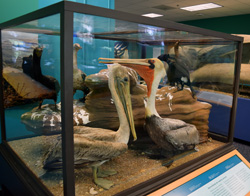
The Nat emphasizes that “when we water the yard or wash the car, our wastewater flows into the storm drain system and directly to the ocean, carrying cigarette butts, plastic bags, pet poop, and pesticides—without any treatments. Urban runoff is the number one cause of ocean pollution.”
We have learned from our mistakes, according to the Nat: “During the 1960s, scientists saw a decline in many fish-eating birds—especially Brown Pelicans. At that time the pesticide DDT flowed from farmland into waterways and entered the marine food chain. Among other bad effects, DDT weakened the shells of pelicans’ eggs so they cracked easily. After the ban on DDT in 1973, pelican populations rebounded. In 2009, they were removed from the Endangered Species list.”
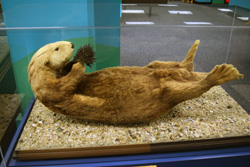
Concerning pet poop, the Nat reports: “Sea otters-furry and curious—lived all along the California coast until fur hunters decimated their population. They still live from central California north, yet today they face other challenges. Besides chemical pollution, parasites found in cat feces enter the ocean carried by rainfall runoff and treated toilet water. Sea otters get infected with the parasite and die. Surfers may be suffering too. A simple solution to promote ocean health: Pick up cat poop and put it in the trash, not the toilet.”
The Nat also inveighs against the unnecessary use of plastic: “Over 5.5 million tons of trash—mostly plastic and covering an area twice the size of Texas—floats in the center of the North Pacific between San Francisco and Hawaii. At least 80 percent of that trash—plastic bags, balloons, water bottles—originated on land. Plastic doesn’t biodegrade. Sunlight makes plastic brittle and it breaks into tiny pieces that attract and concentrate toxic pollutants. Marine life mistakes the floating trash for food. They eat plastic and die. In some places, trash outweighs marine plankton by a ration of 6:1. Take action – limit your use of plastic; use reusable shopping bags; don’t litter.”
*
Glossary
Condensation is the process where water vapor (a gas) changes back into water droplets (a liquid.) This is when we begin to see clouds.|
Evaporation — is the change of state of water (a liquid) a water vapor (gas). On average about 47 inches is evaporated into the atmosphere from the ocean each year.
Groundwater flow is the flow of water underground in aquifers. The water may return to the surface in springs or eventually seep into the oceans.
Infiltration is the movement of water into the ground from the surface.
Plant uptake is water taken from the groundwater flow and soil moisture.
Precipitation — is water that falls to the earth. Most precipitation falls as rain but includes snow, sleet, drizzle, and hail. Around 313,000 mi (3d pwer) of water falls each year, mainly over the ocean.|
Runoff is the variety of ways of which water moves over the earth’s surface. This comes from melting snow or rain.
Sublimation is the process where ice and snow (a solid) changes into water vapor (a gas) without moving through the liquid phase.
Transpiration is evaporation of liquid water from plants and trees into the atmosphere. Abut 50 percent of all water that enters the roots transpires into the atmosphere.
Transportation is the movement of solid, liquid and gaseous water through the atmosphere. Without this movement, the water evaporated over the ocean would not precipitate over land.
*
Harrison is editor and Lauritzen is a photographer for San Diego Jewish World. Harrison may be reached via donald.harrison@sdjewishworld.com