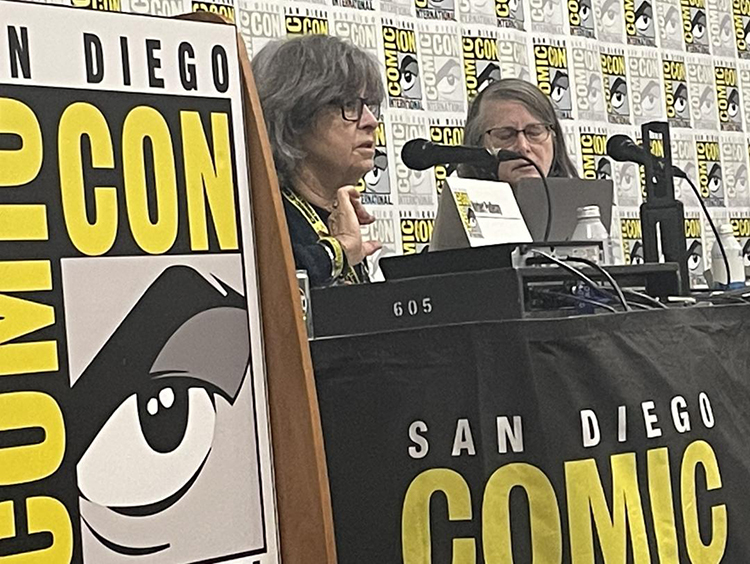
By Cailin Acosta

SAN DIEGO – In a Comic Con panel, Norbert Podlesny (author, The Glimpse of Evil volumes I, II, and III), Marcia Tatz Wollner (western regional director of March of the Living), and Sandra Scheller (creator and curator of RUTH: Remember Us The Holocaust) held a powerful discussion on a unique and rarely seen collection of graphic propaganda from the Holocaust era.
They explored on Thursday, July 24, how visual media was used to manipulate, dehumanize, and control innocent Jews in a chilling form of psychological warfare. In a statement, “the panel promises a compelling examination of the intersection between art, hate, and history”.
As I made my way to room 4 of the San Diego Convention Center, the line wrapped around the building, and the fire marshal advised on the number of people allowed in, so I was thankful to get in and was surprised by how many were interested in this topic.
Scheller started the session and mentioned that Podlesny, who was not present on the panel, had gotten stuck in Poland, but “fear not,” he sent a recorded segment from his house, so he was still able to be a part of the panel. Wollner mentioned this was the eighth year that Scheller has been doing this panel, and it changes each year. When asked if anyone had attended all eight sessions, Scheller’s son said he had attended all of them. We all laughed.
Scheller mentioned the reason for the focus of the art of the Holocaust in Poland is that all panelists have all been to Poland, so they all had that in common.
Scheller mentioned that when she went to Poland, she drove about 1,000 miles in ten days and went to about 15 different concentration and extermination camps. She was focused on the rarest of the rare, she said. She connected with Wollner, who oversees the March of the Living, which takes students to Poland to give them insight into the Holocaust.
Wollner said that the March of the Living is a two-week program for 11th-12th graders, which takes place in April or May, depending on when Yom HaShoah (Holocaust Remembrance Day) lands. The students attend a silent march that goes from Auschwitz to Birkenau, which is about 1.5 miles, but it depends on how many people attend, since it can be a couple of thousand who participate. One week is spent in Poland, and the other week is spent in Israel. While in Israel, the students observe Yom HaZikaron (Israel’s Memorial Day) and Yom Ha’atzmaut (Israel’s Independence Day).
Scheller shared a video interviewing Podlesny, who is the author of A Glimpse of Evil. The symbol “Pole,” which stands for the Polish, was sewn on shirts and was noted to be very rare. Scheller panned to his wall in his home and showed many identification cards of Polish Jews. Maybe patches for the Jewish people just had a “P,” as Podlesny showed the camera. Podlesny showed a long skein of fabric with the “P” patches which would be cut into squares. Podlesny showed a long skein of fabric with “OST” in many squares, which would be used for those from Ukraine, Lithuania, Russia, and Eastern Europe.
Scheller showed a very rare “P” patch, mentioning they are in the Holocaust exhibit at the Ruth: Remember Us The Holocaust at the La Jolla Riford Library. This exhibit will be open during library hours until June 2026. Scheller is there every Tuesday and can give those interested a personal tour.
Scheller mentioned people in Poland got the “P” patch and document, which did not specifically clarify they were Jewish, just Polish.
Wollner discussed the difference in the triangle classification symbols. Many of these people lost their identity and lost their names by being classified by the different triangle colors and given a number. If you had a red triangle, you were classified as a political prisoner who was opposed to the Nazi regime. A green triangle designated habitual criminals, purple triangles were Jehovah’s Witnesses, black triangles were a-sexual or considered gypsies more accurately known as Senti-Roma.
The yellow triangle was to identify the Jews, but there could be different triangles to identify a person, such as one being yellow, and a red one placed on top to show they were Jewish, but also political prisoners who did not support the Nazi regime. Some prisoners from other countries would have a white band and a blue band, and the yellow star saying “Jude.” The pink triangle was to identify homosexuals.
Scheller interjected that a pink triangle has been added to the RUTH: Remember Us The Holocaust exhibit this year and is now on display with document detailing the life of the then 12-year-old boy who was ejected from the Nazi youth movement and processed at Dachau. He was released since he was not Jewish, but he got caught again and was sent to Birkenau, where he died of tuberculosis.
Scheller mentioned that his uniform fell apart, but they were able to salvage the pink triangle. Podlesny and Scheller spent many hours investigating and tracking down documents to pinpoint this young man’s identity.
At events at the Ruth: Remember Us The Holocaust, they have had all the different colored triangles.Wollner mentioned that they have heard of grandchildren tattooing the numbers their grandparents had as a symbol of remembrance to them.
Many Jews do not tattoo due to the horrific tattooing of Jews in the Holocaust. Scheller reported that her grandfather, when asked what those numbers were, would say it was his phone number or would make jokes about it being his driver’s license number. Or possibly lottery numbers.
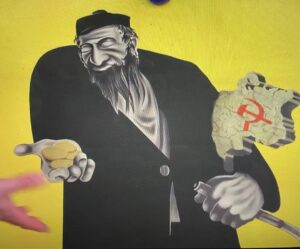
Presented is the only picture that exists of this Eternal Jew movie poster. It was labeled the most famous depiction of a Jew.
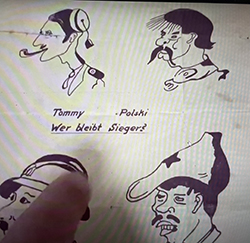
A slide depicting four pigs, Scheller asked where the fifth pig was. When folded in half and put together, it is a depiction of Hitler. The audience was astonished. This was seen as a form of resistance, when looking at the Al Biet Frei, which means “All Will Be Free.” the “B’ is upside down. This is seen as a form of resistance.
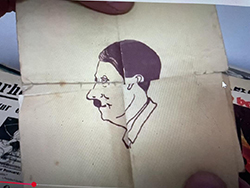
The Poisonous Mushroom was a children’s book. In the small print, it states it is difficult to distinguish between a good mushroom and a poisonous mushroom, to which Jews were equated.
Instead of Ruth: Remember Us, The Holocaust only being an exhibit, the idea of turning this into a permanent museum is an idea for the San Diego community to contemplate. Click here if inclined to donate.
*
Cailin Acosta is the assistant editor of the San Diego Jewish World.