With a Needle & Thread: A Jewish Folktale from Cuba by Jennifer Stempel with illustrations by Libi Axelrod; Moosic, Pennsylvania: Kalaniot Books; © 2025; ISBN 9781962-011068; 32 pages, including glossary and recipe for Ropa Vieja; 19.99.

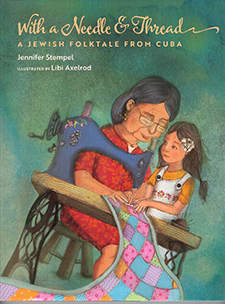 SAN DIEGO – Romi has outgrown her childhood dress. Her arbuelita (grandmother) , the town seamstress in Santiago de Cuba, practices a philosophy of waste not, want not. Materially poor, spiritually rich Jewish Cubans make do with what they have to create what they need, a practice encapsulated by the Spanish idiomatic expression lo que sea.
So, the dress is transformed into a blanket for the brit milah of a neighbor’s newborn baby. When the child doesn’t need it anymore, Romi sews it into a tallit for Manuel’s bar mitzvah. As they grow, Manuel and Romi become engaged to marry. Manuel’s grandfather presents him with a tallit that has been in the family for at least four generations. So Romi converts the tallit into a chuppah.
As a married woman, Romi takes on more and more of arbuelita’s role as a seamstress. When the tablecloth is too small for the growing community, the residents of Santiago de Cuba bring her scraps of material which she adds to the tablecloth to make a colorful covering for the community celebrations.
At the end of the book is a short history of the Jewish community of Cuba, a glossary of such terms used in the story as ke ermoza (how beautiful); m’ija (my dear); ropa vieja (shredded beef in a tomato sauce), and simja (Spanish spelling of simcha). The final page is a recipe for ropa vieja.
Written for children yet informative for adults, this book teaches the value of conserving household items and materials for future, repurposed use; incorporates some Jewish life-cycle events; provides some Spanish-language instruction; and introduces Cuban geography and history. What more can an easily-read children’s book do?
*
Donald H. Harrison is publisher and editor of San Diego Jewish World.