By Cailin Acosta on a visit to El Paso, Texas

I visited the El Paso Holocaust Museum and Study Center in downtown El Paso on Tuesday, Dec. 23. Knowing the subject matter would be solemn and emotionally heavy, I chose to go alone while my family opted for a more upbeat outing.
The El Paso Holocaust Museum was founded in 1984 by Holocaust survivor Henry Kellen. Originally from Lithuania, Kellen and his family were forced into the Kovno Ghetto during the war. After witnessing a Kinderaktion, Henry, his wife Julia, and his nephew Jerry went into hiding with the Urbanos family. They survived the Holocaust and immigrated to El Paso, Texas, in 1946.
The museum began as a one-room display inside the El Paso Jewish Community Center, featuring a small collection of books, posters, and personal memorabilia. Today, the El Paso Holocaust Museum encompasses more than 4,000 square feet of permanent exhibition space. It is one of only 13 free-standing Holocaust museums in the United States and one of just two presented in a fully bilingual format.
The mission of the El Paso Holocaust Museum and Study Center is to teach the history of the Holocaust in order to combat prejudice and intolerance through education, community outreach, and cultural activities.
Education is the heart of the museum. As I walked through the glass doors, the first exhibit depicted Jewish life before the Holocaust. A beautifully staged living room featured Shabbat candles on the table and family photographs on the walls. Before the Holocaust, Jews were largely integrated into society, maintaining close social and business relationships with people of other religions and ethnic backgrounds, despite being targeted by a small but growing minority of racists.
Turning the corner, the tone shifted dramatically. Beginning in 1929, the Great Depression devastated Germany’s economy, leaving one-third of the population unemployed. This instability weakened Germany’s democratic leadership and allowed Adolf Hitler, after becoming Chancellor, to transform the country into a totalitarian police state.
Inside a glass cabinet were Nazi artifacts, including the “Cross of Honor of the German Mother.” These medals were awarded to women for bearing large families: bronze for four or five children, silver for six or seven, and gold for eight or more. The Nazi government even sent congratulatory cards to parents of newborns, reading, “The best gift to our nation is our children – Adolf Hitler.” At the same time, 1.5 million Jewish children were being murdered by the Nazis.
Children throughout Nazi Germany were issued identification cards regardless of age. One card on display belonged to a 10-year-old girl and was stamped with a large red “J” for Jude—Jew.
As I moved through the exhibits, I was confronted by the relentless antisemitic propaganda plastered across Germany, portraying Jews as enemies of the state. Under the Nuremberg Laws, Jews were stripped of their civil rights. Conversion to Christianity offered no protection—if Nazi officials discovered Jewish ancestry, individuals were punished or killed for “lying.” Reading this brought me to tears, imagining the terror of securing false papers in the desperate hope of saving future generations.
Another corner revealed a replica of the aftermath of Kristallnacht—the “Night of Broken Glass” in November 1938. Nazi youth gangs destroyed Jewish homes and businesses, burned synagogues, and looted neighborhoods. More than 300,000 Jewish men were arrested, beaten, and sent to labor camps. Over 100 were murdered, and 20,000 children were left homeless and fatherless. Kristallnacht is widely recognized as the beginning of the Holocaust.
Soon after, Jews were forced into ghettos, which became holding areas before deportation. When Nazi soldiers arrived, families were given mere seconds to pack a single suitcase. A display showed what a family might bring: a child packing a stuffed animal and a book, a mother packing her Shabbat candlesticks and fur coat, and a father packing his kippah and prayer book. These cherished possessions were ultimately confiscated, sorted, sold, or discarded.
Behind me stood a full-size replica of a cattle car. I stepped inside and stood still. Goosebumps ran through me as I imagined the fear, uncertainty, and suffering endured by those crammed inside. We may complain about crowded airplanes, but this level of cruelty and inhumanity is unimaginable and unacceptable.
Walking down the ramp, I encountered the infamous sign Arbeit Macht Frei—“Work Will Set You Free.” I rolled my eyes at the lie. The constant deception inflicted on the Jewish people made me think how impossible it must have been to trust anyone ever again.
Glass cases displayed authentic artifacts donated by survivors and recovered from camps: bullet casings, eyeglasses, shoes, glass bottles, and even a box of human hair. Women’s heads were shaved—sometimes while alive, sometimes after death—and their hair was used to stuff mattresses. Faux “shower heads” were also displayed, representing how prisoners were deceived into believing they were bathing before Nazi guards released Zyklon B gas, leading to horrific deaths.
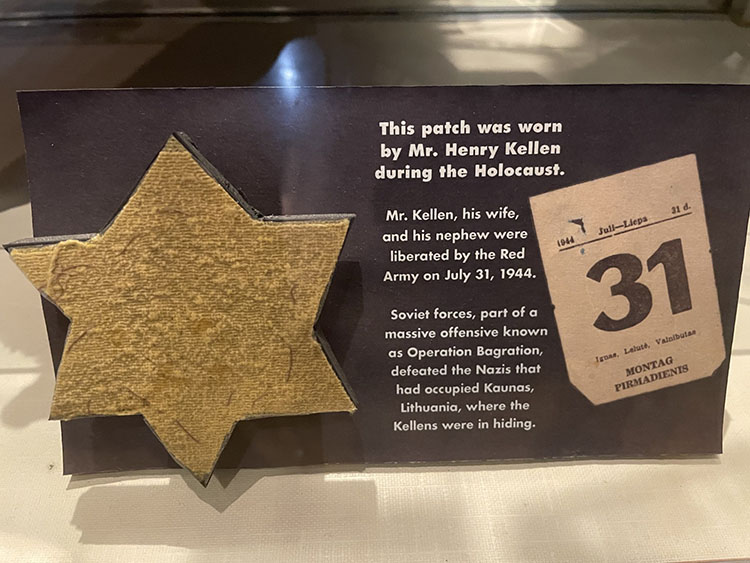
Henry Kellen, his wife, and nephew survived wearing the same clothing and yellow Star of David from 1941 until 1945, when the Kovno Ghetto was liberated by Soviet forces. Those very items were on display.
As I turned another corner, wiping away more tears, I encountered a wall honoring the Righteous Among the Nations—non-Jews who risked and often lost their lives to save Jews during the Holocaust.
Another wall was dedicated to the liberators: American soldiers from Fort Bliss in the El Paso area who helped free prisoners from Nazi camps. An asterisk identified those who were local residents.
The next room honored Holocaust survivors who made El Paso their home after liberation. Among them was Dr. Edith Eger, who now resides in La Jolla, California.
At the end of the exhibition there was a space to remember, reflect, and respond. In Jewish tradition, stones were provided to symbolize placing one on a gravesite in remembrance. I picked up a stone, kissed it, closed my eyes, and thought: “I will never forget. This will not happen again. These stories will not be lost. The younger generations will listen—and they will not be bystanders to hate and discrimination.”
For more information on the El Paso Holocaust Museum and Study Center, click here.
*
Cailin Acosta is the assistant editor of the San Diego Jewish World.
Beautiful, heartfelt story Cailin.