By Alex Gordon in Haifa, Israel

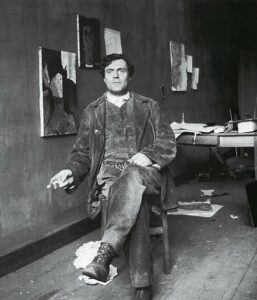
Amedeo Clemente Modigliani, an Italian painter and sculptor, one of the most renowned artists of the late 19th and early 20th centuries, a representative of Expressionism (his second name, Jedidiah, meaning “beloved of God,” was a symbolic name given to him), was born on July 12, 1884, as the fourth and youngest child of Flaminio and Eugenia Modigliani in the port city of Livorno, which became home to a large Jewish community.
His great-great-grandfather on his mother’s side, Solomon Garsen, immigrated to Italy in the 18th century as a refugee. His mother was born and raised in Marseille in a learned Sephardic family and spoke many languages fluently. Her ancestors were scholars of sacred texts and founded a Talmud study school; family legend traces their lineage back to Spinoza.
Amedeo’s father, Flaminio, a native of Rome, was a member of a family of successful entrepreneurs. A mining engineer, he managed the mine and the family’s forest estates. The Modiglianis belonged to the enlightened bourgeoisie and lived as liberal Jews. Amedeo never forgot about his Jewish heritage. Having undergone his bar mitzvah, he became a member of the community and knew Hebrew. But later he did not observe Jewish rituals, as a secular spirit prevailed in their home.
When Amedeo was born, the family business in timber and coal mining went bankrupt. Evgenia contributed to the family’s support as a tutor and translator, writing literary reviews. Deda, as the boy was affectionately called, attended literary tea parties at his grandfather Isaac Garssen’s house, learned French at an early age, which later facilitated his integration in Paris.
Arriving in Paris in 1906, Modigliani encountered public ostracism and antisemitism for the first time in his life, propagated by figures such as journalist and publisher Édouard Drumont, known for his racist views. In Italy, where Modigliani grew up, the attitude toward Jews was much more tolerant, and he was unfamiliar with such ideas. His excellent knowledge of the French language allowed him to integrate into the French cultural environment and move in various circles with greater ease than was available to Jewish artists arriving in Paris from Eastern Europe at that time.
Before moving to Paris, no one referred to Amedeo as a Jew with a contemptuous tone. When he arrived in France, the Dreyfus Affair had finally been closed, but hostility toward Jews persisted. One day, in a restaurant next to Modigliani’s table, a group of antisemites was discussing how poor France was in the hands of people like Dreyfus, and “the Jews need to be expelled.” Amedeo jumped up and shouted, “I am a Jew, and you disgust me!” The antisemites quickly changed the subject and left.
The Soviet writer of Jewish descent, Ilya Ehrenburg, who lived in France for a long time, recalled how Modigliani once confronted a card player who had made an offensive remark about Judaism: “Shut your mouth! I am a Jew, and I can talk to you. Do you understand?” The card players fell silent, and the artist bitterly turned to his friend: “It’s a shame that you smear the brush, because for another three hundred years you’ll have to beat the face.”
The British sculptor Jacob Epstein wrote in his memoirs: “Modigliani was very proud of his roots and insisted with fervor that Rembrandt was also a Jew. Proof of this, according to Modigliani, was the “deepest humanism” of this artist.” When meeting someone, he would demonstratively introduce himself: “Hello, I am Modigliani, a Jew.” His close circle included many people of Jewish descent. Among them were artists from Belarus: Chaim Soutine, Ossip Zadkine, Mikhail Kikoine, and Abram Manewich; sculptors Jacques Lipchitz from Lithuania and Hanna Orlova from Ukraine; and portraitists Moïse Kisling from Poland and Jules Pascin from Bulgaria. Modigliani painted them, mentored them, and helped them.
He was close to Marc Chagall, the Cubist David Sterenberg, the sculptor Jacob Epstein, and was friends with writers Ilya Ehrenburg, Max Jacob, and Leon Indelbaum.
Encountering antisemitism not only prompted Modigliani to reflect on his own identity but also sparked his interest in other traditions in visual art created outside of Western Europe—ancient Greek, ancient Egyptian, and African. The influence of African masks affected his penchant for exaggeratedly elongated faces and necks, which became a distinctive feature of his painting. The mask became an important symbol of this enigmatic concept of identity, a metaphor for Modigliani’s ability to assimilate in France, where he remained a stranger.
In one of Modigliani’s most famous works, “The Jewess,” an oil portrait on canvas (1908), the artist expressed his Jewish identity and the state of mind of Jews in France at that time: the noble, stern features of the lady, who cannot relax from the premonition of trouble, reveal restraint and vigilance, a proud and aloof gaze. In the portrait of Soutine (1916), the fingers of the right hand are spread apart, like a Cohen’s during a blessing. Modigliani parodied the blatant caricature with which the French press depicted Jews, Africans, and other foreign ethnic types. He depicted alienness.
Modigliani died in Paris on January 24, 1920, from tuberculous meningitis. He always remained an outsider and a loner in painting, depicting people in an unusual style, outsiders with elongated proportions, “empty” eyes, and mask-like faces. His portraits express the deep alienation and otherness that he himself felt. He did not live to see fame, did not witness his works being sold for hundreds of millions of dollars. He didn’t know he would become a classic. He became one of the most recognizable artists of the 20th century.
*
Alex Gordon is professor emeritus of physics at the University of Haifa and at Oranim, the Academic College of Education, and the author of 12 books.