New Russia: Images from a Journey by I.J. Singer, translated by Joshua A. Fogel in 2026; Toby Press; ISBN 9781592-647415; 224 pages; $19.95.
By Rabbi Dr. Israel Drazin in Pikesville, Maryland

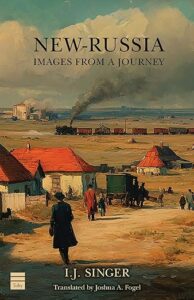 This book by I. J. Singer was translated by Joshua A. Fogel in 2026. Israel Joshua Singer was a Polish-Jewish novelist who wrote in Yiddish. He was born on November 30, 1893 and died on February 10, 1944, at age 50 in New York, NY.
He was the brother of Nobel Prize Winner Isaac Bashevis Singer (1902-1991, died at age 88). He is the author of books such as Yoshe Kalb (1932), The Brothers Ashkenazi (1936), and The Family Carnovsky (1943), all of which are still enjoyed today.
Both Israel Joshua Singer and Isaac Bashevis Singer were major, well-liked Yiddish writers, but their writing styles, themes, and outlooks differ. While they shared a Jewish and Polish cultural background and the Yiddish language, their approaches to storytelling and to the interpretation of Jewish life diverged significantly.
I. J. Singer wrote serious novels that often resemble European realist literature. His novels depict Jewish communities within the larger political and economic systems. He explored class struggles, industrialization, and the collapse of traditional society. His works often portray an entire community or generations, showing how history shapes Jewish life. Religion appears in his works largely as a social force rather than a mystical or theological influence.
His younger brother, Isaac Bashevis Singer, wrote in a psychological and often mystical style. His stories focus on personal problems and conflicts. Ghosts, demons, dybbuks, and other spiritual beings frequently appear, along with questions of life and purpose, reflecting Hasidic folklore and Jewish mystical traditions. His characters wrestle with desire, guilt, faith, and temptation. He often added irony and dark humor.
While his brother wrote many novels, he himself became famous for his short stories and books such as The Magician of Lublin, Gimpel the Fool, and The Slave.
In late 1926 and early 1927, I. J. Singer traveled on an assignment by the Yiddish newspaper Forverts through Soviet Russia. He visited many cities in the Russian, Ukrainian, Belarusian, and Crimean Republics. Being keen of mind, he became deeply acquainted with the countries, cultures, history, and people. He reveals much of this in 34 chapters that read like a fascinating novel, filled with delightful short stories about Jews and non-Jews and featuring many characters.
New-Russia: Images from a Journey offers remarkable snapshots of the Soviet Union during a brief but revealing historical moment. The book captures the Soviet experiment as it was still taking shape. Although seemingly simple travel impressions, the work reads as a deeper novel: a perceptive and unsettling portrait of a society already showing signs of the authoritarianism that would later define the tragic era of Joseph Stalin.
Singer approaches the Soviet Union not as a tourist but as a journalist with a keen eye for contradiction. His sketches of cities, institutions, and everyday encounters are vivid. The narrative style reflects his background as a novelist and as a reportage writer: brisk, observant, and anecdotal. Yet beneath these travel snapshots lies a probing analysis of the revolutionary state. Singer notices not only the enthusiasm of the new order but also the growing bureaucratic machinery, the omnipresent surveillance, and the gradual erosion of hopeful revolutionary ideals.
The translation by Joshua A. Fogel is clear and accessible.
Here we see I. J. Singer is crafting elaborate narratives recording history in spiraling motion. His descriptions, written “in a moment,” as he himself admits, nevertheless acquire lasting significance because they capture a society shifting at a critical crossroads.
*
Rabbi Dr. Israel Drazin is a retired brigadier general in the U.S. Army Chaplain Corps. He is the author of 67 books.