By Jerry Klinger in Boynton Beach, Florida

Donald Schneider was 19 years old when he mysteriously died by “accident.” Schneider had enlisted in the Royal Merchant Marine Service in 1943. He was assigned to the pre-war luxury liner, the Isle de France, ferrying troops from North America to the United Kingdom.
The ship had been converted for dual-purpose use under the British Admiralty. The ship was a troop transport to the United Kingdom and a prisoner-of-war prison ship, ferrying War prisoners to Canada. Schneider had completed several transatlantic crossings.
On February 6, 1944, he worked as a coal trimmer. The ship was underway. His job was to physically transfer coal from the coal bunkers to the ship’s boilers. It was especially important to pay attention to the coal bunker’s displacement. The trim of the ship was dependent upon that.
Being a trimmer was a hard, physical job given only to those who were strong enough or disliked enough to have to do it.
Something happened… Schneider’s skull was laterally crushed by a heavy object. Though very near their port of destination, Halifax, Nova Scotia, Schneider was hurriedly buried at sea. The body could have been brought to Halifax, only a few days’ sail away. His remains could have been returned to his parents for Jewish burial in the United Kingdom.
A possible reason for the sea burial is that, once the ship had docked in Halifax, an inquest would have been required as to the exact cause of his death. A sea burial is logged in; no remains would have been available for examination.
Halifax port records log that the Isle de France was turned around extremely fast. She was back at sea by February 14, heading to Greenock, Scotland. She carried over 12,000 tons of munitions, war supplies, and the later famous American 814th Tank Destroyer Battalion.
Schneider’s family was coldly notified by telegram of his death and the sea burial. They were extremely poor Orthodox Eastern European Jewish immigrants living in Whitechapel. Daniel’s father, Sidney, eked out a living as a common laborer. They had no funds for a memorial for him. When the parents passed years later, their remaining sons gave them a dignified burial with an expensive interpretive headstone. They did not remember their lost brother, Donald.
The Commonwealth War Graves Commission refused to have a War memorial or a cemetery token for Schneider. They said he died by accident and not in action. He was not entitled to an official British Governmental honor.
The British Jewish community thought otherwise. Schneider is memorialized in British Jewry’s War Dead Book – We Will Remember Them.
The Jewish American Society for Historic Preservation (JASHP) was approached by Martin Sugarman, the archivist for the (British) Association of Jewish Ex-Servicemen and Women (AJEX). Sugarman asked if we would fund a token stone memorial for Donald Schneider. JASHP agreed.
All those who served in the War against Nazism, in whatever capacity, are entitled to respectful memory.
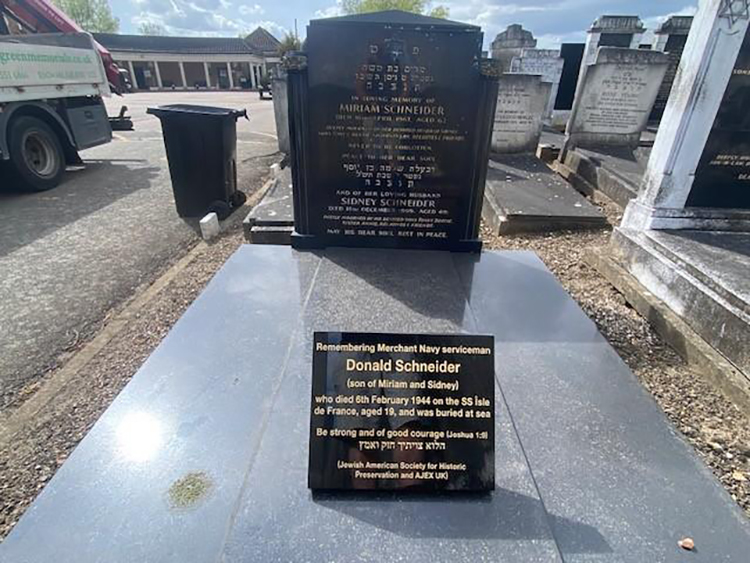
The token memorial was fabricated by a Jewish stonemason. It was sited on the grave cover plate of Schneider’s parents. Symbolically, and all who pass by can see, they are united again.
What happened to 19-year-old Daniel Schneider? Was his death an accident? Was he murdered? Was antisemitism a factor? The records of Schneider’s death from the Isle de France were destroyed in a Nazi bombing attack on London. Only an informational index card about Schneider survived the War.
What happened is buried in the deep, dark Sea known only by God.
The text of the memorial token:
Remembering Merchant Navy serviceman
Donald Schneider
(son of Miriam and Sidney)
who died 6th February 1944 on the SS Isוe de France, aged 19, and was buried at sea
Be strong and of good courage {Joshua 1:9)
הלוא צויתיך חזק ואמץ
{Jewish American Society for Historic Preservation and AJEX UK}
*
Jerry Klinger is the President of the Jewish American Society for Historic Preservation.