By Cailin Acosta in San Diego, California

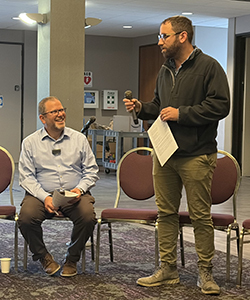
“Jewish Sources of Hope in Israel and Beyond” was the topic of discussion Tuesday afternoon as Rabbi Leon Morris, president of the Pardes Institute of Jewish Studies in Israel, spoke to participants at Tifereth Israel Synagogue.
In a time when hope can feel difficult to find or believe in, Morris reflected on the Siddur passage, “As for us, we know not what to do; but our eyes are upon You.”
He described the passage as looking to G-d for answers and guidance. After Oct. 7, hope was difficult to hold onto, and many struggled to place faith in G-d while everything seemed to be in turmoil. Many turned to prayer, asking for answers.
Hope was also explored through II Chronicles 20:1, which describes how the Moabites, Ammonites and others came against Jehoshaphat to wage war. Morris explained that the passage mirrors the recurring experience of the Jewish people facing threats from surrounding enemies, similar to the atmosphere following Oct. 7, and again asking: What do we do now?
Morris then described hope through the image of an axis plane. On the x-axis is how much a person desires something, while the y-axis measures how likely it is to happen. When both desire and likelihood are high, hope is more easily sustained. However, when desire is high and likelihood appears low, Morris called this “optimal hope.”
He referenced Oded Leshem’s “Hope Amidst Conflict: Philosophical and Psychological Explorations,” which states:
“The central premise of optimal hope is that our desires and expectations should be considered separately lest they influence one another in harmful ways. In extreme conditions (like malign diseases or intractable conflict), optimal hope means that we can decrease our expectations but keep our hopes propelled by our desires.”
Morris explained that optimal hope allows people to continue striving even when success seems unlikely. Rather than being driven only by expectations of fulfillment, optimal hope is fueled by wishes, aspirations and determination.
The discussion then turned to how hope is reflected in Jewish living. Morris referenced Shabbat 31a:11, in which Rava teaches that after departing from this world, a person is asked several questions, including: “Did you await salvation?”
Morris said this demonstrates that Jewish life calls on people to live each day with hope for redemption, acting in ways that reflect a more redeemed world while awaiting Moshiach.
Hope can also be found in the blue thread of the tzitzit. Morris cited Chullin 88b:12, where Rabbi Meir explains that the sky-blue dye resembles the sea, which resembles the sky, which resembles the sapphire stone beneath the Throne of Glory.
Morris then shared Rabbi David Lerner’s interpretation of the blue cord:
“The tallit and tzitzit with its blue cord pull us into another experience. They bring G-d’s presence into the moment and help us see beyond, see and feel something deeper, something eternal.”
According to Lerner, the blue tzitzit lift people’s eyes heavenward, helping inspire kindness, connection and hope.
Another perspective came from the CCAR Centenary Perspective, which states:
“The existence of the Jew is an argument against despair; Jewish survival is warrant for human hope.”
Morris emphasized that even the continued existence of a single Jew represents hope for survival and continuity.
He also referenced theologian Eugene Borowitz, who wrote that Jewish hope is deeply connected to G-d’s role in history and the destiny of the Jewish people, particularly the State of Israel.
Borowitz reflected on the aftermath of the Six-Day War in 1967, writing:
“Thus, in one incredible week we reclaimed two strands of our old Jewish hope: we saw G-d save our people Israel; and we recognized personally how our individual being was tied to our Covenant folk.”
Morris explained that these moments helped reconnect personal faith with communal Jewish experience and restored a sense of covenantal hope.
In closing, Morris reminded attendees that hope has remained part of Jewish history throughout generations. He said Jewish tradition teaches a balance of trust, faith and perseverance, even during periods of uncertainty.
“Hope,” he said, “will continue to be an emotion and longing for decades to come as we face changes in the world and continue looking to G-d for answers.”
Click here to learn more about The Pardes Institute of Jewish Studies.
*
Cailin Acosta is the assistant editor of the San Diego Jewish World.