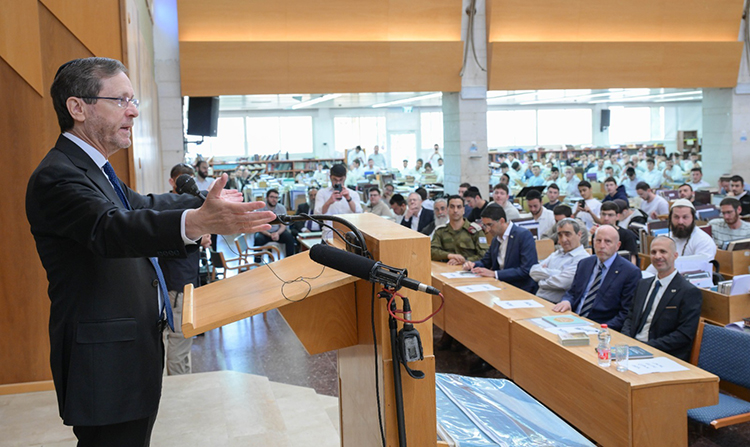
JERUSALEM, Israel (Press Release)— President of the State of Israel Isaac Herzog last Wednesday visited the Jerusalem College of Technology (JCT), where he met with faculty and students and even took part in a traditional chavruta (study session with a partner) in the institution’s Beit Midrash.
During the visit, President Herzog expressed deep appreciation for the integration of Torah and academic studies. He noted that the land on which the JCT campus stands was developed with the involvement of his father, former President of the State of Israel Chaim Herzog, and his mother, Aura Herzog. He also shared that he personally knew the founder of JCT Prof. Ze’ev Lev and his son Nahum, who served in the elite Sayeret Matkal unit of the Israel Defense Forces and was tragically killed in a car accident.
“Prof. Lev was a remarkable figure,” President Herzog said. “The unique integration that JCT represents—between Torah and science—is a tremendous asset for the State of Israel, especially in a time of division.”
At the Beit Midrash, President Herzog was joined by JCT students as well as institutional leaders including Rector Prof. Dan Buchnik, CEO Roi Ohev Zion, heads of the Beit Midrash Rabbi Yosef Zvi Rimon and Rabbi Amnon Hadari, Chairman of the Executive Committee Stuart Hershkowitz, and Chairman of the Board of Trustees Dov Rubin.
“We present a uniquely Israeli model that integrates Torah and science, academic excellence, and a strong values-based identity,” Ohev Zion said. “Within a framework that respects a religious way of life, many Haredi young men and women find here a natural home for entering academia and meaningful careers—without compromising their identity, lifestyle, or values.”
JCT is home to approximately 4,500 religious and Haredi students pursuing undergraduate and graduate degrees in engineering, management, life sciences, and health professions, as well as preparatory programs. The institution offers a unique academic framework that combines top-tier academic studies with Torah learning, aimed at cultivating values-driven leadership that contributes to shaping Israeli society and industry. The College’s graduates hold key positions in the IDF and Ministry of Defense; the defense sector; and across Israel’s civilian industries in high-tech, management, and healthcare.
“The Beit Midrash here brings together Haredi and religious communities, immigrants and native-born Israelis, and connects Torah with science,” Rabbi Rimon told President Herzog. He added that, as someone engaged in the intersection of Torah and science, he is well-acquainted with the teachings of President Herzog’s grandfather, Rabbi Yitzhak HaLevi Herzog, who served as the first Chief Rabbi of Israel and previously as Chief Rabbi of Ireland.
President Herzog responded emotionally, sharing that his grandfather wrote his doctoral dissertation on the biblical dyes tekhelet and argaman, which were used in the High Priest’s garments in the Tabernacle and the Temple.
“He was a man who bridged Torah and science, and taught me that one can study Torah and also be a great scientist,” President Herzog said of his grandfather.
The president also noted that he had just returned from a trip to Kazakhstan, where there is strong and ongoing interest in Israeli technology.
“We must continue to invest in strengthening both our spiritual foundations and our scientific capabilities for the future resilience of the State of Israel,” he said.
As part of the visit to JCT, President Herzog met with approximately 120 students and faculty members and answered their questions on a range of topics. Meir Krombi, a Haredi student in a military academic program in computer science, asked, “As someone who will soon serve as an officer in a mixed technological unit, what is the most important thing I should know?”
President Herzog replied, “I believe there has been a significant shift in Israeli society, across all its segments, toward respecting different lifestyles and beliefs. Despite the differences, today’s environment is more accommodating and respectful of individual dignity and faith. You will find that your unit respects you deeply and may even admire you. There is a strong desire within the IDF to integrate members of the Haredi community while ensuring adherence to guidelines developed in coordination with rabbinic leadership. You also have a mission—to share your story, to explain your way of life, and to show that it can be preserved with confidence.”
Dr. Haya Libeskind, a lecturer and researcher in computer science and a Haredi mother of eight, shared her research with the president. Her work focuses on detecting harmful discourse on social media in Hebrew and Arabic.
“I appreciate the President’s Residence initiative ‘Time to Talk,’ which promotes respectful dialogue in Israeli society,” she said, asking how its spirit could be expanded to social media by combining technological solutions with education, public responsibility, and agreed-upon standards for respectful discourse.
The president invited her to participate in a major conference next month, hosted by the Office of the President, which will address ways to ease tensions and promote respectful dialogue across Israeli society. Referring to recent incidents of violence, he said, “Today more than ever, the powerful teaching of Rabbi Akiva is clear: ‘Love your neighbor as yourself—this is a great principle of the Torah.’ The violence and aggression we have seen in recent days are deeply troubling and lead to terrible tragedies.”
At the conclusion of the visit, Ohev Zion thanked the president and presented him with a personalized 3D portrait created at the Schreiber LevTech Entrepreneurship Center.
“For decades, JCT has operated from a clear worldview: a deep integration between Torah and science, between academic excellence and values, identity, and social responsibility,” Ohev Zion said. “We are not seeking to blur identities or compromise between them, but rather to establish a uniquely Israeli model in which religious commitment and academic-scientific excellence move forward together. Precisely because of the College’s religious-Zionist identity and its respect for a Torah-based lifestyle, many Haredi young men and women find at JCT a natural and secure path into higher education and meaningful careers in leading sectors of the economy—without giving up who they are. This model, which combines Torah, science, excellence, and social engagement, is a cornerstone in strengthening Israel’s social and economic resilience, especially in these complex times.”
Preceding provided by the Jerusalem College of Technology