By Cailin Acosta in El Cajon, California

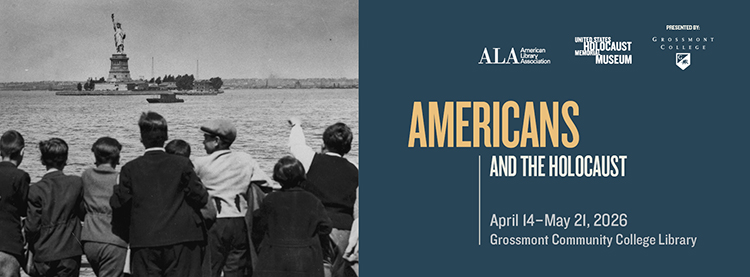
Important questions about morality, responsibility, and public awareness are at the center of the “Americans and the Holocaust” exhibit at Grossmont College.
The exhibit explores what Americans knew about the Holocaust during the rise of Nazi Germany and World War II, and what more could have been done to help Europe’s Jews. It examines the motives, fears, political pressures, and public opinions that shaped the American response to Nazism, war, and genocide.
Holocaust history raises difficult questions about what the international community, including the United States, could have done to stop the rise of Nazism and the persecution of Jews across Europe. By the time Nazi Germany forced the world into war, democratic civilization itself was at stake. The United States military fought for nearly four years to defend democracy, and more than 400,000 Americans died in the war effort. Although American soldiers and civilians made enormous sacrifices to defeat Nazi oppression, rescuing Jews and other groups targeted for extermination never became a central priority.
The exhibit explains that while the United States alone could not have prevented the Holocaust, more could have been done to save some of the six million Jews murdered by the Nazi regime and its collaborators.
Nazism in the News
Popular American newspapers and magazines reported frequently on Adolf Hitler and Nazi Germany throughout the 1930s, including stories about discrimination and violence against Jews. Some journalists questioned whether Hitler would remain in power, while others warned that his ambitions posed a serious danger, particularly to Jewish communities.
Still, most Americans could not have imagined that the persecution would eventually escalate into systematic mass murder beginning in 1941.
The 1936 Olympic Debate
As the 1936 Olympic Games in Berlin approached, Americans debated whether the United States should boycott the event in protest of Nazi discrimination against Jews and other minorities.
The African American newspaper. New York Amsterdam News, encouraged athletes, including track star Jesse Owens, to boycott the games. Some Black athletes, however, resisted the pressure, pointing out the hypocrisy of condemning discrimination in Germany while segregation continued in the United States.
Many athletes hoped their victories would challenge Nazi claims of Aryan racial superiority.
Eighteen African American athletes represented the United States and dominated the track and field events. Their achievements abroad, however, did little to change racial discrimination at home.
Kristallnacht Shocks Americans
On the night of Nov. 9–10, 1938, Nazi officials carried out violent attacks against Jews across Germany and Austria. Synagogues were destroyed, Jewish-owned businesses were vandalized, and nearly 30,000 Jewish men were arrested and sent to concentration camps, where many suffered brutal abuse.
The attacks became known as Kristallnacht, or the “Night of Broken Glass.”
American newspapers covered the violence prominently, yet despite widespread public disapproval of Nazi actions, opinion polls showed that most Americans still opposed admitting larger numbers of Jewish refugees into the United States.
Reporting on Mass Murder
American newspapers and magazines eventually published reports about the mass murder of Jews occurring across Europe. Although there was limited photographic evidence available at the time, information about deportations and killing centers reached the American public during World War II.
Even so, many Americans focused primarily on daily wartime developments rather than reports about genocide.
In April 1945, as Allied troops liberated concentration camps, journalists began reporting directly from the sites. For many Americans, it was the first time they saw visual evidence of the Holocaust.
Obstacles to Immigration
The exhibit also details the barriers Jewish refugees faced when trying to escape Nazi-controlled territories.
Immigrants seeking entry into the United States had to prove they would not become a financial burden and often needed American sponsors willing to support them.
The Immigration Act of 1924 severely restricted immigration through national quotas that favored northern and western Europeans while limiting immigrants from southern and eastern Europe, including many Jews.
Although historians estimate that between 180,000 and 220,000 European refugees received visas between 1933 and 1945, the exhibit notes that the United States could have admitted tens of thousands more people under existing laws.
The Wagner-Rogers Bill
In 1939, Senator Robert Wagner of New York and Representative Edith Nourse Rogers of Massachusetts proposed admitting 20,000 German refugee children into the United States over a two-year period.
The children would not have counted against existing immigration quotas. Despite the proposal, the Wagner-Rogers Bill never reached the floor of Congress for a vote.
America Debates War
Following Germany’s invasion of Poland in 1939, Americans debated whether the United States should enter the war.
The isolationist America First Committee opposed American involvement, while interventionists supported President Franklin D. Roosevelt’s efforts to aid Great Britain and prepare the nation for war.
After Japan attacked Pearl Harbor on Dec. 7, 1941, the United States officially entered World War II.
The exhibit also addresses the forced relocation and incarceration of more than 110,000 Japanese Americans during the war, noting that public opinion polls at the time showed overwhelming support for the policy.
Mass Murder Confirmed
By late 1942, news about the Nazi regime’s “Final Solution” had reached the United States.
The exhibit highlights the efforts of writer Ben Hecht and activist Peter Bergson, who organized the 1943 pageant “We Will Never Die” to raise awareness about the genocide taking place in Europe.
It also discusses the creation of the War Refugee Board in 1944 after Treasury Department officials informed President Roosevelt that reports about the murder of Jews had been suppressed.
The board ultimately helped rescue and assist hundreds of thousands of people targeted by Nazi persecution.
Reflection and Discussion
At the end of the exhibit, visitors entered a Reflection Room where they were encouraged to consider the difficult moral and political questions raised throughout the display.
One prompt asked whether Americans in 1943 were justified in doubting reports of mass murder.
Another asked whether the United States should have participated in the 1936 Berlin Olympics.
Visitors shared a range of responses.
One reflection card read: “The numbers are so huge. It is hard to comprehend humanity can do such a thing to other humans.”
Another compared the dehumanization of Jews during the Holocaust to modern debates surrounding immigration policy.
The exhibit ultimately challenges visitors to reflect not only on the past, but also on the responsibilities individuals and governments hold when confronting hatred, discrimination, and human suffering.
Click here for more information on the exhibit that will be on display until Thursday, May 21 at the Grossmont Community College Library.
*
Cailin Acosta is the assistant editor of the San Diego Jewish World.
Thank you for an informative article. I heard that Grossmont College was one of the few colleges that did this exhibit. Good for them.