By Eileen Wingard in San Diego

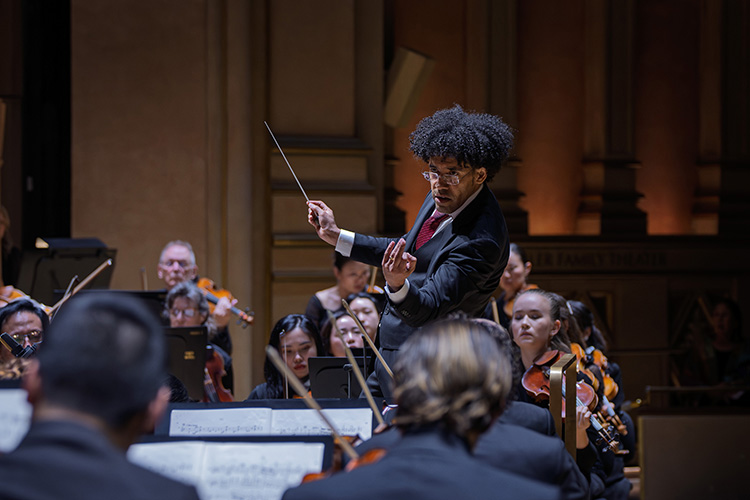
An exciting rendition of Beethoven’s Leonore Overture #3 opened the May 10 matinee concert of the San Diego Symphony Orchestra with Raphael Payare leading his forces with exuberant energy.
Noteworthy were the beautifully executed offstage trumpet calls in the middle of the development, played by the Principal Trumpet Chris Smith from two different sides, and the final sequence of rapidly ascending scales, begun by the first stand of first violins and joined by other strings and finally, the entire orchestra, for a brilliant climax.
Next on the program was the four-movement cello concerto, Dzonot, composed in 2023 by the Mexican composer, Gabriela Ortiz, and dedicated to the performer, Alisa Weilerstein. Dzoznot and Ortiz won the 2026 Grammy Award for Best Contemporary Classical Composition.
Dzonot is the Mayan word for “abyss” and denotes the underground rivers in caves in the Yucatan peninsula, regarded as sacred places where gods and spirits reside. This programmatic music was in four movements, Luz vertical (Vertical light), El Ojo del Jaguar (The Eye of the Jaguar), Jade (Jade), and El vuelo de Toh (The Flight of the Toh).
The concerto demonstrated the composer’s acquaintance with the remarkable technique of the soloist and with all the possible ways of playing the cello. The first movement opened with glissandi (slides) on the A string, resting on notes up and down the string, reflecting light on the moving water. The second movement had the soloist playing col legno, tapping the stick of the bow on the strings to make the sound. The violas answered with col legno passages. Pizzicatos were also used extensively. The third movement had beautiful interchanges between the cello and the harp and the fourth movement, through harmonics, evoked the chirping of birds and their rapid flight. It had wild passages where the cello and orchestra reached heights of frenzy, only to end softy.
The concerto was commissioned by the Los Angeles Philharmonic Orchestra and Alisa Weilerstein premiered it with that orchestra under their conductor, Gustavo Dudamel. Dudamel has been a champion of Gabriel Ortiz’ music and this is the seventh commission awarded her by his orchestra. Alisa Weilerstein’s performance reinforced her reputation as one of the world’s great cello virtuosi.
After intermission, the San Diego Symphony Orchestra gave a heroic rendition of Sergei Prokofiev’s Fifth Symphony. Its premiere performance in Moscow, under Prokofiev, was given as sounds were heard heralding the end of World War II with the Russian forces turning back the Nazi army. Prokofiev conceived of the work as mirroring “the grandeur of the human spirit.”
The first movement, Andante, begins innocently, with two flutes and bassoon, gathering momentum as other themes are introduced and moving to an ominous ending.
The second movement, Allegro marcato, is a Scherzo in ¾, with a repeated beat throughout the opening and closing sections and ample use of piano, tambourine, woodblock and snare drum.
The third movement, Adagio, was music of mourning, The concluding section was particularly beautiful as it drew to a sad, soft conclusion.
The final movement, Allegro giocoso, in rondo form, had a reoccurring jocular theme. One could almost hear laughter in the gaiety of the music. Themes from earlier movements were reintroduced and the movement ended in a loud burst of joyous sound.
The large audience rose in admiration of the San Diego Symphony Orchestra’s performance of this popular Russian symphony under its exciting conductor, Rafael Payare.
*
Eileen Wingard, a retired violinist with the San Diego Symphony Orchestra, is a freelance writer specializing in coverage of the arts.