By Alex Gordon in Haifa, Israel

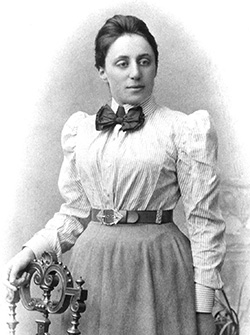
The famous 19th-century mathematician Carl Weierstrass wrote: “One cannot be a true mathematician without being a bit of a poet.” The famous mathematician and professor at the University of Göttingen, David Hilbert, wrote: “He became a poet—he lacked the imagination to be a mathematician.” Both mathematicians were German men and had no idea that, in addition to poetry, the mathematical research requires a struggle against the harsh prose of life, against the significant barriers standing in the way of a Jewish woman’s path to advanced mathematics.
Weierstrass and Hilbert’s compatriot and colleague, Emmy Nöther (1882–1935), had these two inherent disadvantages: she was Jewish and a woman. After her death, Albert Einstein wrote: “Fräulein Nöther was the most significant creative mathematical genius thus far produced since the higher education of women began.”
It turns out that you don’t have to be a poet to become an outstanding mathematician. It is enough to be born into and raised by a family of mathematicians. Emmy Nöther was no poet. She was the daughter of the famous mathematician Max Nöther and had a brother, Fritz Nöther, who was also a mathematician; his unpoetic fate remained unknown to her.
Nöther was born into a Jewish family in the Franconian city of Erlangen. Her parents, the mathematician Max Nöther and Ida Amalia Kaufmann, came from wealthy merchant families. Since Emmy was Jewish, during religion class at school, she would go to the rabbi. She had three brothers: Alfred, Robert, and Fritz, a German and Soviet mathematician.
Emmy began studying mathematics at the University of Erlangen, where her father lectured. She was one of the first women admitted to higher education in Bavaria in 1903. After defending her dissertation in 1907, written under the supervision of the renowned mathematician of Jewish descent Paul Gordan, she worked at the University of Erlangen’s Mathematical Institute without pay for seven years. At that time, it was practically impossible for a woman to hold an academic position.
In 1915, Nöther moved to Göttingen, where the renowned mathematicians David Hilbert and Felix Klein were working at the university. Hilbert tried to secure Nöther a position as a Privatdozent at the University of Göttingen, but all his efforts failed due to the professors’ prejudices. Nöther, however, although holding no official position, is often lectured instead of Hilbert. It was only after the end of World War I that she was able to become a Privatdozent—in 1919—and later an adjunct professor (1922).
During the early period of her scientific career (1908–1919), Nöther developed the theory of invariants and number fields. Her theorem on differential invariants in the calculus of variations, Nöther’s theorem, has been called “one of the most important mathematical theorems used in modern physics.” Nöther’s theorem states that every symmetry of action for a physical system with conservative forces corresponds to a conservation law.
As one of the greatest mathematicians of the twentieth century, she radically transformed the theory of rings, fields, and algebras: in her second period (1920–1926), she undertook work that “changed the face of [abstract] algebra.” In her classic work Idealtheorie in Ringbereichen (Theory of Ideals in Rings, 1921), Nöther developed a theory of ideals in commutative rings suitable for a wide range of applications.
As a woman and a Jew, she faced significant obstacles in her academic work. A debate arose among the male faculty members at the University of Göttingen over whether a woman could attend meetings of the university’s academic council. Hilbert settled the dispute. He casually remarked, “Is the academic council a bathhouse that women aren’t allowed in?”
Edmund Landau, a professor at the University of Göttingen, is credited with this remark about Nöther: “I can believe in her mathematical genius, but I cannot swear that she is a woman.” Emmy had a manly appearance and did not give much thought to her appearance, especially during classes or academic debates. According to eyewitness accounts, she would forget to style her hair, iron her dress, or chew her food thoroughly, and she displayed many other traits that made her seem not very feminine in the eyes of her proper German compatriots.
Emmy suffered from severe nearsightedness, which is why she wore glasses with thick lenses and looked like an owl. She wore dresses without any embellishments or embroidery and kept her hair cut short. She preferred sturdy men’s shoes for long walks and a wide-brimmed hat that could protect her from the rain. A large leather bag hung over her shoulder, stuffed with notebooks and notes. Contrary to the opinion of Weierstrass and Hilbert, Nöther was not a poet.
In his book I Am a Mathematician (1956), the American mathematician Norbert Wiener wrote the following about her: “Already on the train to Lucerne, and later to Zurich, I began to meet members of the illustrious cohort of mathematicians. Among them was Emmy Nöther —our old friend from the time of our trip to Göttingen and, probably, the most talented of all known female mathematicians. As always, she looked outwardly like a very energetic and very nearsighted laundress; in reality, she was an exceptionally warm person—no wonder her numerous students followed her around like newly hatched chicks following a mother hen.” Her femininity manifested itself in her touching care for her students and her constant readiness to help them and her colleagues.
Nöther held social democratic views. For ten years she collaborated with mathematicians in the USSR. After the Nazis came to power in 1933, Jews were removed from teaching positions at the University of Göttingen. Her main Soviet colleague, Pavel Alexandrov, tried to secure her a position at Moscow State University, but it did not work out—Soviet officials deemed her insufficiently valuable, and she moved to America, from where she repeatedly attempted to return to the Soviet Union. In the U.S., she became a professor at Bryn Mawr College in Pennsylvania, where she taught until her death on April 14, 1935, at the age of 53.
She never found out what became of her younger brother Fritz, whom Soviet officials had taken a liking to, granting him permission to immigrate to the Soviet Union.
On September 5, 1935, Pavel Alexandrov, president of the Moscow Mathematical Society, wrote: “The death of Emmy Nöther is not only a great loss for mathematical science, but also a tragedy in the full sense of the word. The greatest woman mathematician who ever lived died at the very height of her creative powers; she died, driven from her homeland and torn from the scientific school which she had created over the years and which had become one of the most brilliant schools of mathematics in Europe; she died, torn from her family, which had been scattered to different countries because of the same political barbarism that caused Emmy Nöther herself to emigrate from Germany.”
Fritz Nöther was two years younger than his sister. He graduated from a humanities-focused secondary school, studied mathematics at the University of Erlangen—where his father taught—and earned his doctorate from the University of Munich in March 1909.
During World War I, Fritz fought on the German-French front and was awarded the Iron Cross. After being wounded, he was assigned to work on ballistics. In late 1922, he took up a position as professor of theoretical physics and applied mathematics at the Technical University in Breslau, where he worked until 1934, when he was forced to resign for “racial reasons.” Emmy took a short leave of absence and returned to Nazi Germany to accompany her brother Fritz to Soviet Russia—thanks to the patronage of mathematician Pavel Alexandrov, he was accepted into the Department of Applied Mathematics at Tomsk University. She was not afraid to find herself back in Nazi Germany.
Like his sister, Fritz was a Social Democrat. While in Germany, he was a member of the Social Democratic Party and was included in 1940 on the lists compiled by the Nazi Reich Security Main Office of those to be arrested immediately upon the occupation of the Soviet Union. On September 1, 1934, Fritz became a professor at Tomsk University. In April 1935, he traveled to Germany to visit his family. There he learned of the death of his sister Emmy in America.
In September 1935, Nöther traveled to Moscow, where he attended a session of the Moscow Mathematical Society dedicated to the memory of his sister. By a resolution of the Higher Attestation Commission dated February 1, 1936, he was awarded the degree of Doctor of Physical and Mathematical Sciences without defending a dissertation.
On September 22, 1937, Nöther was arrested. On October 23, 1938, a visiting panel of the Military Collegium of the Supreme Court of the USSR sentenced him, in a closed-door hearing, to 25 years in prison with confiscation of his property. In April 1938, Albert Einstein sent a letter to the People’s Commissar of Foreign Affairs of the USSR, the Jewish Maxim Litvinov, in defense of the arrested mathematician. Einstein vouched for his impeccable reputation and requested a fair investigation. But on September 8, 1941, the Soviet judiciary sentenced the Jewish mathematician Nöther to death for spying on behalf of Nazi Germany.
On September 10, 1941, Professor Fritz Nöther was shot in a prison in the city of Orel, three weeks before the Nazis captured the city. Had he not been shot then, the Nazis who occupied Orel would have killed him for belonging to the Social Democratic Party of Germany. They knew perfectly well that he had not spied on them but was their enemy. And the Soviet communists shot him, a Jew, for spying for Nazi Germany. Like his sister, Noether was not a poet. He was a victim of life’s harsh prose, persecuted as a Jew and a socialist and murdered by “socialists.”
*
Alex Gordon is professor emeritus of physics at the University of Haifa and at Oranim, the Academic College of Education. He is the author of 12 books.