By Stanley Tiger in San Diego
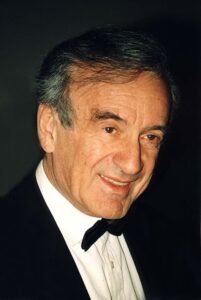
When Eli Wiesel passed away on Thursday, July 2nd of 2016, I asked myself the question, “How does one mourn the passing of a prophet?”
Around that time, the U.S. was involved in releasing billions of dollars of Iranian assets to the Hitler-admiring mullahs of Iran. Imagine the outrage Wiesel felt in the pit of his stomach of a man who personally suffered, witnessed and documented the abuse of the Jewish people in one of the world’s most notorious death camps, Buchenwald?
Consequent to his boyhood imprisonment, Weisel became a motivated and capable warrior for Israel and the Jewish people. In 2013, when those big bucks were going to Iran, he took out a full-page ad in The New York Times with the following statement, “Our nation is morally compromised when it contemplates allowing a country calling for the destruction of the State of Israel to remain within reach of nuclear weapons.”
Ten years later on this milestone of remembering Eli Wiesel, the messenger of history and of blessed memory, I must ask: Could we be witnessing something reminiscent of a “vast eternal plan?” Why? Within days of this commemoration, Washington and the world are in the process of stripping nuclear capability from the Iranians. Could this be his “déjà vu all over again” moment?
The future we do not know. Only the unfurling of time will reveal the results of the “agreement.” What is for us to know now is that this revered author was a shining light for both the Jewish people and what is left of a seemingly diminishing fully-conscious humanity.
In the eyes of the free World, Eli Wiesel is remembered as a recipient of the 1986 Nobel Peace Prize and the author of the 1955 autobiographical book, Night, which is still actively in demand with translations in over 30 languages. It is a first-person document describing his experience of the indelible disgrace of Nazi Germany. In his Nobel speech, the esteemed Jewish author proclaimed, “Never shall I forget these things, even if I am condemned to live as long as God himself. Never.”
In an introduction written for the book of a friend, I shall never forget his description of how the poorest of poor Jews were rounded up, with what little they owned – even to the forfeiture of their eyeglasses. Of this he wrote, “[T]hey were robbed even of their poverty.”
These were part of the memories of a 14-year-old boy living in the intentionally vile conditions engineered by a depraved nation. As an adult, he refused to allow the rest of the world to forget the facts, writing, “To forget the dead would be akin to killing them a second time.”
Again, I must wonder: How would he feel today, when words such as “Auschwitz,” “Nazi,” “Hitler,” and “Holocaust” are flitted around in the air like paper confetti – frivolous expressions of the disgruntled and of those who would rekindle the very memories Eli Wiesel refused to forget.
Besides his writing of books, plays and essays, he worked diligently as an activist for causes which hinted of his past. He could not remain silent. With typical poignancy, the following comment was made about the suppression of Jews in the Soviet Union: “What torments me most is not the Jews of silence I met in Russia, but the silence of the Jews I live among today.”
Wiesel was also a great lover of the State of Israel and deeply devoted to Yad Vashem which he described as “the heart and soul of Jewish memory.” Among the many noteworthy phrases he penned is a description of the Old City of Jerusalem: “…. where the stones themselves tell the story of the only people of antiquity to have outlived antiquity.”
As a witness to the past, he was particularly gifted with an exceptionally powerful memory as witnessed in his book, Souls on Fire. It is one of the greatest of legacies he left for the Jewish people, documenting in detail the Chassidic legends of the lost Jewish civilizations that flourished in Russia and Eastern Europe. This unforgettable and irreplaceable culture of wisdom was dedicated to Torah study and the longing for a better world, one in which nation would not war against nation. That is the culture which flourished in the region in a multitude of formerly life-vibrant shtetls. Wiesel reflected on those lost civilizations in his inimitable way, saying they “would live and perish in a world that did not deserve them.”
Souls on Fire is hardly a book of sadness, rather, he extols tales worth pondering surrounding the great rabbis – their mystical culture, their courts and their insight into the heart and soul of Judaism. The primary reason for their existence was to wrap themselves up in the love of God, perfected by the understanding of the 304,805 letters of the Torah.
According to Elie Wiesel’s teachings: “Being Jewish means fulfilling oneself in more than one dimension; It’s like living a forty-eight-hour day intensely and to the full.” It seems as if the lost civilizations of his youth may have been unwilling to open their eyes to the ominous stirring of unfathomable blind-hatred that was to destroy their purposeful culture – characterized by a high standard of human decency, lived at its highest level. Perhaps it was a culture too spiritually advanced for the rest of the world to accept.
Today, on this 10th anniversary; if not for a prophet, then we commemorate the memory of an aspirant to this sacred status.
How may we be worthy of his memory?
*
Stanley Tiger is a San Diego-based writer whose next book will feature the super-intelligence of the Torah.