By Alex Gordon in Haifa, Israel

On March 17, 1808, Napoleon issued the “infamous decree” (Décret infâme), which imposed strict economic and social restrictions on the Jewish population of the French Empire. The decree was adopted to quell accusations against Jewish merchants engaged in usury and to attempt forced assimilation, converting Jews into artisans and peasants. In essence, the decree suspended the civil equality granted to Jews during the French Revolution, creating special discriminatory conditions for them.
The concluding words of the “infamous decree” clearly show its essence: “The general provisions of this decree will be enforced for ten years in the hope that by the end of this period, under the influence of various measures taken toward the Jews, there will no longer be any distinction between them and the other citizens of our empire.” The decree remained in force even after Napoleon’s fall and was only repealed in 1818.
The emperor’s decree was a significant setback in establishing equality
for Jews during the French Revolution. Bonaparte wanted to dissuade Jews from Judaism. He believed that they needed to be saved from their erroneous faith, corrected in their national anomaly, and assimilated into France.
He wished to forcibly marry every third Jew to a Christian woman and to compel every third Jewish woman to marry a Christian man. He was Corsican, but he “Frenchified” himself. He believed that since he did it, the Jews should do it even more. Napoleon wanted to turn Jews into French citizens in France and into French agents beyond its borders.
On July 20, 1808, an additional decree was issued, requiring all French Jews to adopt fixed surnames. In this essay, we discuss a case in which Napoleon’s “infamous decree” led to the success the emperor had hoped for.
Alsace was a land of discord between France and Germany. It was Napoleon’s visit to the Alsatian capital of Strasbourg and the slanders against the Jews that he heard there that led him to issue the “infamous decree.” The Jews of Alsace felt oppressed doubly as Jews and as Alsatians. In their community, deep conservatism persisted. They opposed the spread of Reform Judaism.
Alsatian Jewish artists were cosmopolitan in their outlook. Therefore, there were emigration sentiments among them. This essay will discuss one such successful emigration from Alsace to Paris.
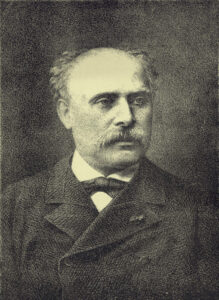
Charles Émile Waldteufel, a French composer, conductor, and pianist, was born on December 9, 1837, in the Alsatian capital of Strasbourg into a Jewish family of musicians (the original surname was Lévi; the surname Waldteufel means “forest devil” in German). His father, Louis Lazare Lévy Waldteufel, was a French violinist, conductor, and founder of a musical dynasty, who had his own orchestra, which later became one of the most renowned in Paris.
Émile’s mother, Flora Neubauer, was born in Bavaria into an Alsatian Jewish family. Flora was a student of the Austrian composer and virtuoso pianist Johann Hummel, a pupil of Salieri and Mozart. She was also an avid singer and dancer. To the wife of her teacher Hummel, the opera singer Elisabeth Röckel, Beethoven dedicated his piano piece “Für Elise.”
The composer’s father and his uncles were respected musicians in Alsace. To stand out and make their performances more memorable, the family members adopted a stage pseudonym. When the talented violinist Léon Waldteufel (Émile’s brother) was accepted into the Paris Conservatory (1846), the entire family moved to the French capital following him.
By that time, their new “German” surname had already become a recognizable family musical brand, with which Émile Waldteufel entered the history of music. In his family, art prevailed over loyalty to Jewish customs and values. Moving to Paris and immersing himself in the musical world of the French capital meant a further departure from Judaism. After 22 years of living in Paris, Émile married a Catholic woman.
Émile’s first music teacher was his father. In Paris, he studied piano and composition at the conservatory. One of his classmates was the composer, Jules Massenet. After graduating from the conservatory, he performed as a pianist. The main works of Waldteufel as a composer were waltzes. The first waltzes by Waldteufel were “Joy and Sorrow” (“Joies et peines”) and “Manola,” which he published at his own expense, and which brought him great fame.
In 1865, Waldteufel was appointed pianist to Empress Eugénie and soon received the position of conductor and ball manager at the court of Napoleon III. He was also the conductor of the ball orchestra “Bals de l’Opéra” in Paris (1865).
Throughout his life, Waldteufel composed over 250 waltzes. His most famous waltzes include Les Patineurs (“The Skaters”), Mon Rêve (“My Dream”), Estudiantina, Grenadiers, and España. His waltz “Dolorès” (1880) became the basis for the famous Russian and Gypsy romance “Darling, hear me.” Waldteufel earned the title of king of Parisian waltzes.
During the Franco-Prussian War (1870–1871), Waldteufel demonstrated French patriotism by volunteering for a regiment stationed in the Lower Pyrenees. But France was defeated: Napoleon III was captured, the Second Empire fell, and the Third Republic was established. Alsace, along with Waldteufel’s hometown of Strasbourg, remained under German control for the rest of his life. Waldteufel remained in France.
In 1874, Waldteufel met the future King of England, Edward VII, at one of the balls, who was enchanted by his waltz “Manola.” The king facilitated the conclusion of his contract with the London publishing house Hopwood and Crew. Waldteufel’s music began to be regularly played at Queen Victoria’s receptions at Buckingham Palace. This brought him to the European and world stage as one of the main composers of dance music.
In 1882, his main work, “The Skaters”, was born. In 1885, the composer triumphantly toured London, and in 1889, Berlin. In 1890–1891, he conducted the orchestra performing his music at prestigious balls in Paris. In 1899, he retired. The composer died in Paris on February 12, 1915, having learned that the world war had begun, bringing hope for the return of Strasbourg to France.
In his waltzes, in his dizzying career, at the height of his fame, Émile Waldteufel distanced himself from the Jewish people. He lived a happy family life, marrying in 1868 a Frenchwoman, a non-Jew, singer Célestine Dufau. The couple had three children. His daughter Berta (1883–1969) became a composer and pianist. Her father was her first teacher. In 1894, an antisemitic case against Waldteufel’s compatriot and fellow tribesman, the Alsatian Jew Alfred Dreyfus, began in Paris. Unlike his namesake, the writer Émile Zola, the composer did not protest against this antisemitic slander.
*
Alex Gordon is professor emeritus of physics at the University of Haifa and at Oranim, the Academic College of Education. He is the author of 12 books.