By Karen Klein in Northridge, California

Throughout the 1990s, I must have attended at least 20 piano recitals at California State University, Northridge (CSUN), where my older sister was enrolled in the youth music program. I spent countless afternoons waiting for her lessons to end, zooming through the outdoor corridors on roller skates. In fact, I practically grew up on that campus, taking my first steps there as a baby, learning to ride a bicycle on the ramps in front of the Oviatt Library, and eventually graduating from the university myself in 2008.
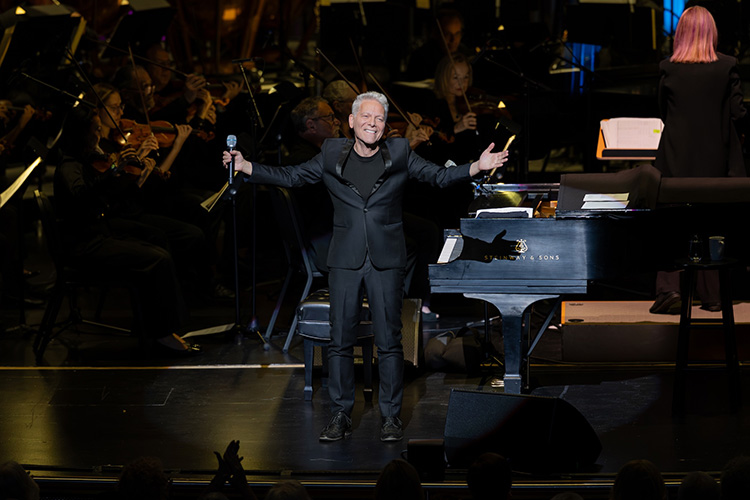
So when I returned on Sunday evening, October 11, for Gershwin and the Golden Age, featuring Michael Feinstein and the Los Angeles Jewish Symphony, I was delighted to discover an entirely new side of a place I thought I knew so well. The performance took place at the Younes and Soraya Nazarian Center for the Performing Arts, known as The Soraya, a magnificent concert hall that opened in 2011. Just steps from the music buildings where I spent so much of my childhood, the venue offered quite a contrast to my sister’s modest piano recitals.
Originally opened as the Valley Performing Arts Center, the venue was renamed in 2017 following a transformative gift from Los Angeles philanthropists Younes and Soraya Nazarian. Today, The Soraya presents internationally acclaimed musicians, orchestras, dance companies, and artists from around the world. From its striking architecture and elegant interior to its outstanding acoustics, I found the experience comparable to performances I’ve attended at some of Southern California’s most celebrated concert halls, including Walt Disney Concert Hall.
Interestingly, on my way out, a gentleman who introduced himself as a retired professional in music recording enthusiastically informed me that, in his opinion, The Soraya’s acoustics are technically superior to those of Disney Hall. I can’t independently assess that claim, but I certainly shared his admiration for the sound. And naturally, as a Northridge native and CSUN alumna, I am an entirely impartial judge of such things.
The evening marked the opening of The Soraya’s 2026–27 Signature Series, a fitting occasion to celebrate the extraordinary contributions of Jewish composers to American music. Michael Feinstein, whose career has been devoted to preserving and interpreting the Great American Songbook, brought a joyful warmth to the stage. His refreshingly humble presence and easy familiarity made the performance feel intimate despite the grandeur of the setting. Feinstein seemed like someone sharing stories and songs with old friends, and the audience responded with delighted applause.
Joining Feinstein was the Los Angeles Jewish Symphony (LAJS), led by its founder and artistic director, Dr. Noreen Green, whose enthusiasm was nearly as enjoyable to watch as the music was to hear. A conductor’s ability to communicate without speaking has always fascinated me, and Green appeared thoroughly delighted to be onstage, guiding her musicians with an energy that traveled into the audience. I was equally struck by the diversity of the orchestra, whose accomplished musicians came together through a shared commitment to the music and the cultural history it represents.
The program culminated in George Gershwin’s Piano Concerto in F major, featuring pianist Samuel Glicklich, whose remarkable talent was among the evening’s highlights. Written following the success of Rhapsody in Blue, the concerto demonstrates Gershwin’s musical ambition, blending classical traditions with jazz, blues, and the energy of 1920s New York.
In an interview ahead of the performance, Green explained why the Gershwins’ story continues to resonate with American audiences. “What I love about the Gershwins is that their story is really an American story,” she told me. George and Ira were the sons of Jewish immigrants who grew up in New York amid a convergence of cultures and musical traditions. Their work absorbed Jewish and Yiddish influences alongside jazz and African American musical styles, helping define a distinctly American musical identity.
“So much of what we call the Great American Songbook—and even the sound of Broadway and Hollywood—was shaped by Jewish composers and lyricists whose families had come to this country looking for opportunity and belonging,” Green observed.
Those contributions became so deeply embedded in mainstream American culture that many listeners today may not recognize their Jewish origins. Since founding the Los Angeles Jewish Symphony in 1994, Green has dedicated herself to sharing that musical heritage with audiences across cultural, religious, and generational lines.
At a time of heightened antisemitism, she believes music can foster understanding in ways that extend beyond the concert hall. “We may not be able to eliminate antisemitism with a concert, but we can educate, we can create empathy, and we can give people an opportunity to understand one another,” she said.
Watching the orchestra perform offered a wonderful illustration of that philosophy. As Green explained, “My role is to inspire the musicians so that, together, we can inspire the audience.” Judging by the enthusiastic response throughout the concert hall, she succeeded.
The performance also prompted me to consider The Soraya’s place within the larger cultural landscape of Los Angeles, particularly its potential to serve the Jewish community of the San Fernando Valley. Home to approximately 1.8 million people, the Valley boasts extraordinary cultural diversity, yet its institutions are sometimes overshadowed by those elsewhere in the city. Having grown up in Northridge, I have long felt that the region deserves greater recognition for what it offers.
Ahead of the concert, I interviewed Chad Hilligus, who became The Soraya’s executive and artistic director in June 2026. Still in the early months of his tenure, Hilligus has been getting acquainted with the Valley and exploring how the venue can better reflect the region’s cultural richness. When I asked about Jewish cultural programming, his response was particularly encouraging.
“Los Angeles has the second largest Jewish community in the United States—roughly 565,000 strong—and the largest Persian Jewish community in the United States. That’s not just an opportunity; it’s a responsibility.”
His enthusiasm for expanding Jewish cultural programming gives me optimism about The Soraya’s future and its relationship with our community. I find it particularly meaningful that the leadership of a major performing arts institution recognizes the importance of engaging Jewish audiences and celebrating our cultural contributions.
Hilligus also hopes to strengthen connections with CSUN alumni, noting that nearly 350,000 live in the Los Angeles region. The university’s longstanding Jewish student community presents another opportunity for engagement. Beyond attending concerts, students can participate in master classes and, in some cases, perform alongside internationally recognized artists.
I also had the pleasure of meeting Hilligus briefly before the performance and was impressed throughout the evening by the warmth and professionalism of The Soraya’s staff. Their gracious hospitality complemented the quality of the concert itself.
With its beautiful facilities, artistic ambition, and leadership, The Soraya has the potential to become an increasingly important cultural destination for our Jewish community and the region more broadly. For those accustomed to traveling to central Los Angeles for exceptional performing arts, I would encourage making the trip to Northridge. The programming and setting alone make the journey worthwhile, even for those who don’t share my admittedly strong attachment to the neighborhood.
As I left the concert hall, I thought about the afternoons I spent in that same corner of CSUN as a child, racing around on roller skates and sitting through my sister’s piano recitals. I certainly never imagined that decades later, I would return to hear Michael Feinstein and the Los Angeles Jewish Symphony in a concert hall of this caliber, just steps from where those childhood memories were made.
What a pleasure to discover that a place I’ve known nearly my entire life has found a new way to surprise me.
*
Karen Klein is San Diego Jewish World’s Los Angeles correspondent.