By David Amos
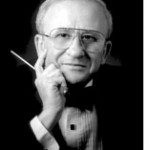
SAN DIEGO –Just for having been involved in serious music making for practically all my life, I have encountered many well-meaning people who recognize me, and share some of their musical thoughts after concerts I have attended or conducted.
Sometimes, their comments are based on mis-information, and preconceived notions about music and musicians. Some are as annoying as those half-pages in the San Diego U-T, and others I dismiss as expected and a display of predictable ignorance. Here are some of these jewels, followed by brief comments.
“I have heard you on radio for a long time. You sure sound younger on the air!” I’ll work on sounding my age.
After a performance of my community orchestra which I directed: “I heard this same work in the 1950’s with Arturo Toscanini and the NBC Orchestra at Carnegie Hall; they sounded better.” I should certainly hope so.
After a fine performance of the London Philharmonic, here in San Diego, another concertgoer approached me and asked, “What did you think of their staccatos and pizzicatos? I can’t remember what I answered.
Another gem: “I don’t know much about music, but I have a very good ear. I didn’t enjoy this concert because I heard one wrong note.” I have been to countless orchestral concerts which I thoroughly enjoyed. Some were performances of the world-class orchestras which you and I know about. Occasionally, the soloist or the orchestra drop enough notes on the stage for the composer to write another symphony or concerto. But what counts is the message. Did the music evoke an emotional response? Did it communicate? Could you sense the involvement of the artists on stage? That is what it is really all about, not the right note-wrong note ratio.
”David, the reason I don’t go to your concerts is that you program too much the music of Schoenberg.” I politely told the gentleman that I had never, never programmed Schoenberg in my concerts. To this, he replied, “Oh yes, you have!” and walked away. Go figure.
“C’mon, David. Has any music of any value been composed after 1900?” Do you smile, give a polite, dismissing response, and walk away, or go into a long dissertation which is most probably useless, to convince the other party? Someone recently told me that practically all music of the Twentieth Century sounded “angry” to him, and he refuses to listen to it, or even give it a chance. A somewhat more refined gentleman told me that “how can any kind of music composed today match the high standards of classics of the 19th Century and before?” Again, with that mindset, we are condemning classical music to be a museum piece with a dying audience, instead of a living, vibrant art form that continues for future generations. Only a small percentage of modern music is good and deserving survival, but we are obligated to provide it with a forum (live concerts and recordings) for history to decide.
“Why should I attend solo piano recitals? After all, they are so boring.” Again ignorance and lack of understanding of musical qualities and values.
“I have a six month old grandson who claps his hands vigorously when he hears a Sousa March. Do you think that he is a future conducting star?” Love those proud grandparents. I may not say that about my grandchildren, but I confess to crossing the line when talking about them.
“This conductor is so inferior. No wonder I never heard of him.” This was said in a music review in our local paper about ten years ago. Actually, some of the best instrumentalists and singers from around the world (including conductors and composers) are somewhat unknown and are not part of the glamour jet-set names that are familiar to all of us. Quality comes in many different packages; all we have to do is to listen intently.
“This conductor is so good! He conducted by memory.” So can Ronald McDonald, or Bozo. Mental athletics have nothing to do with artistry. They may be combined, but one does not necessarily go with the other. A famous legendary conductor of the last century was asked as to why he always conducted with the orchestral score in front of him. He replied, “Why not? I can read music!”
And then there is the occasional old timer who may tell me a story that goes like this: “When I was in the Army, back in 1945, there was this fellow who played the trumpet. He was so good, that he could play by heart, you know, without any music. Have you heard of something like that?” Fifteen minutes later, I was still hearing about this seemingly ordinary musician who was elevated to a pedestal larger than life to an impressionable young man. No need to burst a bubble.
“If you will program Fiddler on the Roof at every concert of your orchestra, you will always see me there”. Yes, but……..
*
Amos is conductor of the Tifereth Israel Community Orchestra (TICO) and has guest conducted professional orchestras around the world. He may be contacted at david.amos@sdjewishworld.com
Just today, the news reported the death of one of the greatest forces in popular music today, Marvin Hamlisch. He was 68 years old. His awards were many. He was one of eleven to have been awarded Emmys, Grammys, Oscars, and a Tony. Also he was one of two people to have won all of the above, plus a Pulitzer Prize. The other recipient was Richard Rodgers. Hamlisch was also recognized with two Golden Globe Awards.
One of his few contributions to serious classical music was a piece called Anatomy of Peace, for orchestra, chorus, and vocal soloist.
His work in Broadway (A Chorus Line, and more), in films, and his many hit songs are legendary. Recently, he led a very busy life as the principal Pops Music conductor for around ten major orchestras, including our own San Diego Symphony.
He and I met about two years ago. I encouraged him to compose orchestral and choral music on subjects of his Jewish heritage. He was interested, and was toying with the idea of creating a Friday Evening Service. Most unfortunately, this opportunity was lost, and it shall not come to pass.
David Amos must be a saint to respond so patiently to those who approach him and make such statements. And Mr. Amos tells the anecdotes with great humor. I think he should consider also submitting these stories to the New Yorker so that a greater audience may enjoy them, particularly other musicians and artists of all genres, who will immediately recognize the types Mr. Amos so wonderfully describes.