Press Notes
Southwestern Jewish Press, June 28, 1957, Page 3
By Julia Kaufman
 Stop the Clock! In the last issue, I discussed some of the highlights of my visit to the State Capitol in Sacrament. In the growing State of California, it is becoming increasingly difficult for legislators to complete all their work in the 120 working days allotted to them. On June 12, at midnight, all work must cease and unfinished work is “dead” for that year’s session. In the last few weeks of the session time becomes a major problem and both the Senate and Assembly find it necessary to stop the clock.
The clock is stopped when time is running out (12 midnight officially ends the day) so that a vote on a bill presented may be voted on another day and till bear the date of the day it was presented. Whew! I could make it more confusing but you get the idea … I hope. The practice is specifically prohibited by the State Constitution but I was told it has been done since Caesar’s time. During one of the sessions I attended, the clock was stopped at 10 p.m.– the legislators working on into the morning. One year the legislators worked four days and four nights, without rest, in their battle against time.
*
Decor. I noted that the Senate ha red carpeting and upholstery while the Assembly has green. The Senate color is fashioned after the House of Lords and the Assembly after the House of Commons in England. Looking very much like “apples for the teacher” were the two melons on the desk of each Senator and Assemblyman. It is not unusual for counties to send in “samples” of their products to the Capitol.
*
Hearing my name called out during a Senate session, I immediately popped up. One of the clerks explained that no one wanted me — my name was merely being read into the Senate Journal and a copy would be sent to me. This was Senator Fred H. Kraft’s formal greeting to a fellow San Diegan.
I met legislative advocates (lobbyists) and watched them operate between sessions and during committee meetings. I was intrigued by the note passing and whispering, accompanied by glances over the shoulder, the ear and elbow bending … with the lobbyist picking up the tab. There are over 500 regular lobbyists who represent organizations in both government and business. Unles you reside on a desert isle, you are being represented either as an employee or employer, as a renter or home owner, as a merchant or professional, etc., etc. They are the agitators in our government machinery, and the opposition between them keeps things on a more or less even keel.
*
A chance to be heard. During Senate and Assembly sessions, lobbyists and visitors may be seen (in the balcony) but in order to be heard they must attend a committee meeting. No one is permitted on the Senate and Assembly floors during sessions. However, in the committee rooms a special table, equipped with microphones, is set up for advocates. The air conditioned meeting rooms resemble little theatres, with the legislators sitting in a semi-circle facing the visitors. Here any interested person has an opportunity to “get in the act” and expound his views on a particular bill. I attended meetings on Education, Water, Municipal affairs and Social Welfare. The attendance was in proportion to the controversial nature of the meetings — the greater the dissension, the more exciting the “show” for the visitors.
*
Complaint Dept. Visitors at the Capitol building are attracted by the graphic displays in the lobby, showing the products and interesting highlights of each county. I smugly thought of all the wonderful things I would find in our display, what with the Fiesta, Shakespeare Festival, Famous Zoo, Concerts Under the Stars, Beaches, Fishing, plus all the products of our natural resources. Do you know what I found? A large fish! Before the current display highlighting sportsfishing, San Diego County displayed airplanes. In addition to an eye-catching display, I would like to recommend a large pictorial map of San Diego or the offices of our legislators. Now, I feel better.
*
Were you listening when the editor and publisher of the Southwestern Jewish Press were being interviewed by Margie on KGB last week? This was our second interview on her program and each time we heard from unexpected listeners. This morning we received a phone call at 7:30 a.m. from our answering service requesting that we call a Poway number before 9 a.m. The name and number were unfamiliar but we phoned at 8:30 a.m. as instructed. I’ll try to repeat as closely as possible the conversation. “Is this Mr. Kaufman of the Jewish Press? I am not Jewish but I have a Jewish friend in San Francisco who is holding a breeze (bris) and I’d like to know what to do on this religious occasion.” And so because of a radio program in San Diego, someone in San Francisco is going to receive a telegram and a gift.
*
This is the time to arrange for your summer entertainment. With the increase in population during vacation time, it is sometimes difficult to secure seats. I had this happen to me on Sunday when I wanted to attend a concert presented by the Musical Arts Society of La Jolla, conducted by Nikolai Sokoloff. Mr. Sokolff kindly invited us to sit in the wings of the stage which was a new experience for me. It was a special occasion because Mr. Sokoloff conducted the first performance of his son, Noel’s, “Canticle for String Orchestra.”
Monday night I attended the Dress Rehearsal of the “Reluctant Debutante” at the La Jolla playhouse. Mothers and fathers with daughters of marriageable age will find much to chuckle about. I thoroughly enjoyed the competent acting of the professional performers.
*
Letter to the Editor
Southwestern Jewish Press, June 28, 1957, Page 3
Dear Mr. Kaufman:
I am happy to inform you that AB 2880 on June 12, 1957, passed the Senate unanimously. It is now awaiting the signature of the Governor to make the law of our great State of California.
At this occasion, I wish to express to you the heartfelt thanks of all who were so earnestly engaged in a combined effort to have this bill passed and then enacted into law for your gracious cooperation which you had so readily extended us.
Through your worthy publication, I wish to offer the profound appreciation of all of us to your distinguished Assemblymen and honorable Senator for their solidarity and full support.
Looking forward to the bright future when our observant California Jewry who adhere to our Mosaic Dietary Laws will enjoy peace of mind, securely confident that the Kosher food which they will purchase will really be kosher, I am most cordially yours, (Rabbi) Elijah D. Stamper, Dean, Hebrew Theological College.
*
Weinberger Lodge News
Southwestern Jewish Press, June 28, 1957, Page 3
How would you like to win two all-expense paid trips to Europe, including spending money for twenty-seven wonderful days? Weinberger Lodge is sponsoring a move to make such a trip possible for you. There will be 1001 tickets available and no more. The donation for each ticket is only $10 per ticket.
Tickets may be secured from any Lodge officer, or from Al Kaye, general chairman of this undertaking, or his assistant, Marty Freedman.
Monday July 22nd marks the date for the third annual Weinberger Lodge Golf Tournament. Marshall Zucker has been selected to chair the event, and he requests that reservations be made as soon as possible. The tournament will be held at Mission Valley Country Club, and the charge will be $6.50 for golf and dinner. Those desiring to dine only, will be charged $3.50 for the dinner. Please contact Marshall immediately and arrange your foursome and tee off time.
Members of the Lodge are requested to consider individual donations to the planting of trees in the Martyrs’ Forest in Israel. Trees will be planted in the B’nai B’rith section of the forest for a charge of $1.50 per tree. The forest will provide an eternal tribute to the sacred memory of the six million who perished at the hands of the Nazis and will provide at the same time an essential protection for Irael against its hostile neighbor across the Jerusalem corridor. Those desiring to contribute please contact Dvid Vogel at BE-9-9526 or Lou Levitt at CY-5-2446.
*
73 Year Old To Walk Cross Country
Southwestern Jewish Press, June 28, 1957, Page 3
Pat Thienes, who has walked cross country many times for Polio and Crippled Children campaigns, will set out on Saturday, June 29, to break his own record of 77 days. Pat, at the age of 73 years, had resigned himself to short walks until he met Jim Jones, author of “Count to Four,” who believes that anyone can have whatever he wants and be whatever he wants to be.
The public is invited to attend the big send-off for Pat to be held on June 29, at 8 p.m. at the Russ Auditorium. Admission is free.
*
The Jewish Center — Community Need (Editorial)
Southwestern Jewish Press, June 28, 1957, Page 3
The erection of the Jewish Community Center presents a significant challenge to the entire Community. A number of people have demonstrated an alarming disinterest in the project. These disinterested people are frequently those who for various reasons do not expect to receive any “direct benefit” from the Center. A typical expression of this attitude is “… We won’t use the Center and neither will my children… we belong to the country club.”
But, there have been other objections to the Center which certainly cannot be said to be motivate by “self-interest.” To some, the Center represents a threat to the youth programs offered by the Synagogues. Others have expressed doubts as to the ability of our young Community to support the project. “San Diego,” it is said, “is too small for a Center.” A further argument against the Center is that the money for the project could be better spent if contributed elsewhere, i.e., to overseas relief.
These are valid points and we feel that some attempt should be made to clarify the situation. It is true that we are a young Community. But we are also a rapidly growing Community. Furthermore, the great influx of population in recent years has consisted of young married couples with children. So, that when we are building this Center we are preparing for the future as well as the present needs of our Community. And, if comparisons of this sort are fruitful, we might note that every other city in the United States with a population comparable to our own — has a Jewish Community Center.
The Center and the Synagogue need not be mutually exclusive nor antagonistic in any sense. It has been the case, in fact, that Synagogue youth programs have benefitted through the cooperative use of Community Center facilities and services.
The difficulties in allocating financial resources to both overseas relief and to Community needs have been faced by every Community which has sought to perform its functions knowledgeably. They both must be thought of as part of the total fabric of Jewish experience. Thus, the compassion which is felt for brethren in need overseas can arise only from a situation in which the values upon which this compassion is based are thoroughly assimilated at home. The heart of the matter is the institutionalization of Jewish values, the feeling of Community solidarity and the recognition of the duty of one Community of Jews towards another.
This Community consciousness is manifest in the operation of true Community projects like the Center. It is through the institution of the Center, (a body which for these purposes transcends the many religious and social groups composing the whole Community) that the individuals of the whole Community may become aware of the Community problems, among them the problems of overseas Jews.
If one is interested in fostering a consciousness of general welfare which will accomplish great good both at home and abroad, one should actively support the Jewish Community Center.
*
As the Psychologist Sees You
Southwestern Jewish Press, June 28, 1957, Page 3
By Irving R. Stone, Psychological Consultant
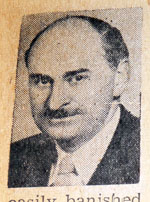
Delinquency Abroad
There is always a danger that one considers himself an expert if he makes a study of a problem, even though the time spent on the investigation is very short and the amount of information he has gathered is minute compared with the total situation. Admitting that what little I was able to learn on the vast problem is but a small part of the conditions in Europe and hoping that there will be an opportunity in the future to expand the study, I shall give you some of the things I found in my investigation. This, of course, makes me far from an expert.
To study delinquency abroad one must take into account three very important factors which are both the causes of delinquency and at the same time are the basic reasons for the methods of prevention and treatment. I refer to the economic, social or cultural, and the religious factors. Where economic conditions are poor and employment is scare there is the heightened danger of a high delinquency rate and restricted means for taking care of the delinquents. Cultural factors play a part in the cohesion of the family, the opportunity to place children away from the family, and the concept of individual rather than group activity. Religious factors determine the type of treatment needed to work with the offender and who will supervise this treatment.
Denmark, for example, has a rising rate of juvenile delinquency. Children must go to school between the ages of 7 and 14 and because of economic conditions few children continue beyond the mandatory age of fourteen. Jobs are scarce and boys are unable to find work. With too much time on their hands and the need for money, these youngsters are easily led into delinquent activities. Boy prostitution is more prevalent than before. Girls, too, are unable to find jobs and are led into what they consider “half prostitution” with many of the girls coming from the better homes. Unfortunately, servicemen, especially those in the American forces, find Copenhagen a nice place to visit and as they have more money to spend than the average native of the city, find willing companions. There is no law against prostitution, provided the individual concerned has another job as well. Because of economic conditions, both husbands and wives usually work and children are left unattended. There are not enough trained, paid workers in the fields of social work and recreation and much of the care given to children is by volunteers.
In France, the custom of drinking wine, not always of the best grade, has caused much difficulty in family circles. Not only are children brought up on the wine bottle instead of the milk bottle, but as adults the habit has caused far too much alcoholism as well as family confusion. A recent survey showed that more people die in Paris hospitals of alcoholism than of any other ailment. The Paris subway or Metro displays signs which say “Give your children milk instead of wine– it is better for them” or “Drink only a litre of wine a day.” So far, the results of this project have not shown too many encouraging signs.
*
Young Leadership Group to Hear Dr. Harry Ruja
Southwestern Jewish Press, June 28, 1957, Page 4
Dr. Harry Ruja, Professor of Philosophy at San Diego State College, will be the guest speaker at the July meeting of the Community Service Organization, according to Dr. Gerald Kobernick, President. His subject will be “The Philosophy of Being a Jew.” The Young Leadership Group, which is now affiliated with the Federation of Jewish Agencies, has developed a program for the balance of the year which will give them an excellent insight into the social, civic and welfare problems of not only the Jewish community of San Diego, but of the community as a whole.
Schedule of meetings announced by Dr. Kobernick is as follows: July 9–Dr. Harry Ruja; August 13–Dr. William C. Rust, President, Cal Western University. The subject will be “Higher Educational Opportunities in San Diego.” September 10–Abe Kaminker of the American Association for Jewish Education in Los Angeles. The subject will be “Jewish Education for Our Children.” This will be a joint meeting of husbands and wives.
October 8– John Pennock, Executive Director of the San Diego Coordinating Council, will speak on “Preventing Juvenile Delinquency in San Diego.” November 12–James Britton, Art Editor of San Diego Magazine. December 10 — Milton Senn, Executive Director, Anti-Defamation League of Southern California, speaking on “Prejudice.”
Besides these activities, members of the Community Service Organization have been invited to sit on boards of Jewish Welfare Agencies as part of their training.
Membership in the Organization is primarily for men between the ages of 24 and 35 and is by invitation only.
*
Yo-Ma-Co News
Southwestern Jewish Press, June 28, 1957, Page 4
Yo-MNa-Co will elect new officers at the next meeting to be held on July 10. It is important that all members be present as there will be a number of capable candidates vying for office.
The Club’s Installation is set for Sunday, July 14, at the Bali Hai and another successful affair is anticipated. Make reservations by calling Mrs. Evelyn Herrmann, JU-2-0370.
*
Council Thrift Shop
Southwestern Jewish Press, June 28, 1957, Page 4
The National Council of Jewish Women maintains its Thrift Shop on a full time basis. Located at 2205 Logan Ave., it provides a livelihood for the new American couple employed there as managers. It sells clean merchandise to people who might not otherwise be able to afford new clothing, household articles and toys. The proceeds from its sales help to finance Council’s Human Welfare projects. According to Mrs. Robert Friedman, Council President, the very existence of Thrift Shop depends on a steady stream of new stock. Council asks you to look through your closets and boxes. Your discarded slippers may dance lightly for a young Cinderella.
Mrs. Irving Coleman is vice president in charge of this project. Pick-ups can be arranged by phoning Mrs. Fred Mintz, JU-2-2209, or Mrs. Harold Robinson, JU-2-5965.
*
City of Hope Aux
Southwestern Jewish Press, June 28, 1957, Page 4
Delegates elected to attend the National Biennial Convention in Hollywood July 6th through10th are: Becky Bard, Ethel Berwin and President Ruth Aronoff. Alternates chosen are Gladys Tappen, Lil Shapery and Esther Schwartz. The Ambassador Hotel in the Convention Headquarters — a trip to the Sanatorium in Duarte, Calif., is part of the agenda.
Bay City News
Southwestern Jewish Press, June 28, 1957, Page 4
The 35th Annual Convention of Bay City B’nai B’rith Women District No. 45 will be held in San Francisco, June 30th through July 4th, with headquarters at the Mark Hopkins and Fairmont Hotels.
Reva Garvin, PP and executive board member, will represent the district; Ann Schloss, PP, will represent the chapter. All members who can do so are asked to attend the sessions.,
The Chapter is planning a fabulous Fiesta Party on July 20th … Barbecued Dinner with all the trimmings: Games, Prizes– everyone is welcome –come with y our husband and friends. Place: 1050 4th Ave., Chula Vista.
Please call Mrs. Louis Entin, Chairman, for further information: Chula Vista-154J.
*
Beth Jacob Ladies Hold Annual Picnic
Southwestern Jewish Press, June 28, 1957, Page 4
The Beth Jacob Ladies Auxiliary will hold their Annual Picnic on Sunday, July 7th at Pepper Grove, in Balboa Park, starting at 11 a.m. There will be delicious food including a complete lunch plate. There will be wonderful new merchandise on sale. Don’t forget the date, July 7. Come and bring your friends.
*
(Rubber Hits the Air)
Southwestern Jewish Press, June 28, 1957, Page 4
The landing gear system of an Air Force jet bomber contains enough rubber to manufacture 100 automobile tires.
*
Adventures in San Diego Jewish History” is sponsored by Inland Industries Group LP in memory of long-time San Diego Jewish community leader Marie (Mrs. Gabriel) Berg. Our “Adventures in San Diego Jewish History” series will be a regular feature until we run out of history. To find stories on specific individuals or organizations, type their names in our search box, located just above the masthead on the right hand side of the screen.