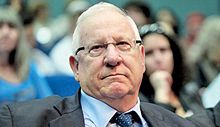
(Photo: Wikipedia)
JERUSALEM (Press Release) — President Reuven Rivlin addressed the opening session of the Institute of National Security Studies (INSS) annual conference on Sunday, Feb. 15. The conference, entitled ‘Israel in a turbulent region’, will address security and policy issues arising from regional and global developments.
The President said, “One of my greatest teachers, was professor, and Israel Prize laureate, Zvi Yavitz. In a ground-breaking speech on receiving the Israel Prize, around twenty five years ago, he said, and I quote, “I am addressing all those people who think themselves ready and worthy to lead this people, to treat seriously – without trite slogans – the following four essential topics, in view of the recent dramatic changes which have taken place across the world. First, our relationship with the great superpowers, our relationship with our Arab neighbors, in particular the Palestinians, our relationship with Zionism and the Jewish Diaspora, and our relationship with ourselves and our way of life.”
“In the words of Thucydides, said Yavetz, we learn that in a period of social and political tensions, words lose their real significance and become slogans. I don’t have to explain what happens to a people misled by slogans, or to commanders who fight the wars of tomorrow according to the agendas of yesterday, or the statesman who remain captive to paradigms of the past – while they in reality need to deal with the challenges of tomorrow. We have had enough surprises, and investigations after the fact. Re-evaluation, to create the cure before the illness, is best done before.” So said my mentor and teacher, Zvi Yavetz, as he received the Israel Prize. Truth be told, I should end my words here. The words of Yavetz are as poignant, true, and relevant today as they were then, and it is difficult for me to add to them.
“The first danger that Yavetz warned us of, was that words would lose their true meaning, and become slogans. Yavetz, who knew well the fate of democracies beginning from ancient Greece, also understood the weakness of populism. Slogans have an important value, if they succeed in including substance, however, when the slogan is the be all and end all, we are left with a problem. Just as any other citizen, I walk around in the current pre-election climate. I see the signs, I hear the voices, and I must tell you that I feel a dissonance.
“In the north, we face a new front of Shi’ite fundamentalists, another front with Iran, and Hezbollah in Syria. Stable countries on our borders are fearing the threat of the Islamic State, and the various satellite Sunni fundamentalists. In the east, the Palestinians are not discouraged from using non-conventional weapons in the international arena, and they have had notable successes. In the south, Hamas remains entrenched in Gaza, and we are witnessing the Sinai turn into the ‘wild west’. These issues, make up the ‘security front’.
“Meanwhile on the economic front, the challenges are no less important, far from it. The Israeli economy is lagging. The gaps in the State of Israel are among the widest in the developed world. Young people from the middle class find it difficult to achieve economic stability. Yet despite this painful reality, the politicians are engrossed in the ‘creative’ – making viral clips and slogans. The Israeli public, I feel, are tired. They are fed up with attempts to drug them with satire and stardom.
“The Israeli public is looking for outlook, for hope. It wants to hear solutions. It wants leadership driven by content and values, that is able to make decisions. In the spirit of Professor Yavetz’s words, I ask the candidates competing for the leadership of the this people – and they are many, all good and suitable – I urge them to address the four essential issues. How are they going to deal with the threatening trends in the Middle East? One, the possibility of Iran becoming a nuclear state. Two, Israel’s role in a campaign against Shi’ite or Sunni fundamentalism. Three, who are Israel’s allies in the current arena – are there any? Four, what is the future of the strategic alliance between Israel and the USA, and between Israel and Europe?
“More immediately, the questions are; how should Israel relate to the steps taken by the Palestinian Authority? What is route Israel should take to deal with Hamas in Gaza? Is there a realistic possibility to reach some sort of agreement against the backdrop of a turbulent Middle East, and the Palestinian demands, or alternatively, what should be done in the absence of such an arrangement?
“Internally, we must ask our leaders. How should Israel be grappling with integrating the ultra-Orthodox, and the Arab communities into the mainstream economy? Has it sunk in that we are no longer talking about minorities, when they today make up over fifty percent of the children in first grade?
“And on the economic front, we must ask ourselves; how can we ensure equal opportunities? How can we transition from a split-economy of hi-tech and low-tech, to a stronger more inclusive economy? Can we consolidate a budget that will provide a response to the security threats and social needs of our society? And does the exemption of thousands of army conscripts, and the erosion of their wages not damage us, both from a security and social perspective?
“These questions need to keep on being asked of our leaders, while we relentlessly demand of them, to address the people, and to give serious answers to these questions.
“I believe that if we consider it fitting, to speak on the international stage about the dangers lurking and threats we face, all the more so, we should be talking directly, and at length, to our citizens at home. We have no other choice. We have no other constituency. We have no other elections. We have not other parliament. The citizens of our country come first. Whatever we have to say, let us say, at least, at home as well.
“I thank you for all you do, and I hope that together, we will advance a deep and inclusive dialogue about the challenges which lie before the State of Israel today.”
*
Preceding provided by the office of President Rivlin