Story by Donald H. Harrison; Photos by Shor M. Masori
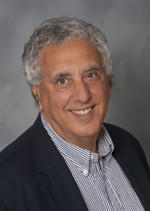
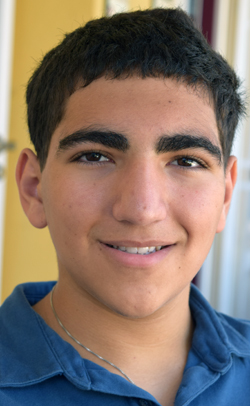
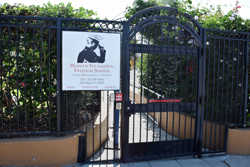
SAN DIEGO – After Congresswoman Loretta Sanchez, a runoff candidate for California’s open U.S. Senate seat, and former Congressman Patrick Kennedy – son of the late U.S. Senator Edward M. Kennedy—settled themselves on a couch at the Warrior Foundation’s Freedom Station, Sandy Lehmkuhler switched on a video to introduce her visitors to the work of her organization.
Among those appearing on the video was Povas Miknaitis, a former resident of the compact property consisting of eight bungalows, an office, and some small apartment spaces at 1223 28th Street. Miknaitis told of going through the back door of an enemy building, when Sweeney, a fellow in his unit, stepped on an IED and “blew his legs off.” The shrapnel also hit Miknaitis, but under the rush of battlefield adrenalin, he was unaware of that until after he had carried Sweeney to a truck.
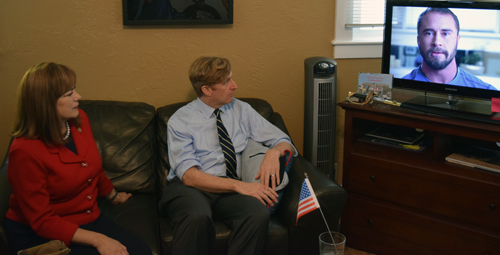
“I was missing roughly a third of my mouth and my ear on my right side was hanging by a thread,” he recalled. Surgery built him new lips and attached a prosthetic ear, but post-surgery, it was the Freedom Station that made a huge psychological difference in his life.
“I often think about where I might be if it hadn’t been at Freedom Station,” he said on the video. “Sometimes I wonder maybe I would be that person on the street corner asking for money because I know I have been in some pretty dark places. Freedom Station has been able to help me out with the different battles I faced in my life.”
Lehmkuhler, president of the all-volunteer organization, said that the residents of Freedom Station typically begin living there while they are still active-duty service personnel, waiting for their military discharges, and stay either months or years, on a case by case basis. While on active duty, they are entitled to free medical care at Balboa Naval Hospital. Even after the residents are discharged from the Armed Forces, they continue to be able to access some services of the hospital.
Miknaitis, a tough Marine, refused to have his jaw wired shut for his treatment, yet through will power was able to refrain from moving it for nine months, Lehmkuhler marveled. All that time, “he was on a liquid diet and he’s been written up in medical journals. Every one of the guys here have stories like that. They’re highly decorated warriors, who needed a place to regroup.”
She told Sanchez, an Orange County Democrat, and Kennedy that the United States government typically is unwilling to pay for dental coverage for a Marine like Miknaitis, even though a portion of his mouth was blown away. “What amazes me is that you take an injury like this to the face, and they do not allow you dental work,” she said. “We had a guy who has had 48 surgeries and they won’t give him dental because he doesn’t get 100 percent disability.”
Sanchez, a member of the House Armed Services Committee, nodded sympathetically and shared that her husband, retired Army Colonel Jack Einwechter, is getting implants for his teeth “because of what he calls ‘Army teeth.’ If something hurts or if something is not perfect, they just pull it out! So he had gaps, molars missing and so forth, and of course, as you get older you know what that does to your face. I used to be a dental assistant when I was in his school, so I’m real connected to the dental profession.”.
Having wounded members of the military start their process of reintegration into civilian life while they still are on active duty is key to what Lehmkuhler described as Freedom Station’s success rate of close to 100 percent in helping military personnel to make the transition without becoming dependent on either alcohol or drugs in contrast to so many other veterans who suffer from Post-Traumatic Stress.
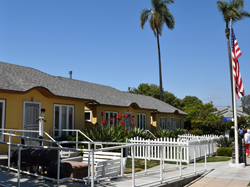
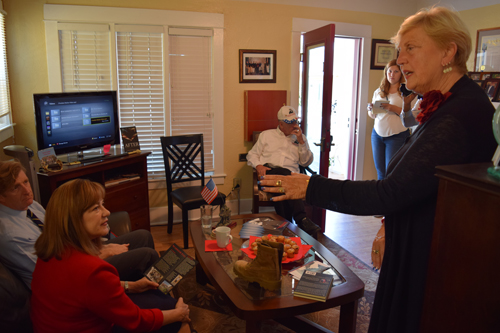
Besides having their own homes, which they may furnish to their individual tastes or with the help of some very kind, motherly volunteers, residents have the opportunity to talk with other military personnel who have been traumatized by similar battlefield injuries. Freedom Station has an outdoor conversation pit with seating grouped around a barbecue where the conversation sometimes is about such serious subjects. On other occasions, it’s more light-hearted, for example, joshing each other about which is the better branch of service: the Navy or the Marines. There is also a small but well-equipped gym where the residents can work out together.
Some 200 members of the military have lived at Freedom Station since its founding in 2011, and Lehmkuhler remembers many of them like members of her family. For example, there was one veteran who had lost his hip, both legs, and a third of his brain, and who was so short-tempered that he yelled at a female writer who came to visit the Station. When the author later requested interviews with the residents of the Freedom Station, Lehmkuhler wondered whether she should perhaps omit that man from the list of invitees. But she decided not to interfere, and the writer interviewed him for four hours on one occasion, and for four hours more on a follow-up occasion. P.S., they subsequently were married.
Another former resident went on to take advanced studies in neuroscience and wrote a paper about how the Freedom Station model helps PTS sufferers to recover. He even was invited to Europe to lecture to some 600 PhDs on the subject.
On a small table in front of Sanchez and Kennedy was a brown boot with a zipper in the back. Lehmkuhler said the zipper was developed after she watched amputees trying to fit regulation Marine boots over their prosthetic legs so that when they marched in formation they would look like other Marines.
From 1995 to 2011, Kennedy served in Congress from Rhode Island, and currently is involved in a campaign to persuade Congress that the government should be just as caring about mental illnesses caused by battlefield trauma as it is about physical injuries. Mental health is a personal matter for Patrick Kennedy. In 2008, he revealed that he is a recovering alcoholic who also suffered from bipolar disorder.
About Freedom Station, he commented to Lehmkuhler, “There is real love here. You can feel it, what you guys do.”
Lehmkuhler responded, “We have an incredible board (of directors).”
“You inspire,” said Kennedy.
“They (the wounded service personnel) inspire,” Lehmkuhler demurred. “How can you look at someone who is slapping on arms and legs, and say ‘I am having a bad day’?”
“You’re like them,” Kennedy responded. “You don’t want credit. That is one thing that Loretta and I have experienced with our veterans. They don’t want credit for what they have done. That is why you are in synch with them. We may have special forces over there in Coronado but there is another special force, the people like you who are responding to our veterans when they get home, and make sure that our nation doesn’t forget. It is incredibly impressive what you are doing. Tragically, it is not the rule, it is the exception to the rule, and I just want to salute you guys.”
One could see that Lehmkuhler, a volunteer who has devoted the last six years of her life to this cause, was moved by the compliment from a man whose family –his uncle, former President John F. Kennedy; another uncle, former U.S. Attorney General Robert F. Kennedy; both of them assassinated in the prime of their lives; and his late father, U.S. Senator Edward “Ted” Kennedy — set the tone of American politics for many years. Sanchez similarly smiled with pleasure when Patrick Kennedy, citing fond memories of their service together in Congress, voiced his endorsement of her U.S. Senate race.
Sanchez is opposed by California Attorney General Kamala Harris in the November election to succeed U.S. Senator Barbara Boxer (D-California). She told reporters monitoring her Freedom Station tour that as a senior member of the House Armed Services Committee she has learned that in the case of the severely wounded, “there is a whole continuum of how do you patch them. We have realized through empirical evidence that we have gathered that if we don’t catch them in the first six months after they leave the military, they tend toward homelessness, substance abuse and other issues that you can just see.”
She expressed interest in Freedom Station’s concept of helping wounded military personnel to readjust to civilian life even before they are separated from the Armed Services.
Following the tour and meeting with news media, Sanchez and Kennedy conferred privately with some of the facility’s residents.
*
Harrison is editor and Masori is a staff photographer of San Diego Jewish World. Their emails are donald.harrison@sdjewishworld.com and shor.masori@sdjewishworld.com, Comments intended for publication in the space below MUST be accompanied by the letter writer’s first and last name and by his/ her city and state of residence (city and country for those outside the United States.)